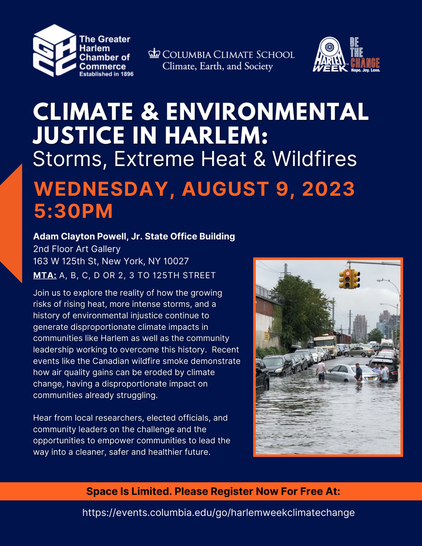
Climate & Environmental Justice in Harlem: Storms, Heat & Wildfires
<h2><strong>Join us for a Special <a href="https://harlemweek.com/about/" target="_blank">HARLEM WEEK </a>Climate Change Conference in the heart of Harlem, NYC.</strong> This is the fourth in a series of events, kicked off on Earth Day 2022, exploring the reality of how the growing risks of rising heat, more intense storms, and a history of environmental injustice continue to generate disproportionate climate impacts in communities like Harlem as well as the community leadership working to overcome this history. Recent events like the Canadian wildfire smoke demonstrate how air quality gains can be eroded by climate change, having a disproportionate impact on communities already struggling with heat, air quality concerns, and their associated health impacts.</h2>
<h2>What is government doing to address these risks and get at the root causes of our climate crisis? How can community organizations and residents partner with local businesses, academic organizations, and government to cause real change in policy and outcomes?</h2>
<h2>Hear from local researchers, elected officials, and community leaders on the challenge and the opportunities to empower communities to lead the way into a cleaner, safer, healthier future.</h2>
<h2><strong>Our Keynote Speakers: </strong>Remarks about the challenges and opportunities of environmental justice, Justice40, and local investment opportunities for improved heat mitigation, air quality protection, and community resilience in communities like Harlem.</h2>
<ul>
<li>
<h2><a href="https://www.ccny.cuny.edu/profiles/vincent-boudreau" target="_blank">Dr. Vincent Boudreau</a>, President, The City College of New York. </h2>
</li>
<li>
<h2><a href="https://www.weact.org/person/peggy-shepard/" target="_blank">Peggy Shepard</a>, Co-Founder and Executive Director, WE ACT for Environmental Justice. </h2>
</li>
</ul>
<h2><strong>Panel: Changing Policy to Achieve Environmental Justice</strong>. Moderated by Daniel Zarrilli, Special Advisor for Climate and Sustainability, Columbia University.</h2>
<h2><strong>Panelist:</strong></h2>
<ul>
<li>
<h2>Robbie Parks, Assistant Professor of Environmental Health Sciences, Columbia University</h2>
</li>
<li>
<h2>Donna Walker-Kuhne, Esq, The Greater Harlem Chamber of Commerce Legal Committee</h2>
</li>
<li>
<h2>Chris Rice, NYC Mayor’s Office, Senior Advisor, Environmental Justice, NYC Mayor’s Office of Climate and Environmental Justice</h2>
</li>
<li>
<h2>Tasfia Nayem, Chief of Staff, 5BORO Institute</h2>
</li>
<li>
<h2>Rossalyn Quaye, Project Manager, State Regulatory Affairs, Con Edison</h2>
</li>
</ul>
 Susan Larson ♀️🏳️🌈🏳️⚧️🌈
 Andrea Zio
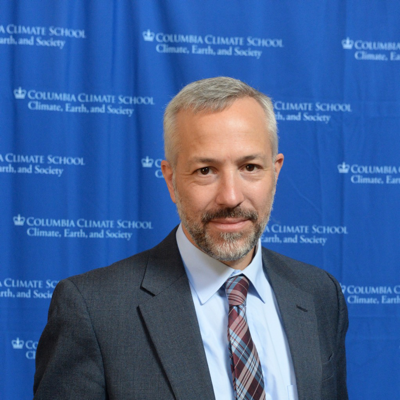 Daniel Zarrilli