Life finds a way...

Scientists say they cruised the ocean in a deep-sea submersible and came across an undiscovered ecosystem

The hadal zone is primarily comprised of oceanic trenches and troughs — some of the deepest and least explored environments on Earth. At these depths, “life needs tricks to survive and thrive there,” explained Du, a professor and researcher at the Institute of Deep-sea Science and Engineering at the Chinese Academy of Sciences.

#hadalzone #deepsea #life #environment
https://www.cnn.com/2025/08/11/science/deep-sea-discovery-hadal-trenches

Scientists say they cruised the ocean in a deep-sea submersible and came across an undiscovered ecosystem

While exploring the ocean in a deep-sea submersible, scientists say they discovered a flourishing ecosystem capable of sustaining life without sunlight.

CNN

#NewSpecies of ocean predator in the Atacama Trench
https://phys.org/news/2024-12-ocean-predator-atacama-trench.html #DeepSea

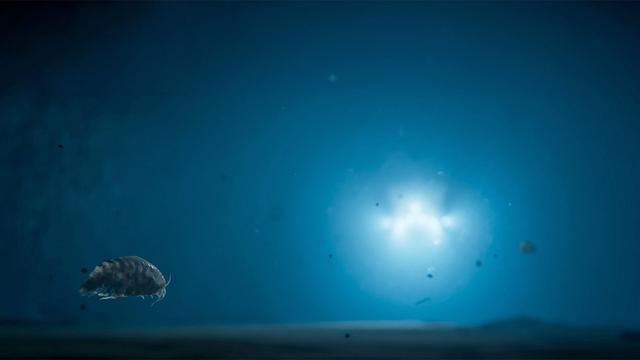
A new large predator (#Amphipoda) hidden at hadal depths of the #AtacamaTrench: Johanna Weston et al. https://www.tandfonline.com/doi/full/10.1080/14772000.2024.2416430

"Characterized by darkness and intense pressure, the ocean's #HadalZone seems uninhabitable, yet dozens of unique organisms call it home... A new study highlights one of those species... This #crustacean is the first large, active predatory #amphipod from these extreme depths"

Researchers discover new ocean predator in the Atacama Trench

Characterized by darkness and intense pressure, the ocean's hadal zone seems uninhabitable, yet dozens of unique organisms call it home. Each species discovered there adds a crucial piece to the puzzle of how life has evolved and even thrives in one of Earth's most extreme environments.
Phys.org

A new way to discover life in the #ocean’s #hadal zone https://www.whoi.edu/oceanus/feature/a-new-way-to-discover-life-in-the-oceans-hadal-zone/

"#HadalZone, depth ranging from 6,000 meters and deeper, is home to #animal life that is adapted to crushing pressure, inky blackness, and island-like habitats. Every species #scientists find can tell us more about where to look for life beyond our planet. We just need to catch them. That’s where #WHOI biologist Johanna Weston comes in... she’s designing a new sampler... the first rated for much deeper missions"

A new way to discover life in the ocean’s deepest, darkest places

WHOI ecologist Johanna Weston devises a novel tool to catch and study life in the ocean's most extreme depths

Woods Hole Oceanographic Institution

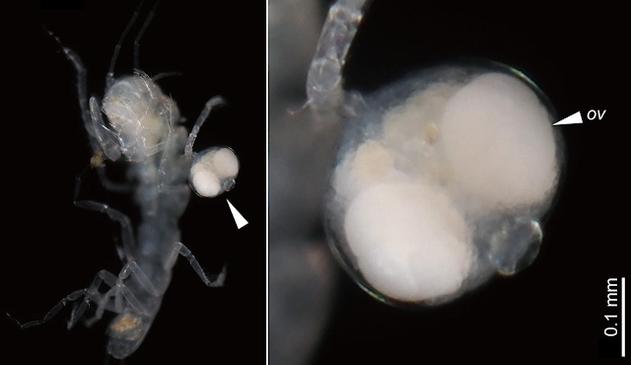
#Parasite of the Day: Diexanthema hakuhomaruae http://dailyparasite.blogspot.com/2023/07/diexanthema-hakuhomaruae.html

D. hakuhomaruae sp. nov. (#Copepoda) from the #HadalZone in the Northwestern #Pacific https://link.springer.com/article/10.1007/s11686-023-00676-z

"Parasitic #copepods come in all kinds of shapes that would defy most people's idea of what a #crustacean is 'supposed' to look like. And D. hakuhomaruae is no different - its tiny body is ROUND and if anything, it looks like a legless tick. And much like a tick, it attaches itself stubbornly to the leg of its host"

<i>Diexanthema hakuhomaruae</i>

The study in this post takes us to one of the darkest corners of the deep sea, over 7000 m below sea level in the Kuril-Kamchatka Trench, lo...

How deepest sea dwellers adapted to their environment https://phys.org/news/2023-06-scientists-reveal-deepest-sea-dwellers.html

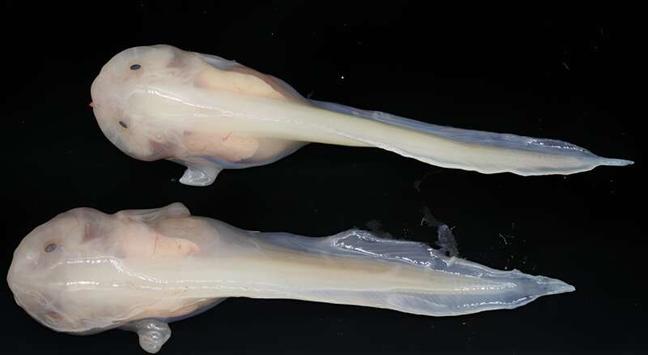
Chromosome-level #genome assembly of #HadalSnailfish reveals mechanisms of #DeepSea adaptation in vertebrates https://elifesciences.org/reviewed-preprints/87198v1

"The complete absence of light in the #HadalZone appears to have had a profound effect on the #fish. The scientists observed a substantial loss of many #genes related to vision. In addition, many genes related to #CircadianRhythms were absent."

Scientists reveal how deepest sea dwellers adapted to their environment

A genetic analysis of the hadal snailfish, the deepest-dwelling known vertebrate species, has suggested a number of key adaptations that allow it to survive more than 6,000 meters under the sea.

Phys.org