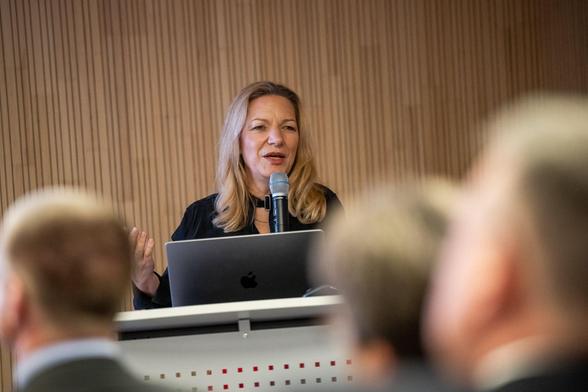
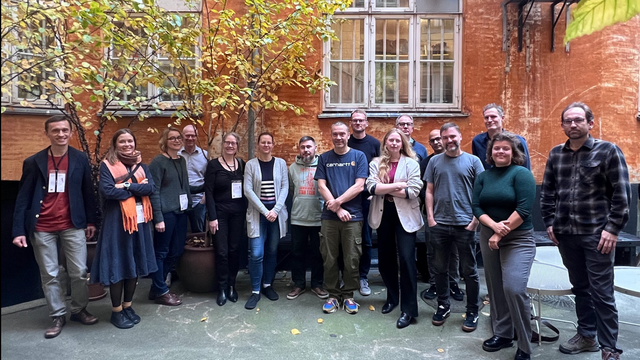
That's a wrap 🧬 on the eDNA workshop this week!

Huge thank you to all participants for sharing your expertise and joining engaging discussions.

We're excited to continue dialogue on the new GBIF eDNA roadmap! 🗺️

This workshop was made possible by Minderoo Foundation 💚

@obis #hifmb #JonahVentures #DTOBioFlow #UNITESH #MycologyAndMicrobiologyCentre
OnlineFirst - "Slippery substances: Accreting alternative chemical knowledges in a heavy industry port" by @ameliahine

@awi
#chemicalstudies #sediments #seabed #chemical #port #decarbonisation #hifmb 

https://journals.sagepub.com/doi/full/10.1177/25148486251323455

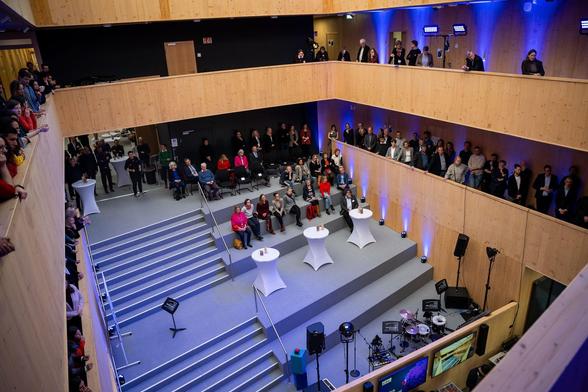
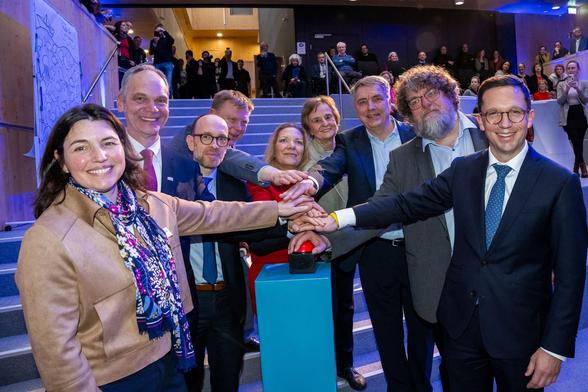
🎉 Gestern wurde das neue #HIFMB-Gebäude in Oldenburg feierlich eingeweiht!

Durch das Programm führte #AWI-Verwaltungsdirektor Karsten Wurr, Grußworte sprachen der niedersächsische Wissenschaftsminister Falko Mohrs und der Präsident der Universität Ralph Bruder. Den Abschluss des Festprogramms bildete die Keynote von AWI-Direktorin Antje Boetius, die die zentrale Rolle interdisziplinärer Forschung für den Schutz der marinen Biodiversität hervorhob.🌍💡

Fotos: UOL, Daniel Schmidt

Thresholds and tipping points are frequently used concepts to address the risks of global change pressures and their mitigation. It is tempting to also consider them to understand biodiversity change and design measures to ensure biotic integrity. In this perspective, we argue that thresholds and tipping points do not work well in the context of biodiversity change for conceptual, ethical, and empirical reasons.

https://link.springer.com/article/10.1007/s12526-023-01342-3

#biodiversity #HIFMB #tippingpoints #conservation

Thresholds and tipping points are tempting but not necessarily suitable concepts to address anthropogenic biodiversity change—an intervention - Marine Biodiversity

Thresholds and tipping points are frequently used concepts to address the risks of global change pressures and their mitigation. It is tempting to also consider them to understand biodiversity change and design measures to ensure biotic integrity. Here, we argue that thresholds and tipping points do not work well in the context of biodiversity change for conceptual, ethical, and empirical reasons. Defining a threshold for biodiversity change (a maximum tolerable degree of turnover or loss) neglects that ecosystem multifunctionality often relies on the complete entangled web of species interactions and invokes the ethical issue of declaring some biodiversity dispensable. Alternatively defining a threshold for pressures on biodiversity might seem more straightforward as it addresses the causes of biodiversity change. However, most biodiversity change appears to be gradual and accumulating over time rather than reflecting a disproportionate change when transgressing a pressure threshold. Moreover, biodiversity change is not in synchrony with environmental change, but massively delayed through inertia inflicted by population dynamics and demography. In consequence, formulating environmental management targets as preventing the transgression of thresholds is less useful in the context of biodiversity change, as such thresholds neither capture how biodiversity responds to anthropogenic pressures nor how it links to ecosystem functioning. Instead, addressing biodiversity change requires reflecting the spatiotemporal complexity of altered local community dynamics and temporal turnover in composition leading to shifts in distributional ranges and species interactions.

SpringerLink

Open access article led by Lucie Kuczynski shows that caution is required when analysing temporal trends in species richness: net imbalance between colonisation and extinction will bias towards positive slopes as shown by data and neutral simulations. As long as environmental conditions change, the absence of a trend in richness is no good news as it deviates negatively from the expected increase.

https://www.nature.com/articles/s41559-023-02078-w

#biodiversity #monitoring #biodiversitychange #HIFMB #TimeSeries

Biodiversity time series are biased towards increasing species richness in changing environments - Nature Ecology & Evolution

There is great interest in describing biodiversity change through time, but such analyses present various technical challenges. Here, using datasets for fish and birds, the authors show that a bias towards colonization over extinction can result in an increasing species richness over time, especially in short time series, and argue that studies should account for this bias.

Nature

Highly important paper about projected changes in marine biodiversity under different climate scenarios. Based on information on >33000 species and scenarios for 7 environmental factors, Doro Hodapp and colleagues show that we need to expect massive turnover characterized by reductions in suitable habitat size and separation into smaller sub-areas.

https://onlinelibrary.wiley.com/doi/10.1111/gcb.16612

#Biodiversity #RangeShift #Scenarios #HIFMB #ClimateChange #HIFMB
@awi @geomar_en

New #metaanalysis out now in #Oikos led by @MarenPlankton on the effects of light limitation on marine primary producers.

https://onlinelibrary.wiley.com/doi/10.1111/oik.09501

We found high physiological adaptation potential to reduced light but overall negative growth and biomass responses. Clear scaling to percent remaining light allows using the results as predictive baseline for future coastal darkening.

#PlanktonEcologyLab #HIFMB