#H2Safety
Some say any hydrogen in pipelines would not be safe.

That is true, if the pipeline is old and there is bad preventive maintenance. Just ask #MNenergy peeps in Minnesota, where a #NNGCompany pipeline explosion left hundreds without natural gas.
#hydrogen #H2 #safety via #PipelineandGas

#Hydrogen101 #Safety101 #H2Safety

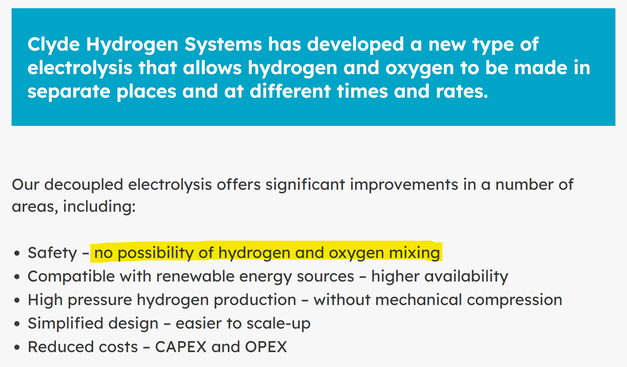
RE: Clyde Hydrogen demo of integrated decoupled electrolyzer prototype.

⬇️Claim "Safety-no possibility of #hydrogen and #oxygen mixing"

UNTRUE: flow sheet shows O2 could travel with liquid mediator to catalytic hydrogen generator.
H2 + O2 = BAD!

RE: https://mastodon.mit.edu/@keithdpatch/115770028565331973

#Safety101 #H2Safety
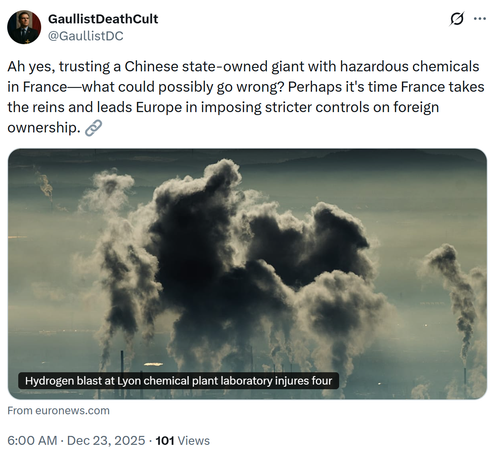
How can a French factory reopen after an explosion kills 2 workers, without finding the cause of the blast?

Silicone plants often use hydrogen; unsafe #hydrogen levels can explode; 1 died in this plant in 2016 & a 2nd safety incident in 2025!!

It makes me wonder if this plant is under new US "safety" regulations, or still follows EU requirements...[insert smirk emoji here!]

https://bit.ly/4pl1K5C #H2 #safety

#Hydrogen101 #H2Safety
💥Hydrogen explosion at Elkem silicone factory near Lyon, France injures 4, 3 seriously. Plant has had numerous safety problems, including 1 fatality in 2016.

Might be similar to 2019 Illinois, US silicon hydride plant SiH explosion.
#H2 #hydrogen #safety

#Hydrogen101 #H2Safety
In Oman, Netherlands' H2-Fuel & HydroFlexx ↙️lie about their "new" powdered sodium borohydride hydrogen carrier:
-NaBH4→H2 not a new idea (ca. 1950s)
-High #hydrogen density-NO (lower than 700Bar gaseous #H2 )↘️
-Non-flammable-NO↘️↘️
-Non-toxic-NO↘️↘️
#H2Safety #HydrogenSafety
💥Hydrogen explosion in an engineering laboratory at the University of Tehran #UnivOfTehran . 1 dead; 4 injured.
Occurred when a hydrogen cylinder was being replaced.
Shows the need for training & standard operating procedures #SOP .
#hydrogen #H2
#H2Safety
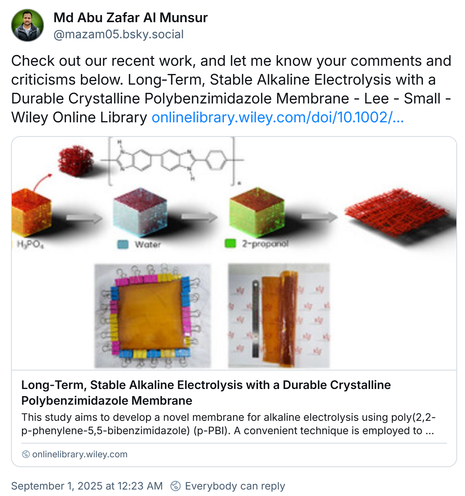
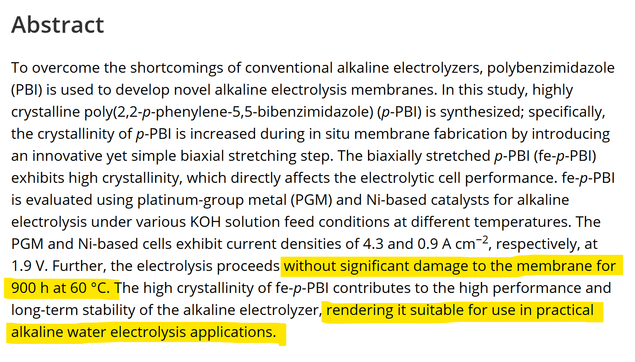
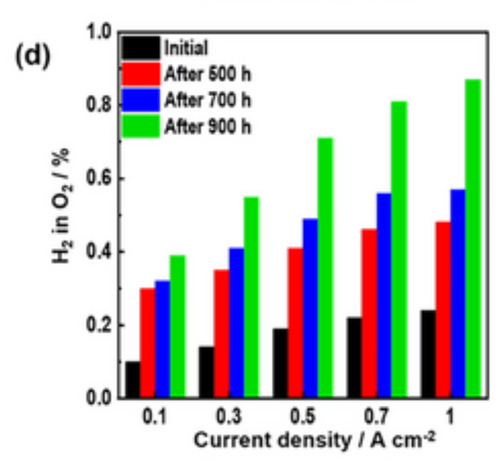
1) How can one say↙️ "suitable for use in practical alkaline water electrolysis" ↘️ when at only 900hr the 1A/cm2 hydrogen crossover ↘️↘️ becomes 0.9% H2 in O2 #HTO, or 22.5% of the lower flammability limit #LFL for #H2 in #O2?
ISO-22734 requires shutdown at 2% H2, or 50% of the #LFL! Extrapolation shows that 2% H2 would be reached in only 1,100 more hours of operation!
2) RE: "without significant damage to the membrane" - I'd say a 4x increase in #HTO at 900hr is "damage", wouldn't you??

@tinoeberl

Es erheitert mich immer wieder wie überraschend simple physikalische Gegebenheiten für einige "Experten" in der EU sind,wobei eine einfache Googlesuche hier helfen kann :
H2 ist das kleinste Atom, diffundiert also durch die dicksten Stahlflaschen/leitungen in kürzester Zeit => Lagerung/Transport nur flüssig oder hoher Druck.
Erfahrungen:: BWM Flughafen Münch.+ Betreiber von H2 Tanke.
https://publications.jrc.ec.europa.eu/repository/handle/JRC140673
#Wasserstoffwirtschaft
#Energiewende
#Pipeline
#Werkstofftechnik
#H2Safety

Pipelines for hydrogen transport: A review of integrity and safety challenges

The European Commission highlights hydrogen as an important energy carrier and chemical feedstock that could help decarbonise sectors otherwise deemed hard-to-abate. Europe’s existing natural gas grid is seen as a promising asset to repurpose for the transportation of hydrogen. This technical report provides a literature review of hydrogen's impact on pipeline materials, particularly steel and polymers. Hydrogen is known to reduce the ductility, fracture toughness, and the fatigue crack growth resistance of steel materials commonly found in transmission pipelines. It is also known to permeate through polymeric materials that are often used in the distribution grid. The possible implications for pipeline integrity and safety are reviewed. This report emphasises the need for further experimental research and practical experience combining material science and safety engineering disciplines. Key areas lacking knowledge include the full- or large-scale validation on pipeline sections of small-scale laboratory results, the behaviour of typical pipeline defects, and the long-term performance of polymeric pipeline materials, all under the influence of gaseous hydrogen. The report highlights the essential role of testing facilities such as the High-Pressure Gas Testing Facility (GasTeF) of the European Commission’s Joint Research Centre in addressing these gaps.

JRC Publications Repository

@tinoeberl

Es erheitert mich immer wieder wie überraschend simple physikalische Gegebenheiten für einige "Experten" in der EU sind,wobei eine einfache Googlesuche hier helfen kann :
H2 ist das kleinste Atom, diffundiert also durch die dicksten Stahlflaschen/leitungen in kürzester Zeit => Lagerung/Transport nur flüssig oder hoher Druck.
Erfahrungen:: BWM Flughafen Münch.+ Betreiber von H2 Tanke.
https://publications.jrc.ec.europa.eu/repository/handle/JRC140673
#Wasserstoffwirtschaft
#Energiewende
#Pipeline
#Werkstofftechnik
#H2Safety

Pipelines for hydrogen transport: A review of integrity and safety challenges

The European Commission highlights hydrogen as an important energy carrier and chemical feedstock that could help decarbonise sectors otherwise deemed hard-to-abate. Europe’s existing natural gas grid is seen as a promising asset to repurpose for the transportation of hydrogen. This technical report provides a literature review of hydrogen's impact on pipeline materials, particularly steel and polymers. Hydrogen is known to reduce the ductility, fracture toughness, and the fatigue crack growth resistance of steel materials commonly found in transmission pipelines. It is also known to permeate through polymeric materials that are often used in the distribution grid. The possible implications for pipeline integrity and safety are reviewed. This report emphasises the need for further experimental research and practical experience combining material science and safety engineering disciplines. Key areas lacking knowledge include the full- or large-scale validation on pipeline sections of small-scale laboratory results, the behaviour of typical pipeline defects, and the long-term performance of polymeric pipeline materials, all under the influence of gaseous hydrogen. The report highlights the essential role of testing facilities such as the High-Pressure Gas Testing Facility (GasTeF) of the European Commission’s Joint Research Centre in addressing these gaps.

JRC Publications Repository

#Wasserstoff gilt als Hoffnungsträger für die #Dekarbonisierung, doch beim Transport durch bestehende #Erdgasleitungen gibt es #Sicherheitsrisiken.

Wasserstoff macht Stahl spröder, schwächt die #Bruchfestigkeit und durchdringt #Kunststoffe. Ein Bericht der EU zeigt, dass viele Fragen zur Materialbeständigkeit und #Sicherheit im Dauerbetrieb noch offen sind.

https://publications.jrc.ec.europa.eu/repository/handle/JRC140673

#Wasserstoffwirtschaft #Energiewende #Pipeline #Werkstofftechnik #H2Safety #Energiewende

Pipelines for hydrogen transport: A review of integrity and safety challenges

The European Commission highlights hydrogen as an important energy carrier and chemical feedstock that could help decarbonise sectors otherwise deemed hard-to-abate. Europe’s existing natural gas grid is seen as a promising asset to repurpose for the transportation of hydrogen. This technical report provides a literature review of hydrogen's impact on pipeline materials, particularly steel and polymers. Hydrogen is known to reduce the ductility, fracture toughness, and the fatigue crack growth resistance of steel materials commonly found in transmission pipelines. It is also known to permeate through polymeric materials that are often used in the distribution grid. The possible implications for pipeline integrity and safety are reviewed. This report emphasises the need for further experimental research and practical experience combining material science and safety engineering disciplines. Key areas lacking knowledge include the full- or large-scale validation on pipeline sections of small-scale laboratory results, the behaviour of typical pipeline defects, and the long-term performance of polymeric pipeline materials, all under the influence of gaseous hydrogen. The report highlights the essential role of testing facilities such as the High-Pressure Gas Testing Facility (GasTeF) of the European Commission’s Joint Research Centre in addressing these gaps.

JRC Publications Repository