
Confusing verbs: lay & lie

In response to a recent question from several of my students, here’s a grammar post about two confusing verbs: lie and lay. (Actually, it’s three verbs, but we’ll come to that later.)

TO LAY

‘To lay’ means to put something down. It is followed by a direct object, i.e. it’s a transitive verb—after it we have to use a noun or a pronoun.

Take this blanket and lay it on the ground.

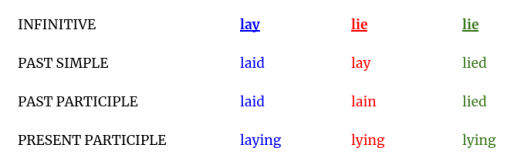
Its Simple Past and Past Participle form is LAID:

He laid the books on the table.

We have laid the foundation for our future cooperation.

The Present Participle, which we use to form all continuous tenses is LAYING:

We are laying down new rules.

This verb is often used with different prepositions, forming phrasal verbs with various meanings. Here are a few examples:

  • to lay down: to define and implement a rule; to put something down
  • to lay off: to make someone redundant
  • to lay over: to stop somewhere for a short time during a journey
  • to lay up: be / stay inactive due to illness or injury

TO LIE

‘To lie’ means to be in a horizontal position. It is not followed by a direct object, i.e. it’s an intransitive verb.

I feel very sleepy. I’m going to lie down. 

BE CAREFUL: the Simple Past form is LAY – same as the infinitive / present tense of ‘to lay’:

He lay in bed all day because he was unwell.

The Past Participle form is LAIN:

She had lain on the sofa for some time before she got up.

The Present Participle is LYING:

How long have you been lying in the sun? Your skin is so red!

This verb is also used to make a number of phrasal verbs, some of which are very frequent, such as:

  • to lie around: to leave something out of place; spend time relaxing, not doing anything
  • to lie ahead: to happen in the future
  • to lie in: to stay in bed later than usual

TO LIE = to deceive

Finally, there’s the verb ‘to lie’, meaning to say something untrue in order to deceive. This verb is regular (just be careful with spelling): its Past Simple and Past Participle is LIED, and the Present Participle is LYING.

Stop lying to me!

I have never lied to anyone.

To recap, here’s the overview of the main forms of these three verbs:

You can now practise these verbs a bit using the online grammar exercise I’ve prepared on this topic.

#EnglishGrammar #EnglishLanguage #EnglishVocabulary #grammarPractice #grammarQuiz #learningEnglish #verbs

Grammar practice: the causative have

In this post we’ll do a bit of grammar practice on a special use of the verb ‘have’, namely the causative have.

This structure is used when you want to say that you didn’t do something by yourself, but they you’ve simply arranged (i.e. caused) for someone else to do it for you.

It always follows the following pattern: have + object + Past Participle

Compare these two examples:

I have washed my car. – This is Present Perfect, where ‘have’ is the auxiliary verb. The sentence says that I washed the car by myself – ‘I’ is the subject.

I had my car washed. – Look at the pattern, with the object between the causative have and the Past Participle. This sentence implies that I asked someone else to wash the car for me.

Here’s another typical example:

I have cut my hair. – I did it myself.

I had my hair cut. – Someone else did it, presumably a hairdresser.

You can use the causative have in different tenses. For example:

I‘m having my hair cut. (I’m at the hairdresser’s right now.)

I‘ve had my hair cut. (Someone’s done it for me at some point in the past.)

I’m going to have my hair cut. (I intend to ask someone to do it.)

I’m sure this wasn’t very difficult. You can now click here to complete a simple grammar quiz on this topic.

#EnglishGrammar #EnglishTeacher #grammarPractice #grammarQuiz #learningEnglish

Grammar practice: other, others, another

Three words that students often confuse: other, others, and another. What’s the difference between them and when to use which? Read on for a few basic explanations and some grammar practice suitable for students at A2 / B1 level.

OTHER

Other is a determiner – an adjective that stands before nouns. Since it’s an adjective, it never takes a plural form. It means ‘additional’ or ‘different’. It can be used with uncountable nouns or, much more commonly, with countable nouns in plural. You can also use it with the pronoun ‘one(s)’.

Let’s meet some other time.

Do you have any other books?

This book is so boring. That other one was much more interesting.

ANOTHER

When you look at this word, it’s clearly a combination of the indefinite article a(n) + other. It has the same meaning as OTHER above, but we use it before singular countable nouns, or the pronoun ‘one’:

Can I get you another cup of coffee? (i.e. an additional one)

I finished the book last night, so I started reading another one this morning.

OTHERS

This word is not an adjective / determiner, but a pronoun. It replaces a plural noun:

I don’t like these gloves. Are there any others? (i.e. any other gloves)

Go play with others. (i.e. with other children)

So, to repeat:

OTHER (adjective) + uncountable and plural countable nouns / pronoun ‘one(s)’

ANOTHER (adjective) + singular countable nouns / pronoun ‘one’

OTHERS (pronoun)

You can now do a simple grammar quiz and check your knowledge! To start, click here.

And if you are at a more advanced level, have a look at this selection of links for additional study:

Other, The Other and Another (a VOA Learning English feature)

Other, others, the other or another? (a Cambridge Dictionary page)

NOTES

I’m a freelance language tutor (English, Latin, Classical Greek), researcher, and a literary scholar currently based in Belgrade, Serbia.  

If you wish to receive new content from my blog – as soon as it’s published – please enter your email address in the subscribe box below.

To support my work, you can send me a donation via PayPal. It would be greatly appreciated!

#English #EnglishGrammar #grammar #grammarPractice #grammarQuiz #learningEnglish

Grammar dilemmas: ‘in the beginning’ or ‘at the beginning’?

A mistake I often hear in conversation classes has to do with the choice of preposition before the nouns ‘beginning’ and ‘end’. Did something happen ‘in the beginning’ or ‘at the beginning’? And what happened ‘in the end’? Or is it ‘at the end’?

Likely due to influence of Serbian / Croatian – most of my students’ mother tongue – I also often hear ‘on the beginning’ and ‘on the end’ (na početku, na kraju). 

So, which one is it?

To eliminate one for starters, ‘on’ the beginning / end is NOT an option, as it’s grammatically incorrect. It’s also a good lesson: never translate prepositions literally!

The good news is that you can use both ‘in’ and ‘at’ with these nouns; the bad news is that they don’t mean exactly the same thing. Let’s check out the difference.

IN THE BEGINNING

This has a more general meaning, implying the beginning of a longer process, historical event or development. One usually has in mind a whole period of time, not any single moment. A great example of this is the opening verse of the Bible, which starts like this:

In the beginning God created the heavens and the earth.” (Gen. 1:1)

Later verses describe these events in greater detail; all of which were “in the beginning.”

You can also use it to introduce contrast:

In the beginning, I didn’t like my neighbourhood, but now I’m very happy there. 

In this sense, it means the same as AT FIRST

AT THE BEGINNING

This refers to a specific time or place; a single point that was the start of something:

I introduced myself at the beginning of the meeting.

There was a horrifying scene at the beginning of the film.

IN THE END

Similar to ‘in the beginning’, IN here refers to the end of a longer process, development, situation etc. The phrase means the same as EVENTUALLY, FINALLY:

I was trying to learn Japanese; in the end, I gave up.

The war was very long and difficult, but we won in the end.

AT THE END

Same as with ‘at the beginning’, this too refers to a specific location or a point in time:

You’ll find my house at the end of the road.

The film was so sad, everyone cried at the end.

I hope this was not too difficult. You can practise this a bit by doing my short grammar quiz on this topic!

NOTES

I’m a freelance language tutor (English, Latin, Classical Greek), researcher, and a literary scholar currently based in Belgrade, Serbia.  

If you wish to receive new content from my blog – as soon as it’s published – please enter your email address in the subscribe box below.

To support my work, you can send me a donation via PayPal. It would be greatly appreciated!

#English #EnglishGrammar #EnglishLanguage #EnglishLesson #EnglishVocabulary #grammar #grammarPractice #grammarQuiz
Mastering Narration, Voice, and Articles Through Practice | English Grammar with Dr. Gaurav Dixit

YouTube
✅ Level Up! Active & Passive Voice Made Simpler – Part 2 || English with Dr. Gaurav Dixit

YouTube