@frumble
Danke für das Feedback!

Ich nutze nun schon eine ganze Weile Manjaro.
Allerdings beim Desktop Chinnamon, also eine Community Edition.

#GHULbenchmark sollte eigentlich auf allen Arch basierten Distros laufen.

Alle Linux Distributionen haben ihre Vor- und Nachteile, #CachyOS und #Garuda habe ich schon mal testweise zur Probe installiert, #EndeavourOS muss ich noch probieren, bis ich dann noch #Arch selber teste: wenn es da tut tut es überall.
Allerdings kommt für eine #SteamMachine nur ein Rolling Release auf Arch Basis in Frage, schon aus dem Grund, weil Valve (Steam) auch Arch nutzt, für ihr SteamOS.
Proton, Mesa, Nvidia-Treiber, OpenGL, Vulkan - alles binnen kürzester Zeit verfügbar.

🧵 #GHULbenchmark – why this exists (thread)

I wrote GHULbenchmark because #Linux 4 #Gamers deserved better tools.

Not prettier graphs.
Not higher scores.
But truth.

Hardware doesn’t fail because of low FPS.
It fails because of thermals, VRAM hotspots, airflow lies and “silent” firmware decisions.

Modern GPUs ship with fan behavior hard-burned into the BIOS.
You see the temperatures.
The kernel sees them.
The sensors scream.

…but you’re not allowed to spin the fans.

That’s not a feature.
That’s a bug.

Death comes silent — and slowly degrades your VRAM and die.

GHULbenchmark exists to make this visible.
No GUI lies. No marketing. No mercy.

The display of the thermal sensors has been made clearer, green means normal, blue excellent and red means exceeding the pain threshold of the hardware.

More below. 👇

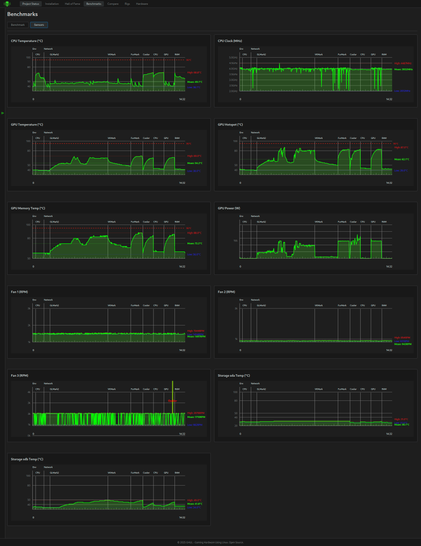
GHUL update – frontend work in progress 🧪📊

Right now I’m developing the GHULbenchmark GUI locally on my own machine.
The focus is not “pretty graphs”, but measurement correctness.

The visualizer already detects sensor glitches (they always happen),
marks them as outliers, and filters them out for calculations and analysis –
so averages, peaks and ratings stay meaningful.

This is slowly turning into a real measurement lab instead of a gaming dashboard.
First impression attached. More to come.

#GHUL #GHULbenchmark #LinuxGaming #OpenSource #HardwareTesting #DataMatters

Gaming hardware using Linux – but nobody really knows how powerful your rig is?
The solution is coming: #GHULbenchmark.

Today I built the upload API and wired it directly into ghul-benchmark.
Benchmarks can now run in a session-based flow, validate timestamps and steps, and upload results securely to the server.

I also added Hellfire mode 🔥

--hellfire (default torture)

--hellfire --wimp (short, reduced pain)

--hellfire --insane (no cooldown, long runtime, brutal settings – for the truly insane)

Combined with --share, your benchmark and sensor data can be uploaded automatically after the run.

⚠️ uploads are not public yet.
frontend is still missing, and I really don’t want the community hammering my server with benchmarks while I’m still building the UI 😄
For now: uploads work, but only for me.

Fun fact: one run is ~200 KB.
Storage won’t be the bottleneck – design and fairness will be.

Linux gaming deserves proper, transparent hardware benchmarking.

We’re getting there. 😝

Here’s some context for #GHULbenchmark:

Most tools show synthetic numbers — #GHUL measures real heat, real load, real sensors. Hardware doesn’t die from FPS; it dies from thermals, VRAM hotspots, and PSUs begging for mercy. 🔥💀

Fun fact from RDNA4 testing: the new “silent” fan feature is a silent killer. VRAM hits 90°C, hotspot follows, fans chill at 46% (BIOS-enforced).
GHUL would cook the card instantly if I hadn’t added emergency shutdowns.

Uploads aren’t required — real nerds test locally first, then send a PR when something explodes or a sensor speaks folklore. 😄

AMD & NVIDIA supported; Intel ARC is next.
Own an ARC card? Congrats, you’re volunteered.

#Linux #Benchmarking #FOSS #GHUL #LinuxGaming #AMD #NVIDIA #ARC

@serebit
Thanks for the boost!

My old Fediverse account is dead as a doornail, so I finally made a new one —
and #GHULbenchmark was the thing I needed to get off my chest for weeks.

Trying to make #Linux #hardware testing suck less…
…one script at a time.

(Phoronix drove me nuts, so I wrote my own tools.)

Appreciate the signal boost from someone who actually ships real Linux work.