
Incidentally, in our latest article in #FrontiersInGenetics we discuss the "Opportunities and challenges for newborn screening and early diagnosis of rare diseases in Latin America" including the opportunity to implement #GenomicSequencing as an add-on to current NBS programs to provide accurate diagnoses for patients living with #RareDiseases in #LATAM #GenomicEquity

https://www.frontiersin.org/articles/10.3389/fgene.2022.1053559/full

Opportunities and challenges for newborn screening and early diagnosis of rare diseases in Latin America

Rare diseases (RDs) cause considerable death and disability in Latin America. Still, there is no consensus on their definition across the region. Patients with RDs face a diagnostic odyssey to find a correct diagnosis, which may last many years and creates a burden for caregivers, healthcare systems, and society. These diagnostic delays have repercussions on the health and economic burden created by RDs and continue to represent an unmet medical need. This review analyzes barriers to the widespread adoption of newborn screening (NBS) programs and early diagnostic methods for RDs in Latin America and provides recommendations to achieve this critical objective. Increasing the adoption of NBS programs and promoting early diagnosis of RDs are the first steps to improving health outcomes for patients living with RDs. A coordinated, multistakeholder effort from leaders of patient organizations, government, industry, medical societies, academia, and healthcare services is required to increase the adoption of NBS programs. Patients’ best interests should remain the guiding principle for decisions regarding NBS implementation and early diagnosis for RDs.

Frontiers

Proud to share our latest article on "Opportunities & Challenges for Newborn Screening and Early Diagnosis of Rare Diseases in Latin America" published today in #FrontiersInGenetics

This article is the product of careful review, deep discussion & insightful consensus on the current state and opportunities of newborn screening & early diagnosis approaches in Latin America for the better & accurate diagnosis of #RareDisease patients in #LATAM #ERCAL

https://www.frontiersin.org/articles/10.3389/fgene.2022.1053559/full
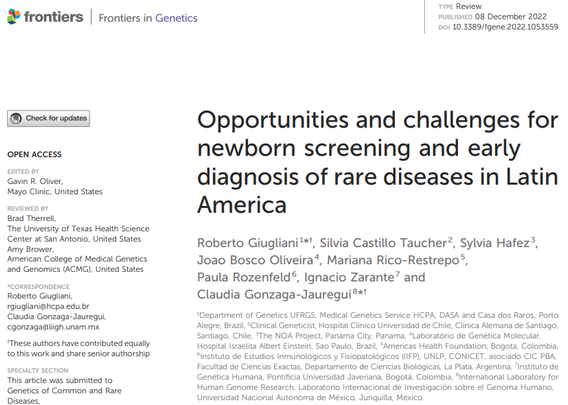
Opportunities and challenges for newborn screening and early diagnosis of rare diseases in Latin America

Rare diseases (RDs) cause considerable death and disability in Latin America. Still, there is no consensus on their definition across the region. Patients with RDs face a diagnostic odyssey to find a correct diagnosis, which may last many years and creates a burden for caregivers, healthcare systems, and society. These diagnostic delays have repercussions on the health and economic burden created by RDs and continue to represent an unmet medical need. This review analyzes barriers to the widespread adoption of newborn screening (NBS) programs and early diagnostic methods for RDs in Latin America and provides recommendations to achieve this critical objective. Increasing the adoption of NBS programs and promoting early diagnosis of RDs are the first steps to improving health outcomes for patients living with RDs. A coordinated, multistakeholder effort from leaders of patient organizations, government, industry, medical societies, academia, and healthcare services is required to increase the adoption of NBS programs. Patients’ best interests should remain the guiding principle for decisions regarding NBS implementation and early diagnosis for RDs.

Frontiers
Brazilian study published in #FrontiersinGenetics show gender bias in the use of #menstrual blood. The material tends to be less used in experiments and its scientific value tends to be underestimated, which brings gender bias to a technical and molecular level. All this, despite proven scientific quality of menstrual blood mesenchymal cells. https://doi.org/10.3389/fgene.2022.957164
Gender bias and menstrual blood in stem cell research: A review of pubmed articles (2008–2020)

Despite proven scientific quality of menstrual blood mesenchymal cells, research and science output using those cells is still incipient, which suggests there is a resistance to the study of this type of cell by scientists, and a lack of attention to its potential for cell therapy, regenerative medicine and bioengineering. This study analyzes the literature about the menstrual blood mesenchymal stromal/stem cells (mbMSC) on the PubMed database between 2008–2020 and the social attention it received on Twitter. A comparative analysis showed that mbMSC accounts for a very small portion of mesenchymal cell research (0.25%). Most first authors are women (53.2%), whereas most last authors are men (63.74%), reinforcing an already known, and still significant, gender gap between last and corresponding authors. Menstrual blood tends to be less used in experiments and its scientific value tends to be underestimated, which brings gender bias to a technical and molecular level. Although women are more positive in the mbMSC debate on Twitter, communication efforts toward visibility and public interest in menstrual cells has room to grow.

Frontiers