 Andy Arthur - Threadinburgh
Educating Newhaven: the thread about the Victoria and other Schools
Since at least he late 16th century, education in the village of Newhaven has been conducted under the auspices of the Society of Free Fishermen. This was the local fraternal society, one which jealously guarded the privilege of maintaining their own poor and providing for the community. Their first known schoolroom in School Close (now called Lamb’s Court) off of the Main Street, the building and teacher paid for by the Society. Its pupils – all boys at the time – paid a fee, which could be waived at the discretion of the Boxmaster; the elected official in charge of the Free Fishermen’s poor box.
Newhaven as depicted on Robinson & Fergus’ 1759 survey of Edinburgh. Main Street is easily discernible, with Whale Brae ending at the The Whale inn and the recognisable placename of “Peacocks” at the edge of the village by the Links. The Free Fishermen’s first school was in the range of buildings highlighted blue, to the west of St Andrew’s Square (now Fishmarket Square). Credit Edinburgh City Archives, own photo.By the early 19th century the old schoolroom was dilapidated and so in 1817, under the spiritual guidance of the Rev Dr Ireland of North Leith Parish Church (where Newhaven then worshipped), the foundation stone for a new schoolhouse was laid at the west of Main Street: where the Free Fishermen’s meeting hall would later be built. The Society raised £140 towards the cost, the City of Edinburgh (the notional civic authority) contributed £10, £5 each came from the Duke of Buccleuch and Lord Melville, and twenty cartloads of “best rubble” were donated by the proprietors of Craigleith Quarry. The teacher who was employed was not up to his task however and the Rev Ireland took an ever increasing role in oversight to ensure the children’s literacy was sufficient for them to read their catechism and the bible, thus progress in their religious and moral education. In 1822 the minister instituted the Newhaven Education Society, which the following year took over complete control of the school. By 1825 girls and infants (aged three to seven) were being admitted, the latter being unusual at the time and of great value in a community where the menfolk were away at sea much of the time and the women and older girls daily worked far from the village.
“Newhaven Minstrels” by Keeley Halswelle, 1866. Black and white facsimile from a sale at Sotheby’s of the original oil painting depicting children of Newhaven singing. Halswelle painted a number of evocative, romantic scenes of Newhaven folk around this time. Credit Paul Mellon Centre for Studies in British ArtIn 1828 the charge of North Leith Parish was taken up by Rev Dr James Buchanan at which time the school had one hundred and sixty pupils. The new minister began to conduct mid-week services at the schoolhouse for the benefit of the elderly and infirm, which grew in popularity to such an extent to make the case of building a church in the village itself (its previous – Catholic – chapel had fallen out of use after the Reformation in 1560). In October 1836 a new Chapel of Ease was opened on the New Cut (the northern extension of Craighall Road) as a mission of North Leith under Buchanan. Newspaper reports note that the undercroft was to house a school, but whether this was a day school or a Sabbath school is not clear. In 1838 the church was raised to the status of a Quoad Sacra Parish (that is one in only an ecclesiastical sense, without the civic functions of a civil parish) under its own minister, the Rev James Fairbairn.
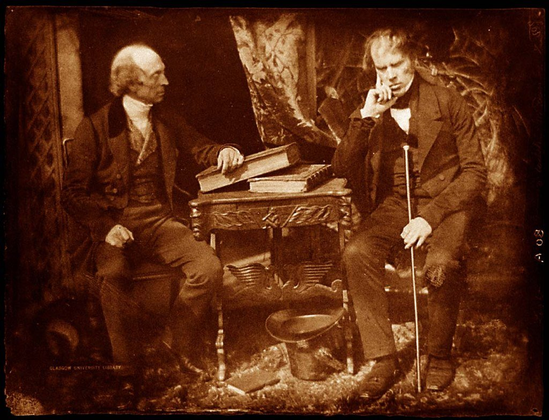
The Rev Dr James Fairbairn (seated) preaches to Bessy Crombie, Mary Combe, Margaret Lyell and two other Newhaven Fishwives, while James Gall of the Carrubbers Close Mission listens on. The scene is staged for the camera outside the Rock Villa studio of David Octavius Hill & Robert Adamson on Calton Hill. Collection of the National Galleries of ScotlandThe Rev Buchanan left North Leith for the High Kirk of Edinburgh in 1840 but had likely instituted a committee before his departure to try and acquire a feu of land to build a new village school. These plans came at a turbulent time in the religious life of Newhaven (and Scotland in general): at The Disruption of 1843 the majority of the parishioners followed their minister and walked out of the Established Church of Scotland (the Kirk) and into the new Free Kirk. In this case the walk-out was figurative as well as literal – the Free Kirk congregation refused to give up the use of the parish church until they were removed by legal action in 1849 (allegedly the communion silverware mysteriously “disappeared” at this time). In the midst of this upheaval the site for a new school was secured at the east of the village on Newhaven Links from the City of Edinburgh. This spot was at that time home to a dilapidated boat shed called the Life House, which housed a lifeboat eschewed by the fishermen who preferred and trusted their own boats for mercy missions and never used it. The map below shows that this school’s boundary wall was on the high spring tide mark.
1852 Ordnance Survey Town Plan of Edinburgh showing the Victoria School at the west of the Links. A single room, single storey affair with tiered seating at one end and other bench seats around the walls and in the centre of the floor. Reproduced with the permission of the National Library of ScotlandThe foundation stone was laid in 1844 and it is likely that the Free Kirk was involved in the establishment as they maintained privileges of using the premises as a Sunday School and it served as a temporary home while their new church was erected on Pier Place. It was however not a denominational school: the Ordnance Survey Name Book of 1853 records it was superintended by ministers of both village kirks. The building was a simple affair; a single storey, single room, Gothic-style affair by the architect John Lessels. The Building Stones of Edinburgh lists its stone as coming from Grange Quarry in Burntisland, which corresponds with anecdotal evidence that the steeple of the Free Kirk had its stones brought across the Forth from Fife in the fishermen’s boats. The Caledonian Mercury in February 1846 refers to it as the New Schoolhouse however it would soon acquire the name of Victoria School in honour of the monarch, confirmed in the aforementioned Name Book:
A neat and substantially built schoolhouse in the Village of Newhaven, it was erected in 1835 and is under the superintendence of the Ministers of Established & Free Churches, the attendance is about 80 scholars and the schoolmaster’s salary consisting of school fees and other amendments amounts to about £50
Ordnance Survey Name Book for Midlothian, entry for Victoria School. Vol. 76 (North Leith Parish) page 81, 1852. OS1/11/76The date of erection given above – 1835 – cannot be correct, however it may suggest that the school had its origins in an earlier establishment before it removed to the 1844 building; perhaps it is that mentioned as being held in the undercroft of the parish church? Naming the new school after the reigning monarch would not have been an unusual thing to do, however Newhaven had a special place in its heart for her on account of a diary entry she made on the occasion of her visit to Edinburgh:
…the fishwomen are the most striking-looking people, and are generally young and pretty women – very clean and very Dutch-looking, with their white caps and bright-coloured petticoats.
Queen Victoria’s diary entry regarding Newhaven Fishwives, 3rd September 18421852 Town Plan of Edinburgh, centred on Newhaven, showing the Quoad Sacra parish church on the left (green), the Free Kirk on Pier Place in blue and three red buildings, from left to right these are; the 1817 school of the Newhaven Education Society, the original Free Fishermen’s school on School Close and the 1843 Victoria School. Reproduced with the permission of the National Library of ScotlandThe Victoria School operated alongside the old Free Fishermen’s school for a time, however by the dawn of the 1860s the latter was no longer up to its task and so in June 1861 factional differences were put to one side and both village ministers jointly presided over the laying of the foundation stone of another new school. £1,100 had been raised towards this locally and it was to be located on ground behind the parish church on the New Cut, although was to be non-denominational. Unfortunately work was brought to a stop by the untimely death of a key promoter – Dr Robertson, Professor of Church History at the University of Edinburgh – that caused that the organising committee to overlook applying for the necessary government grant, leaving half the required funds wanting. The building was therefore only partially completed when it opened in 1862 for its first 200 scholars and a great fund-raising effort took place across Edinburgh to help finish it, which took place in 1863 with the aid of funds from the trust of the late Dr Andrew Bell (see also Dr Bell’s School). For this latter reason it became known as the Madras School as it adopted Bell’s Madras System of monitorial education, i.e. where a single, large, multi-age class was presided over by a teacher whose instruction was relayed to the pupils by monitors; older children more advanced in their studies. The 1861 census recorded 605 children of school age in Newhaven at that time, 300 of which could be taught in this new school.
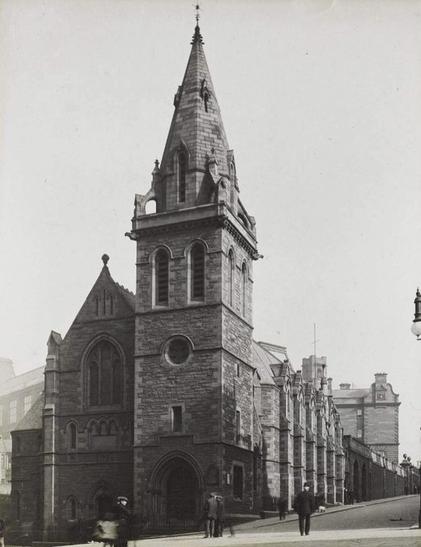
The Madras School behind the former Newhaven-on-Forth Parish Church, outlined amber. The two-storey addition to the left was a house for the schoolmaster. After its school use it became the church hall, and latterly the church building was converted to housing and the congregation now worships in the hall.Alterations were also made to Victoria by Lessels in 1861 and its school role increased to a point where infant classes had to be moved back to the old Free Fishermen’s School; probably what is referred to as St John’s Infant School in some newspaper mentions. Newhaven continued to provide for the education of its own children in this manner for the next decade or so, until everything changed with the passing of the Education (Scotland) Act 1872, which both made education compulsory for children between the ages of five and thirteen and also formed School Boards (largely along parish or burgh boundaries) to organise it. Newhaven was placed within the new Leith School Board, who surveyed the state of affairs in the village and found there were 291 children in the Madras School, 110 at Victoria, 141 in the infant school and 53 in the Free Kirk’s school; a total of 595. There were also children attending a school to the west on Lower Granton Road but this had been allocated to Cramond School Board who could not come to terms with the Leith Board and so they were unceremoniously barred from the former. At this time the Board found 22% of all children of school age in their district were not in education so their immediate priority was to find capacity for accommodating this absent fifth of scholars.
Former Granton School, hard to spot in the terrace of cottages on Lower Granton Road, look for the small ventilator cowl on the roof and the changed spacing of the doors.Looking at Newhaven’s schools, the Board found it could not acquire the Madras School as it was built on land vested in perpetuity to the Church, so they left it to continue to be run under its existing management and instead took over the Victoria School in 1874. At this time they extended the building and to this end 705 square metres of Newhaven Links were acquired from the Leith Dock Commissioners on very favourable terms. The Board’s architect George Craig added a new wing to the rear bringing capacity up to about 300, with associated entrance vestibules and toilets to bring the place up to the required standards of the Scotch Education Department (grants towards funding were dependent on the Boards meeting the standards for buildings set out in the Department’s Scotch Code). At this time the playground was also expanded and divided into separate spaces for boys and girls.
1876 Town Plan of Edinburgh, showing the footprint of the Victoria School after its 1874 extension by the Board, with the original outline and boundary of the 1844 schoolhouse shown in red. The plot size was almost doubled by this time, new entrance vestibules added and a new wing built to the rear but it remained single storey. Playgrounds for girls and boys were now separated. Reproduced with the permission of the National Library of ScotlandBy 1879 the roll at Victoria was 294 with an average attendance of 257: at 12% the absence rate was the lowest across the Leith district, which averaged 18%. With the school reaching capacity in 1884 the Board spent £2,854 to expand it again, increasing accommodation to 503 pupils. No additional land was available for the expansion so architect George Craig had to build up, adding an additional storey. This required three external stair towers to access the upper floor, segregated for boys and girls, as the original building lacked an internal stairwell. Infants and juniors would remain on the ground floor, the senior children going upstairs. Particular attention was paid to ventilation – an obsession to Victorian school designers – with inlet vents added at floor levels, patent fanlights at the tops of all classroom windows and a large fleche-style ventilation cupola on the roof crossing, in which a gas burner created a through draught to extract classroom air through vents in all the classroom ceilings. At this time a small belfry was added above the west stair tower for the school bell and a hot water heating system was installed, the boiler located in a basement at the rear.
1893 Town Plan of Edinburgh, showing the footprint of Victoria School after its 1885 extension by the Board highlighted orange, the original 1844 building in red and the 1874 additions in blue. Reproduced with the permission of the National Library of ScotlandTo raise the height of the building the original decorative buttresses on the south elevation had to be expanded to take on a practical function and support the facade of the upper storey. Craig kept the additions in the Collegiate Gothic style that was then in vogue for school architecture and added carved date panels which read: 1843 VICTORIA 1885, LEITH SCHOOL BOARD. At the formal re-opening on Monday March 2nd 1885 the Chairman of the School Board, Dr Mitchell, delivered a rather patronising address to parents along the lines of the new school being bigger than the village deserved and they should therefore “second the efforts of the Board by seeing that their children attended.“
Tablets added on the rebuilt south façade of the school during the 1884-85 extension commemorating the laying of the foundation stone in 1843 and Leith School Board’s extension. “G. Craig, Archt.” can just be made out in small letters below the right hand panel. Photo © SelfIn his assertion the Chairman would very soon be proven wrong: within a year the managing committee of the Madras School wrote to the Board informing them of their intention to close down for want of funds. The Government inspector had condemned their building as below standard and with the founding endowment almost exhausted there was no money to bring it up to code, which would result in the loss of state grants. If the Madras school were to close its two to three hundred students would suddenly become the Board’s responsibility to house and educate, but they were reluctant to simply take over its running as they too would have to expend money bringing it up to standard while trying to find a long term solution. Ultimately, the Board dithered during which time the roll at Victoria grew: to 623 in 1887. This was well in excess of the nominal capacity and was kept manageable only by a high absence rate of 35%, meaning average attendance was only 406. This was result of a severe outbreak of measles in the village, one which would take over two years to bring under control.
Victoria after the 1885 extension, south façade. Credit: Edinburgh & Scottish Collection, Edinburgh City LibrariesFrustrated at the Board’s lack of action – and possibly pushed by the parish church wanting to get their hands on the building – Madras’ management brought matters to a head and announced that with only £100 remaining the school would shut at the end of summer term 1888. A consequence of this would be £50 of the remaining funds would have to be returned to Dr Bell’s Trust as it was originally granted as a loan for which time the school remained opened. The Board now had no option but to temporarily take on the lease of the school and make what improvements they could, representations were made to the Education Department who agreed to maintain the grant temporarily on condition that a plan was submitted in writing. Things didn’t start well for the Board’s when their appointed headmistress, Miss Menzies, turned the job down! The school was therefore temporarily supervised by the headmaster at Bonnington Road Public School for the start of the 1888-89 term, at which time its roll stood at 248 (but with the high absence rate, average attendance was only 151).
Photograph of primary 4-aged class (seven to eight years old) at Victoria School in 1907, the girl in the back row second from the right named as Maggie Crawford and the teacher as Miss Don. Collection of City of Edinburgh Museums & Galleries, NH.2010.7Leith School Board had bought itself time to plan for the future and its preferred solution was a grand new public school on Craighall Road with a capacity of 1,600 pupils, which would be more than sufficient to absorb the excess from Newhaven and other local schools But before these plans could be advanced an even greater crisis landed in the Board’s in-tray: the Local Government (Scotland) Act 1889, which was preparing for state-provided education being made free (under the 1872 most children were still charged a nominal fee, unless in receipt of poor relief) and in doing so altered the arrangements for state-aid for endowed schools (those supported financially by a founding bequest).
A notice issued by Leith School Board regarding the relief of school fees per the Code issued by the Scotch Education Department, exhibited in the Heritage Museum at the former Victoria School.Such schools included those of Dr Bell’s Trust, of which there were two examples in Leith; on Great Junction Street and South Fort Street. At a stroke the changes meant these schools ceased to be financially viable and the trustees sought to wind them up – making them too the problem of the School Board. The Board closed South Fort Street, its pupils transferred to a very crowded North Fort Street Public School. Reluctantly Great Junction Street was adopted by the Board, which they would enlarged into Junction Place Public School, universally remembered locally as just Dr Bell’s. This issue, while while not directly impacting Newhaven, distracted the attention and stretched the finances of the Board for a good while.
Statue and memorial tablets for the Rev Dr Andrew Bell on the gable of former Dr Bell’s School on Junction Place, marking its establishment by his endowment and according to his “Madras System” educational principles in 1839. Picture copyright HES, via Trove.Scot SC2648345The foundation stone of the new Craighall Road Public School was as a result not laid until July 1891 and it would not open for business until 4th September 1893, by which time there was a capacity crisis in Newhaven such that 100 children were not able to get a school place. Despite the Board’s hopes, the new school provided no answer as many parents shunned it: it was felt to be too far from the village and more importantly it charged fees (Boards were allowed to charge fees in a small number of their schools after 1890). With North Fort Street full and the Madras School closing imminently the state of affairs in Newhaven was only going to get more acute. Once more, the Board felt it had no option but to once again ask George Craig to draw up plans to expand the Victoria School.
Craighall Road Public School in 1893, the year it opened. This building is now part of Trinity Academy. Notice the lamplighter (Leerie) up his ladder on the left. Photograph by Alexander Adam Inglis, Edinburgh and Scottish Collection. Edinburgh City LibrariesBy good fortune in 1892 the Leith Dock Commissioners had obtained parliamentary authority to make improvements to Newhaven harbour that included land reclamation around the Links. The Board therefore negotiated with the Commissioners for a feu on some of this reclaimed land around the school, allowing the size to be almost tripled to 2,670 square metres. In 1896 work commenced at a cost of £5,064 to add 288 more places to the school, bringing the roll up to 800. On the enlarged plot a new three-storey extension was added to the east, with the rear of the 1885 extension being increased in height to three storeys too. Further extensions were added to the rear and the enlarged playgrounds had playsheds to give children some shelter from inclement weather; the despite the land reclamation the school still backed onto the Forth coast.
1893 Town Plan of Edinburgh, showing the footprint of the Victoria School on Newhaven Links after the 1897 extension which is shown in teal: the outline and boundary of the 1844 schoolhouse is red, the 1874 extensions are blue and 1885 is orange. By this time further extensions had been added to the rear. Reproduced with the permission of the National Library of ScotlandWhile the Board’s preferred solution for Newhaven would have been a new build school to the west of the Village, for economic reasons this was never possible and Craig’s repeated expansions to the school over three decades made the best economic use of a small site. Because the same architect underook all this work it was possible to maintain a coherence to the building which can make it difficult for modern eyes to unpick the multiple layers and additions: one might easily assume that the various tiers, cupolas, stair towers and projections were done intentionally, rather than just as a practicality.
The three principal phases of expanding the Victoria School, with the original and 1874 school in red, the 1885 enlargement in orange and the 1897 expansion in teal. George Craig cleverly used the existing stair tower on the south facade to access the third storey by extending its height and changing its orientation half way up – this explains the notch cut out of the building, which means the original windows still provide (some) light into the stairwell.The school is very efficiently conducted, and discipline and general tone are excellent. In the junior section the results of examination were on the whole highly creditable, the only notable weakness being in the written work of the lower division of the third class. In the senior section, both oral and written work of the fourth and fifth classes were very good, with the exception of the the fifth class, which was not more than very fair. The class work of the sixth class leaves room for improvement: reading and recitation were too hurried, and history and nature knowledge were not strong.
Leith School Board’s annual appraisal of Victoria School, reported in the Leith Burghs Pilot, Saturday October 6th 1900Leith School Board ceased to exist as a result of the Education (Scotland) Act 1918, which abolished these bodies and merged them into a smaller number of Education Authorities; for Leith this was the Edinburgh Education Authority. The rest of the municipal functions of Leith, and by extension Newhaven, soon followed and were amalgamated (seized against their will, generations of Leithers will tell you) into Edinburgh in 1920. In 1925 the girls of the school won the accolade of “Overhead Ball Champions of Leith“. This was a relatively new game that was very popular with girls. The basic premise was akin to a form of Rounders played with a football and with the participants arranged into a “batting” and a “fielding” team. The batting team stood in a line and its leader would hit the ball by hand in a random direction at which point the leader began to run rings around their line. It was the job of the fielders to get the ball, arrange themselves in a line behind whomever had the ball and quickly pass it back, hand over head, to the back of the line at which point the umpire blew their whistle. The fielders scored a run for each circuit of the line that their leader had run.
Victoria School’s champion Overhead Ball Game team of 1925. Edinburgh Evening News, July 17th 1925The Education Authorities were a transitional body, and as a result of further local government re-organisation in 1927 it became the Education Committee of the Corporation of the City of Edinburgh. George Craig’s additions served Victoria School well, until 1930 by which point updated accommodation was needed – the convenor of the Corporation’s Property and Works Committee labelled it as the “worst” in Edinburgh “in regard to size, light and intercommunication“: it was “very difficult to get into… and more difficult to get out“. And so yet again an expansion was planned on land reclaimed from the sea, which would take the plot size up to 2,650 square metres; some seven and a half times that of the original 1844 school. In 1932 a new infant department for 200 children was opened at a cost of £14,471 in the east of the enlarged playground. This new structure was a break with the Victorian “Barracks” of the School Board era and instead what emerged was a low, wide, single-storey L-plan structure that sought to make the best use of natural light and ventilation.
1975 photograph of the Infant Department extension, added 1932, demolished 1980s. HES, via Trove.Scot SC1646779This addition coincided with a tipping point for the village’s fortunes: after a very good 1924 season the inshore fisheries were set on an irreversible path of decline due to overfishing. The larger, more modern and mechanised trawlers that were needed to fish ever further out to sea passed Newhaven by and headed instead for Granton which displaced it as the principal fishing port in the locality. The village’s prosperity had always followed that of the herring and the sprats, and the oysters before them, and after four centuries began to dwindle. In July 1935 Dr Sym of the Corporation’s Education Committee provoked outrage when he proposed its school needed special classes for “backward children” on account of seventy percent of its pupils being “normally slow“. His colleague Councillor Allan said this was due to “inter-marrying” by which he implied inbreeding. Newhaven folk had largely always wed other Newhaven folk but this was a practicality; Marriages were as much a business union as one of love and the inherited skills of fisherman and fishwife were mutually complementing but only acquired by growing up into them. Public protest meetings were convened in the Free Fishermen’s Hall, on the site of the 1817 school, to demand an apology to which representatives of the Committee were invited. Councillor Allan attended and apologised, Dr Sym declined to do so.
The school remained open during World War II, although some children were evacuated in 1939 to Fort William. In 1944 its centenary was marked with the unveiling of a wooden copy of the “Armada Stone” presented by Leith shipyard proprietor Henry Robb, unveiled by Lord Provost William Y. Darling. The original stone can be found in the wall of the flats nearby at Auchinleck Court and a metal copy is on the school’s south gable as a war memorial.
The wooden copy of the Armada or Newhaven Stone presented to the school by shipyward proprietor Henry Robb to celebrate its centenry in 1944. It is located in the small museum on the ground floor of the old school, a metal copy is on the outside wall on the south gable as a war memorial tablet. Own photo.A pageant was held in the Usher Hall retelling the history of the village since its foundation by King James IV in the 16th century; the children dressed in period costumes and many of the girls wore their Fishwives’ Braws, the boys their knitted fishing Ganseys. The children raised £2,000 through their own efforts for Leith Hospital, sufficient to endow three cots in the Children’s Ward.
Centenary pageant in 1944, CC-by-NC-SA, Thelma via Edinburgh Collected, donor 0301-071As Newhaven’s fortunes continued to decline post war, the City Corporation hastened its demise by designating the village a Comprehensive Development Area (CDA) in 1959, giving itself powers of compulsory purchase over most of the village in order to demolish most of the old houses (which it had deemed “unfit” and constituting slums) and rebuild them. Like many such schemes done with good intention from a far off desk in City Chambers, ultimately it lost sight of the fact that a community is much more than just its buildings and by dispersing its people to new housing elsewhere it irreversibly altered the character of the place. Families with children were given priority for re-housing and this meant those left behind were frequently the elderly: as a result the population of school age children in the village went into a steep, and what seemed like terminal, decline.
1949 class portrait at Victoria School, CC-by-NC-SA, Thelma via Edinburgh Collected, donor 0407-001The work of the CDA in “improving” Newhaven continued into the 1970s with a new bypass road built to the north of the village in an attempt to reduce traffic along Main Street. Originally this was called Newhaven Place but is now an extension of Lindsay Road and required the school boundary to be moved a few metres south. To compensate for this loss, a portion of land to the east of the school was incorporated into the playground. Unfortunately the heavy traffic – much of it lorries from Granton or Leith Docks – now passed close behind the school buildings and damaged the foundations of the 1930 Infant Department to such an extent that it had to be demolished in the late 1970s or early 1980s. By this time the school’s declining roll no longer required the space, but it did mean its most modern facilities were lost.
An existential threat to the school came in February 1983 when closure was mooted by the Conservative-led administration of Lothian Regional Council, its pupils would have been split between Wardie and Trinity primary schools. This proposal was voted down by the joint Labour and Liberal Alliance opposition but did nothing to reverse the decline in the school’s fortunes, which declined with the spirit of the village of Newhaven. As the old ways began to fade into memory, an awareness of heritage began to flourish locally and concerted efforts were made to reverse the decline. The traditional galas were revived in 1985, with pupils playing an important part performing songs and dances, the girls in their traditional Braws costumes. A small museum was put together in the school by pupils in 1986 to showcase various exhibits of local historic interest to the public which had accumulated in the building over the years.
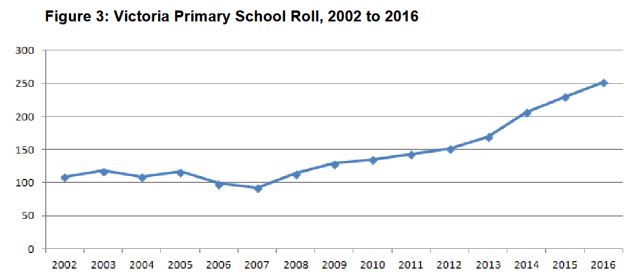
Exhibits in the school’s museum include an old cast school bell (which I am informed is *not* the Victoria bell, but is local).The school celebrated its 150th anniversary in 1994, but its future was still anything but assured. By 1997 the roll was just 131 children and ten years later it dipped below 100. This might have been the end, but salvation came from the sea – or rather by the reclamation of it. Mass house building had been taking place behind the sea wall of Western Harbour since 2003 and as families moved in and children became of school age after 2007 the roll at Victoria began to increase for the first time in decades. It has never looked back; back above 100 in 2008, in 2012 it passed 150 meaning a return to “full stream” – having seven individual classes, one for each age group. The increase was helped by the closure of nearby Fort Primary School in 2010 – a rather short-sighted cost-cutting move, which very quickly precipitated accommodation crises at both Victoria and Trinity Primary Schools!
School roll figures for Victoria Primary, published by the City of Edinburgh Council in a consultation document.As a short term solution four new classrooms were added in a modern building in the playground in 2014 and in 2016 the Council decided to build an entirely new and much larger replacement school. As had always been the case, they looked to reclaimed land for space. The speculative residential development of Western Harbour had largely stalled after the 2008 financial crisis and there was plenty land available and so the new building, on Windrush Drive, is sited on a very generous 14,750 square metre plot – five and a half times that of the old school and over forty times that of the 1844 school! It has a capacity to grow to “three streams” (three primary classes in each of the seven age groups) and is forecast to reach its capacity of 500 within a decade. When the old building closed in 2022 it was by far and away the oldest still in educational use by the city (the next oldest were all 1875 School Board builds).
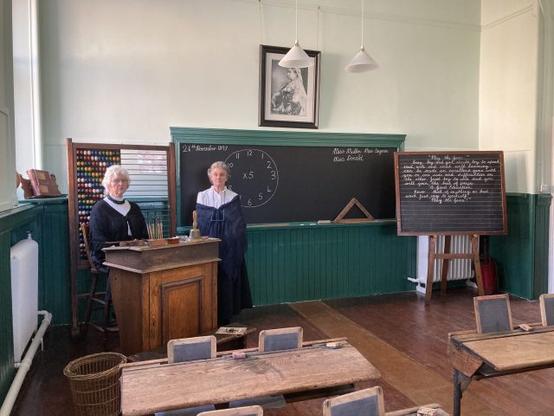
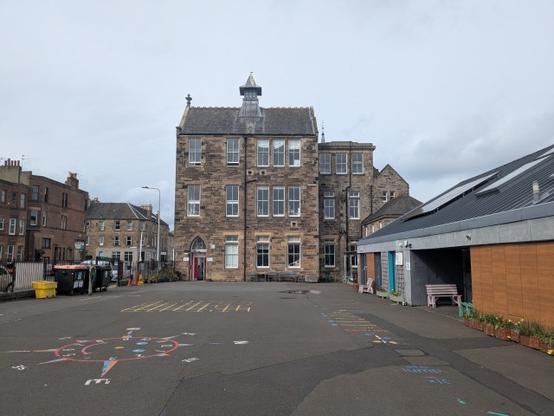
Artist’s impression of the new Victoria Primary School in Western Harbour.Often the future of the old school buildings in Edinburgh is uncertain and they are either left to the vandals or turned over to housing developers. However the old Victoria had a very different prospect when it closed and was taken over by Community Asset Transfer by the Heart of Newhaven Community CIC, funded by the Scottish Land Fund. This preserved the Victorian building and converted it into a mixed-use community centre and base for artists and small businesses. Heritage is one of the Heart of Newhaven’s key founding aims and to this end it maintains the old school museum and houses the History of Education Centre and its Victorian School Room.
The Victorian Classroom in Victoria School, presided over by the eponymous monarch. Via https://www.histedcentre.org.uk who are now based in the building.If you are interested in seeing inside this very interesting old building and its numerous heritage exhibits, there are tours each week that I can highly recommend.
The Heart of Newhaven Community Centre in 2026 on a Saturday open day.Note to readers: unfortunately in April 2026, a third-party plug-in more than exceeded its authority and broke many of the image links on this site. No images were lost but I will have to restore them page-by-page, which may take some time. In the meantime please bear with me while I go about rectifying this issue.
If you have found this site useful, informative or amusing then you can help contribute towards its running costs by supporting me on ko-fi. This includes my commitment to keeping it 100% advert and AI free for all time coming, and in helping to find further unusual stories to bring you by acquiring books and paying for research.
Or please do just share this post on social media or amongst friends and like-minded people, sites like this thrive on being shared.
Explore Threadinburgh by map:
Travelers' Map is loading...If you see this after your page is loaded completely, leafletJS files are missing.
These threads © 2017-2026, Andy Arthur.
NO AI TRAINING: Any use of the contents of this website to “train” generative artificial intelligence (AI) technologies to generate text is expressly prohibited. The author reserves all rights to license uses of this work for generative AI training and development of machine learning language models.
#Edinburgh #Education #FreeChurch #Leith #LeithSchoolBoard #Newhaven #School #Schools #Victorian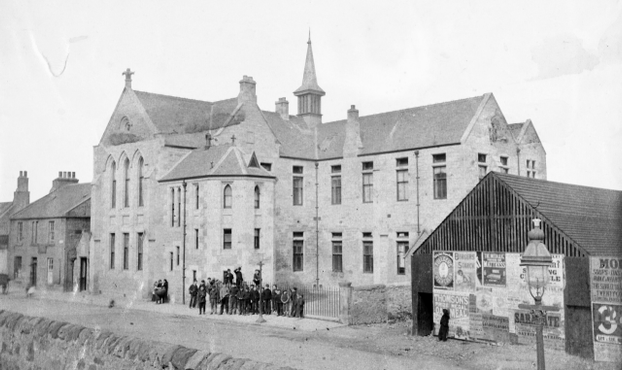
 Jon Bowie
 Kevie 🇬🇧🇨🇾
 Fitheach