Flexoelectricity and surface ferroelectricity of water ice - Nature Physics

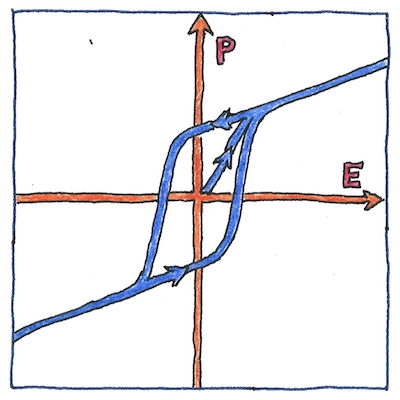
Ice is not piezoelectric, despite the polarity of water molecules, but bending ice may produce electricity. This has now been experimentally demonstrated, with a flexoelectric coefficient comparable to that of common ceramic materials.

Nature
Ah, the "In-Memory Ferroelectric Differentiator" 🚀—because what we truly need is another revolutionary tech that will save the world from its lack of... ferroelectricity? Just don't forget to update that ancient browser of yours, or you'll miss out on all its groundbreaking power 🌐!
https://www.nature.com/articles/s41467-025-58359-4 #InMemoryTech #RevolutionaryInnovation #Ferroelectricity #TechTrends #BrowserUpdate #HackerNews #ngated
In-memory ferroelectric differentiator - Nature Communications

Here, authors develop an in-memory differentiator using a 40×40 array of ferroelectric capacitors. This device efficiently performs real-time differential computation and motion extraction, demonstrating low energy consumption and high operational frequency, with potential applications in edge computing.

Nature
In 1920, Joseph Valasek explained ferroelectricity, the electrical polarization of certain materials. #Poetry #Science #History #Electromagnetism #Ferroelectricity #Valasek (https://sharpgiving.com/thebookofscience/items/p1920c.html)
1920: Ferroelectricity - The book of science

In 1920, Joseph Valasek explained ferroelectricity, the electrical polarization of certain materials.

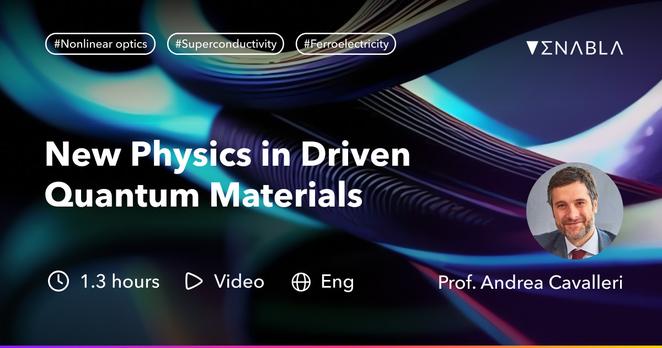
Excited to share a new colloquium by Prof. Andrea Cavalleri, a founding director of the MPI for the Structure and Dynamics of Matter 🎓✨ In his Nordita talk, he explores how coherent electromagnetic radiation can induce unexpected phases like magnetic order, ferroelectricity, and high-temperature superconductivity.

🔗 Watch the lecture here: https://enabla.com/pub/1119/about

Full abstract: In this colloquium, I will discuss how coherent electromagnetic radiation, when tuned to drive collective modes in quantum materials, can be used to induce unexpected dynamical phases. An illustrative set of examples will be discussed for the nonlinear control of the crystal lattice, which is used to induce magnetic order in paramagnetic materials, ferroelectricity in paraelectrics, non-equilibrium superconductivity at high temperatures, and other dynamical phases. These studies open up new directions in fundamental research but also expose a set of phenomena that will inevitably be encountered if one wishes to use quantum materials in ultra-high bit-rate applications.

#QuantumPhysics #QuantumMaterials #NonlinearOptics #Superconductivity #Ferroelectricity #OpenAccess

Enabla: free community-based educational platform

No ads, no fees, just knowledge in a stylish and well-organized form. Enabla is created for the community by the community. Start learning and contributing now

Enabla
Why a Hafnium
Why a no Holmium?😜
Scientists at the Oak Ridge National Laboratory studied hafnia’s potential in semiconductor applications, revealing its behavior can be influenced by the surrounding atmosphere. Their findings offer promising implications for future memory technologies.
https://scitechdaily.com/hafnium-oxide-unraveling-the-secrets-of-next-gen-semiconductors/ #Hafnium #semiconductor #hafnia #memory #Ferroelectricity
Hafnium Oxide: Unraveling the Secrets of Next-Gen Semiconductors

Scientists at the Oak Ridge National Laboratory studied hafnia's potential in semiconductor applications, revealing its behavior can be influenced by the surrounding atmosphere. Their findings offer promising implications for future memory technologies. A team of scientists from the Department of

SciTechDaily
A general theory to realize bilayer stacking ferroelectricity

Two-dimensional (2D) ferroelectrics, planar materials that have a spontaneous and reversible electric polarization, are extremely rare and yet could be extremely advantageous for the development of new nanoelectronics. Due to their ferroelectric properties and thin nature, they could be used to create high-performing, small and flexible devices, including high-density non-volatile memory, optoelectronics, ultra-low energy electronics and wearable technologies.

Phys.org
Discovery of ferroelectricity in an elementary substance

National University of Singapore (NUS) physicists have discovered a novel form of ferroelectricity in a single-element bismuth monolayer that can produce regular and reversible dipole moments for future applications of non-volatile memories and electronic sensors.

Phys.org