aespa’s Ningning Breaks Silence on Fatphobia Allegations Amid Weight Backlash - KpopNewsHub – Latest K-Pop News, Idols & Korean Entertainment

“…regardless of their weight…”

Kpop News Hub

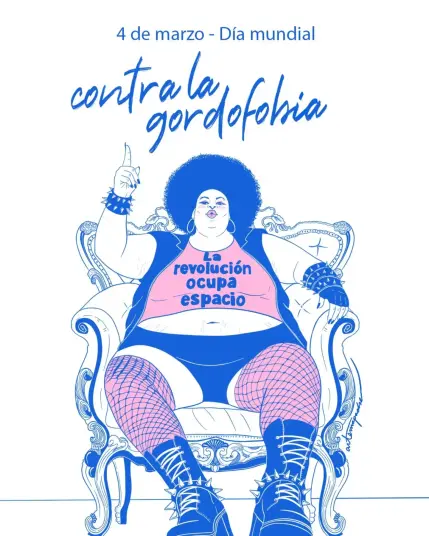
March 4th World Day Against Fatphobia!
Free to be me

#fatphobia

Against the liberalism of "body positivity" we want fat liberation!

“Body positivity individualizes something that is bigger than the individual.”

“What is the utility of "body positivity" if it only seeks to provide one with a false sense of confidence rather than to liberate all from that which cages the body?”

“Insecurities are not a personal indictment; they are an indictment of the World. Being that this is the case, people deemed Ugly should run toward Insecurity. Not as a trauma to inform their politics—as it is dangerous to navigate the world of politics through trauma rather than an informed praxis—but as a political tool that aids in developing their understanding of and relationship to oppressive power structures.”

Da’Shaun Harrison: Belly of the Beast – The Politics of Anti-Fatness as Anti-Blackness

“What we must realize is that it’s not thinness that is being eroticized. What is being eroticized is the submission thinness represents in our culture. Thinness is a secondary characteristic. The true commodity is the willingness of women to acquiesce to cultural control.”

“Dieting is a practice of fatphobia. Dieting is the result of unresolved fatphobia. We become terrified of what it would mean for us to be fat because we understand fundamentally how poorly fat people are treated.”
You Have the Right to Remain Fat by Virgie Tovar

"Why Don’t We Recommend Dieting? The short answer is that intentional weight loss attempts almost never lead to long-term significant weight loss or improvement in health, and often have negative side effects.

Dieting Doesn’t Work
We’re defining “dieting” here as any attempt to manipulate body size through food and/or movement – this would include short-term diets, “fad” diets, diets that eliminate foods, and diets that are referred to as “lifestyle changes.” If the goal is to create weight loss through food and/or movement, it counts!

Dieting Doesn’t Work
While most people are able to lose weight short term, almost everyone gains it back, with up to two-thirds of people gaining back more than they lost. So even if someone believes that becoming thinner would lead to health improvements (and that’s a big “if”) recommending intentional weight loss attempts is the worst possible advice, since it has the opposite of the intended effect the majority of the time.

Weight Cycling Can Be Dangerous
Repeated dieting typically means repeated cycles of weight loss and regain. This is “weight cycling” (sometimes referred to as “yo-yo dieting”) and it comes with its own negative side effects. In fact, the research shows that it is possible that the association between weight and health risk can be better attributed to weight cycling than body size. Weight cycling is associated with a shorter lifespan, and has been shown to increase the risk of diabetes, high blood pressure, high cholesterol, and heart disease.

The Harm of Weight Stigma
Internalized negative attitudes about weight, known as weight stigma, is another mediator between body size and health. Studies show that weight stigma increases the risk of high blood pressure, metabolic syndrome, diabetes, high cholesterol, and eating disorders. This means that placing the focus of medical care on weight management is harmful and has the opposite of its intended effect on health.
Dieting Leads to Eating Disorders
Dieting is one of the most important predictors of development of eating disorders. In fact, prescribing diets often equates to prescribing disordered eating behaviors. Dieting can lead to severe restrictive eating and malnutrition, cycles of starvation and binge eating, as well as other eating disorder behaviors and their medical complications.

Weight loss medications may lead to short-term weight loss, but cause weight cycling in the long run, along with other potential side effects. Weight loss surgeries carry a significant risk of many complications, including death. The research shows that there are more effective ways to positively impact health that do not risk lifelong side-effects.

The evidence that exists around weight and health shows that, understanding that health is not an obligation, barometer of worthiness, or entirely within our control, weight-neutral interventions are health-promoting and carry a much lower chance of negative side effects.

https://haeshealthsheets.com/why-we-dont-recommend-intentional-weight-loss/

#fatphobia #fatliberacion

Weight Loss Is Not a Substitute for Healthcare: Part 1- The Basics

https://weightandhealthcare.substack.com/p/weight-loss-is-not-a-substitute-for

Substituting weight loss for health and/or healthcare accommodation is a primary source of harm enacted on higher-weight people by the healthcare industry. I’ve had a bunch of requests asking me to write about it from a number of perspectives, so I decided to do a series to offer a comprehensive perspective .

This is complicated and there is a lot to discuss so I’m breaking it up into five parts. I want to make help define the problems and draw them into sharp relief both to help readers recognize it and avoid blaming themselves for the failures of healthcare, and so this can be used as a resource to send to people who aren’t getting it. Then, in the final installment of the series, I’ll talk about what can be done. Before I dig into this, I want to say that I’m thrilled you are reading this whether you stumbled onto it or are a free or paid subscriber. Today I also want to offer some extra gratitude to my paid subscribers - a series like this takes a lot of time to create and your support makes this kind of deep dive possible.

Part 1 - The Basics

Part 2 - Denial of Care

Part 3 - Delay of Care

Part 4 - Case Study

Part 5 - What Can Be Done?

The problem that underlies all of this is the idea that healthcare providers/facilities/insurance can/should be able to pick and choose whether they want to accommodate higher-weight people. So much of the healthcare that we receive - tools, techniques, best practices - has been created using research that excluded higher-weight people. There are massive gaps in both healthcare’s knowledge about, and accommodation of, higher-weight bodies. A common justification for this is that higher-weight people can lose weight, and so if they become thin, then they will have access to ethical, evidence-based care and so there is no need to provide ethical, evidence-based care to higher-weight patients.

The idea that higher-weight people can reach whatever weight healthcare wants them to in order to access care is questionable at best (and we’ll discuss that later,) but even if they could, the idea that people do or do not deserve care based on their body size is still horrifying and is still at the root of suffering and even death for higher-weight people.

This has been going on for a long-time - from holding healthcare hostage for a weight loss ransom, to recommending weight loss surgeries for type 2 diabetes in higher-weight patients (when thin patients with the same diagnosis and labs are not asked to take the major risks and life changes of those surgeries), to tools and equipment that aren’t properly rated for higher-weight patients, and more. That said, with the advent of the new generation of GLP-1 weight loss drugs (and their relentless marketing as “miracle” weight loss drugs), I’ve been seeing and hearing about this even more, with providers, facilities, and insurance companies treating these drugs as a substitute for providing proper care to higher-weight people.

I want to be clear that I take a firm view of bodily autonomy in general as well as specific to this situation, I would never shame or blame a patient who attempted to lose weight in order to access healthcare or for whatever their reasons or sincerely held beliefs about weight loss might be. I also take a firm view of what constitutes the ethical, evidence-based practice of healthcare, including informed consent, and that’s where we run into an issue with this substitution of weight loss for healthcare.

One clear and obvious example is BMI-based denials of care. This happens when a patient is told that they cannot have a procedure they need or want (for example joint surgeries, spinal surgeries, or gender affirming care) unless or until they reach a certain BMI or percentage of weight loss.

Rather than creating healthcare for the patients who exist, the suggestion is that higher-weight patients don’t deserve care unless and until they become thinner patients. This also quickly becomes a matter of privilege and resources - a patient’s access to care can determine their fate - some patients can get a procedure and/or accommodation at a BMI at which another patient will be denied. Those with better insurance, the resources and ability to travel etc. have a better chance of accessing care.

The other issue is with accommodation. This occurs when higher-weight patients don’t have access to the same things that thinner patients have. This includes everything from a chair they can sit in, imaging equipment, a bed in the emergency room or hospital, a table in the cath lab, an overbed and/or hoyer lift and/or appropriate staffing ratio to help providers move patients in ways that keep both safe, and more. Higher-weight patients can face a healthcare system that was not built for them. This can also be life or death. I was advocating for a patient meeting with a cardiologist at a very highly-regarded cardiology center. The cardiologist told that patient that if she did have a heart attack, the table in the cath lab was not appropriately weight-rated for the patient and there would be “nothing to do” but medically manage and “watch.” (The facility has since acquired tables rated for higher weight.)

For those who can’t access appropriate, accommodating care, the recommendation is often to lose weight. And I’m using the term “recommendation” loosely here because at this point the patient's healthcare is being held hostage for a weight loss ransom. We have to start and keep asking questions about the ethics of this, the potential coercion (and the ramifications for patients and providers when, for example, a surgeons is being begged by a patient to give them a weight loss surgery that the surgeon knows the patient doesn’t want to have. We have to ask questions about an attitude that the provider/facility/insurance will not treat the patient who exists and needs treatment, and will only treat a hypothetical patient that they believe/hope this patient might possibly become (after enduring difficult and sometimes risky interventions). And if the patient will not subject themselves to the risks of (trying) to become that (thinner) patient, healthcare will allow the patient to suffer and even die and blame the patient.

Certainly the paternalistic and coercive nature of this is a huge issue here, but even if someone believes that weight loss is an appropriate substitute for care or accommodation, there would be some questions they would need to answer around both the denial and delay of care.

#healthselfdefense #fatphobia #medicalfatphobia #fatliberacion

Oh I am, well, pissed is maybe an overstatement, but I am for sure feeling some kind of way.
Once again some grown ass man accosted me verbally about my weight in public, making piggy sounds at me from behind me, on my way *to* the shop I figured hey i probably misheard maybe he was clearing his throat or something don't think too much on it, but the guy was here on the way back from the shop too, and this time he did it louder and for longer and like, at that point any alternative explanation just goes out the window.

Yes my good dude I am a fat white woman with an upturned nose, but I still think I should be able to exist in public without being yelled at or have some other abuse thrown at me. Just like I think everyone should be able to.

It's frustrating because this does happen with some regularity, and it's always the same genre of people too. Teen to early 20s women in groups of two or more, or, much more often, 20s-30s very fashionable and conventionally handsome men.

It's incredibly frustrating having that shit just come out of no where.

#fatphobia

@redsad
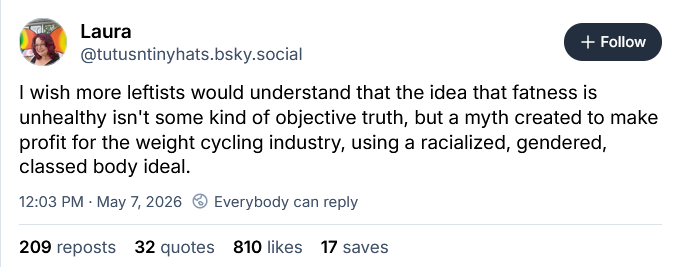
This goes even for horrible people, don't use fatness as your insult or proof that they are horrible! You can actually just name the harm they're doing in the world, leave their bodies out of it! #FatAcceptance #Fatphobia #SeriouslyLiberalsStopDoingThisBullshit #YouTooLeftistsIFuckingSeeYou

OK, Jay has moved on from the cuddly.

In the spirit of cards on the table, last time I checked I was about 337, and I know I'm fucking fat. I know ALL of the consequences of that. I am soaked in the consequences of that, all the time. The most lazy fucking thing you can do as a doctor is to suggest surgery, like literally half a dozen doctors before them. There is a contempt that comes from their #fatphobia that comes from their need to believe that I'm fat because I *deserve* to be fat. Because nobody should want to live and look like me. I am fat, and it horrifies them. They wouldn't want to live like that. They'd risk everything to shed the weight. And they want to get away from you as quickly as possible.

Fuck every "doctor" who collects money for "heath care" and let's their own assumptions about what I must have done to ""deserve" to get fat dictate how much of a shit they give about my situation. Like I said, it's lazy, and the contempt was real.

/5

Like, let's be real. It's hard, with #fatphobia ingrained as deeply as it is, to even ask for help in the first place. by the time I finally got a "tilt-table test", I needed mobility assistance to avoid falling again, no question. But I refused to ask for it, because I was embarrassed. And that is straight up internalized #fatphobia. I tripped over a wheelchair after walking in from the garage, then tried to go to the testing facility, just short way away, by myself in the wheelchair, only to need help navigating the small hill from a passing stranger, again, bless her. And bless the doctor there who did his job without ever letting on that the procedures were different and I couldn't actually use the regular tilt-table, because it's not built for you, fatty.

Anyway, I just wanted an answer. And so the other factor, is the #cannabis. Have I "used" cannabis? Um. I have taken what can fairly be described as an "experimental" dosage of Rick Simpson oil.

3/

I've debated about whether or not to say something publicly about this, because I feel pretty dumb. But ultimately, on the off chance that someone else is dealing with anything like this, I think it's worth some embarrassment to help out.

About 2 1/2 years ago I developed symptoms consistent with #POTS. Basically, as soon as I was standing, my heart rate started to increase. My resting heart rate of about 80 would skyrocket to 120 or 130 within minutes. I would sweat heavily, and before long my legs would start to feel like lead. I had an episode where I collapsed in the hall, and another where I had to call Ivy @jenniferwaltersdances for help to get back to the car. Once I could sit down, I would rebound quickly, but I just couldn't stand, let alone walk, for more than a minute or two without trouble.

Now, to complicate things, I'm also fat. So my first thought, with all the internalized #fatphobia, is that I've got heart failure at age 50.

1/

More than 75% of US adults may meet criteria for obesity under new definition: Study

Only 40% of adults meet criteria for obesity when BMI alone is used. A new definition of obesity could nearly double the prevalence of U.S. adults …

ABC News - Mary Kekatos, Dr. Crystal Richards