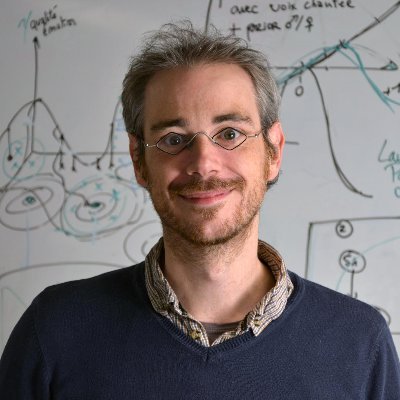
 JJ Aucouturier
# introduction
Hello ! I'm Jean-Julien (JJ) Aucouturier, an academic/neuroscientist based at the FEMTO-ST Institute in Besançon, France. I'm interested in new methods for the analysis of human sensory electrophysiology, and working both with healthy participants and neurological or psychiatric patients. Some of our recent work has involved, for instance, using system identification methods such as reverse correlation to crack how people perceive dominance, trustworthiness or confidence from someone else's voice, and whether people still do that under coma.
#Besançon is really lovely, but I haven't always been here ! I was trained in Computer Science with François Pachet at SONY Computer Science Laboratory in Paris, and was then mentored in cognitive neuroscience at the University of Tokyo with Takashi Ikegami and the RIKEN Brain Science Institute with Kazuo Okanoya. After a decade spent in IRCAM in Paris where I directed the ERC-funded CREAM music neuroscience team, I'm now Directeur de recherche CNRS (equiv. Full Professor) at the FEMTO-ST Institute (CNRS/Université de Bourgogne Franche-Comté) in Besançon.
Lab website: https://neuro-team-femto.github.io
I'm happy to find a new online home here and to reconnect with you guys in a way that, hopefully, will work better for all of us !
#neuroscience #neurology #acoustics #python #openscience #cnrs #cogsci #cognition #consciousness #coma #femtost
 CNRS
CNRS