Ōrawia & Scott's Gap - District Settlers, Moffat Family, WW1 Memorial Entry; Unk... on eHive
Photo's & Records of Harry Moffat from Ōrawia & Scott's Gap, WW1:
1. News clipping of Harry from an unknown newspaper, from family, Pvt. Harry Moffat, KIA in WW1.
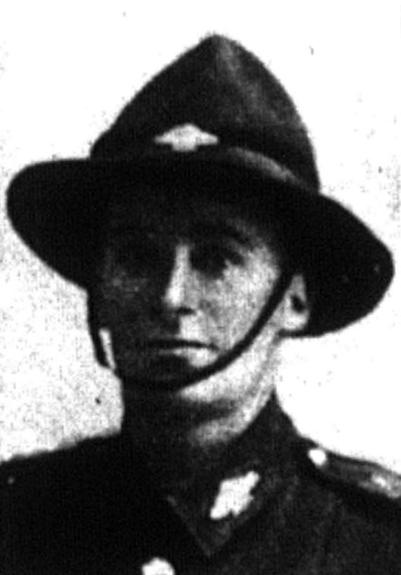
2. Photo of Harry's headshot, unknown source, from family, Pvt. Harry Moffat, KIA in WW1.
3. Photo from the family files, Pvt. Harry Moffat, KIA in WW1.
4. Copy of Harry's letter to his mother from the family, WW1.
5. Printed transcription of Harry's letter to his mother, by our Archivist.
6. Typed up sheet commemorating Harry's Service, compiled by our Archivist from information from the Auckland War Memorial Museum.
7. Ōrawia District Soldier's Memorial photo showing Harry Moffat's name.
8. Ōtautau District Soldier's Memorial photo showing Harry Moffat's name.
9. Anglican Church of Ōtautau (St. Andrew's) Roll of Honour board showing Harry Moffat's name, taken by Digitising Archivist, Suzie Best
Harry was born at Scott's Gap in 1891 and received his education at both Scott's Gap and Ōrawia schools. At age 17, he moved to Te-Ika-a-Maui North Island to be with older brother Oliver, where they both worked in the timber milling industry here. Oliver also served in WW1.
It is recorded that Harry was engaged to a Miss Carpenter in 1913, but with WW1 happening soon afterwards, their wedding plans were then delayed as Harry went off to fight, joining the Taranaki Company of the Wellington Infantry Regiment with the NZEF as an early volunteer. He wrote to his mother about his volunteering, saying he was one of only two volunteers who had been in the territorials who were over the age of 20, as requested. Harry enlisted under the command of Lieutenant Colonel William Malone and his army number was 10/1173.
Harry was enlisted as a Private on 25 August 1915 at Awapuni Camp in Palmerston North. Prior to this, he had been part of the Territorial's for 4 years, obtaining the rank of Corporal while there. Interestingly, Harry’s record shows that he had originally registered for compulsory military training at the saw milling town of Taurangarere, by Taihape.
Harry left Aotearoa New Zealand with the NZEF Main Body on 16 October 1914, via Hobart, Albany in Western Australia, and passing through Colombo and Aden before stopping in Alexandria, Egypt on 3 December. During the voyage, it had been decided that the ANZAC force would stop in Egypt to train. Harry wrote his mother about this.
By the end of 1914 Harry had begun his desert warfare training in Egypt and from there it was off to fight in the Gallipoli Campaign, where Harry was wounded on his second day in the fighting. After receiving wounds in battle, Harry was admitted to 15th General Hospital in Alexandria on 30 April 1915, He was discharged again on 8 May. Apparently, his mother initially received a telegram saying he was dead. His being wounded was reported in the Otautau Standard newspaper’ a number of times during May and June 1915. Harry then rejoined his unit again on 30 June. During this time was when a photo of Harry also appeared in the Otago Witness newspaper, on 9 June 1915, and this is believed to be the headshot in the family collection.
In a sad twist of fate, Harry's mother Catherine had been sent a telegram saying Harry had been killed in battle when the above transpired. Later, Harry wrote to her (see letter attached to this archive entry), saying how sorry he was that she got such a fright from being told he had been KIA when he had only been wounded. Tragically, Harry was indeed to die soon after this letter was sent to his mother, on 7 August 1915. What horrendously bad luck for this to happen.
In the infamous assault on the hill Chunuk Bair, where the Wellington Battalion was held up on 7 August, is when Harry lost his life. It is most probable that Harry was also hit while the bulk of the New Zealander's were situated there. In, ‘The Wellington Regiment NZEF 1914-1919’, book it states: that at the Apex, on 7 August “sniping and machine-gun fire [from the Turks] had commenced and casualties were constantly occurring among the troops on the hillside.” Quoted.
In Harry’s military file, it says under 8 August that he was wounded in action on 7 August, and this was later confirmed as "believed dead". Harry is commemorated at Embarkation Pier Cemetery, where he is named on Special Memorial C 62. The gravestone reads “believed to be buried in this cemetery” and 8 August 1915 is the date shown on this memorial. Of special note is that Harry was buried in a cemetery, meaning either he was wounded in action and returned to the beach before dying, or that his body was later recovered and identified.
Allied Troops were finally evacuated from Gallipoli in December 1915. It is noted in Harry’s military file that the finding of the Board of Enquiry, although not until 16 January 1916, that he was “now believed to be dead”, “On or about 7 August”, of “Cause unknown”. This message was also was cabled from Alexandria on 24 January 1916. Nowhere on his army file at all, is it mentioned where he was buried.
A death notice for Harry was then published in the Otautau Standard newspaper on 15 February 1916, reading: “Moffat – Killed in action at the Dardanelles, 8th August, 1915, Harry, youngest son of Mrs C.S. Moffat, Orawia, age 23 – For the Empire’s sake.” Although it is of note that Harry was actually 24 years old when he died. What anguish so many parents and siblings must have gone through with so long of a wait between the battle and soldier's deaths, to having this confirmed.
However, even if buy chance Harry had not been wounded on 7 August, tragically, it is unlikely that he would have escaped being wounded or killed on 8 August on Chunuk Bair anyway. When Chunuk Bair returned to enemy hands a couple of days later after the his Wellington Battalion that Harry was serving in was decimated: only around 80 out of 800 were still alive and unwounded. What dreadful odds of survival.
What is more, the majority of New Zealanders who died there have no known grave and are commemorated on NZ Memorial to The Missing. Of this battle, Harry is one of the few who has an individual memorial or gravestone. Harry is one of only six from the Wellington Battalion killed in action on 7 August, rather than 8 August. However, there are conflicting dates of Harry's death. 7 August is mentioned by the following sources: Wellington Regimental Roll of Honour (KIA), Auckland War Memorial Museum Cenotaph Database (KIA), also his Parents’ gravestone which says“Killed at Gallipoli”, and his military service file. His Death Certificate itself states that he was Killed in Action “on or about 7 August”. Whereas the 8 August date is mentioned by the following places: Commonwealth War Graves Commission website, and Harry's Special Memorial at Gallipoli. We used the 7 August date for this memorial entry in Harry's honour, as that has most sources.
Harry's other brothers, Norman and Oliver, also from Ōrawia. also served in WW1, but thankfully returned home, even though both were injured, Oliver not so badly, but Norman was invalided out in 1917. Oliver Army number #11501 enlisted with the NZEF in the 12th Reinforcements and joined a machine gun section in the 3rd Auckland Company of the 2nd Auckland Infantry Battalion. While Norman Army number #39413 enlisted with the 24th Reinforcements and was also with a machine gun section. More can be seen about Norman's later history in CWA.004.2, as he bought a farm in the local area, which until recently (2022) was still farmed by a grandson of his.
NOTE: I am indebted to the Moffat family descendants, who have so generously and willingly shared their interesting family history with us. I would also like to especially note Phil O'Malley's history of Henry and his family for providing some of the details used in this entry above.
The photos and letters of Harry Moffat are from the family collection. The Soldier Memorial photos showing Harry's name are thanks to our Digitising Archivist for this online project. This whole archive entry is a memorial to Harry Moffat's bravery and subsequent loss of life, so if anyone in the family has more information to add to this, please let us know. Your photos, reports, letters and comments can be added in.
 Central & Western Archive/GLAM