
CRTI = R̂ / Ί couples recovery dynamics with covariance geometry 
 and detects fold-type transitions earlier while correctly failing outside its domain. Preprint (open access): doi.org/10.5281/zeno... 🖖 #CRTI #ComplexSystems #EarlyWarningSignals #NonlinearDynamics #EWS #SystemsScience 🖖

Compression–Response Transitio...
Compression–Response Transition Index (CRTI): A Mechanism-Specific Early Warning Signal for Fold-Type Critical Transitions

This preprint introduces the Compression–Response Transition Index (CRTI), a bivariate early warning signal designed for detecting fold-type critical transitions in multivariate dynamical systems. The index is defined as T = R̂ / Ί, coupling a recovery-rate proxy derived from the autocorrelation structure (R̂) with a spectral concentration measure Ί = λ₁ / \sum_i λ_i, representing the dominance of the leading covariance mode.   Unlike classical early warning indicators based on variance or autocorrelation alone, CRTI explicitly integrates structural and dynamical information and is equipped with a validity gate via the Structural–Dynamic Separability (SDS) condition. The framework is mechanism-specific, with explicit boundary conditions covering Hopf bifurcations, noise-induced transitions, projection-induced distortion, and reflexive systems.   Simulation results demonstrate that CRTI provides earlier and more robust detection of fold bifurcations compared to AR(1) and variance-based indicators, while correctly failing outside its domain of validity. An empirical evaluation on the Peter Lake ecosystem dataset, based on a pre-registered protocol, supports the theoretical predictions.   CRTI is presented as a diagnostic instrument with explicitly defined scope, not as a universal early warning signal.     CRTI, early warning signals, critical transitions, fold bifurcation, multivariate time series, covariance structure, autocorrelation, spectral concentration, complex systems, nonlinear dynamics

Zenodo
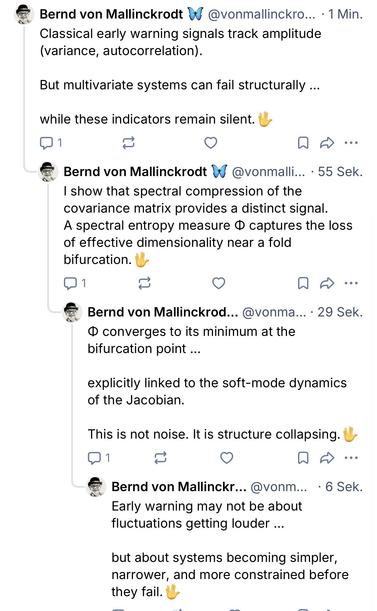
If collapse is geometric, not just stochastic 
 then we may have been measuring the wrong dimension all along. #EWS #CRTI doi.org/10.5281/zeno... 🖖
What if systems don’t fail when variance increases, but when they quietly lose their ability to respond? This paper introduces Structural–Dynamic Decoupling as a complementary early warning mechanism beyond classical #EWS. doi.org/10.5281/zeno... 🖖

Structural–Dynamic Decoupling ...
Structural–Dynamic Decoupling as an Early Warning Mechanism in Organizational Systems: A CRTI-Based Observational Framework

This preprint introduces Structural–Dynamic Decoupling (SDD) as a proposed mechanism of organizational failure, extending the Compression–Response Transition Index (CRTI) into an observational diagnostic framework. While classical early warning signals (EWS), such as rising variance, increased lag-1 autocorrelation (AR(1)), and critical slowing down (CSD), rely on statistical properties of time-series data, many organizational systems exhibit instability through a qualitatively different pathway: a silent loss of responsiveness under conditions of maintained or even reinforced structural coherence. The framework defines four observable dimensions—structural coherence (Ί), response capability (R), narrative consistency (N), and field stability (M)—and formalizes the diagnostic relation T = R / Ί. Structural–Dynamic Decoupling is defined as the condition dΊ/dt ≄ 0 ∧ dR/dt < 0, implying a systematic decline in T preceding transition. CRTI is explicitly positioned as a complementary diagnostic layer, not a replacement for classical EWS methods. It is designed for hierarchical and institutionalized systems in data-sparse contexts, where quantitative time-series approaches are not feasible or reliable. A structured observational protocol is proposed, along with a detailed discussion of domain of validity, limitations, and open empirical questions. The framework is presented as a conceptual contribution intended to generate testable hypotheses and to support real-time diagnostic reasoning in complex organizational environments. CRTI, structural dynamic decoupling, early warning signals, complex systems,organizational systems, system collapse, resilience, critical transitions,observational diagnostics, socio-technical systems, qualitative methods

Zenodo
Wenn Systeme nicht kollabieren, weil etwas passiert 
 sondern weil sie lĂ€ngst aufgehört haben, sich anzupassen 
 warum messen wir Krisen noch immer an LĂ€rm statt am #VerlustVonFreiheitsgraden? A structural perspective on early warning signals: doi.org/10.5281/zenodo.19385885 #CRTI #EWS #Complex🖖

Structural Compression as an E...
Structural Compression as an Early Warning Signal Beyond Critical Slowing Down

Early warning signals (EWS) for critical transitions are traditionally based on dynamical indicators such as rising variance and autocorrelation, commonly associated with the phenomenon of critical slowing down (CSD). However, these indicators are mechanism-dependent and may fail in multivariate systems where structural changes precede observable dynamical signatures. This work introduces structural compression as an alternative early warning signal, operationalized via the spectral effective rank of rolling covariance matrices. The proposed metric captures the reduction of effective degrees of freedom in complex systems, reflecting an increasing coupling and loss of independent modes prior to regime shifts. Using a controlled multivariate Ornstein–Uhlenbeck (OU) framework, we demonstrate that structural compression provides a significantly earlier and more robust signal of impending transitions compared to classical variance-based indicators. The approach is particularly suited for high-dimensional systems where collapse is driven by endogenous structural reorganization rather than exogenous shocks. Boundary conditions and limitations are explicitly discussed, including cases where structural compression is not expected to provide reliable signals (e.g., oscillatory instabilities, isotropic noise regimes). The results suggest that incorporating structural metrics can substantially improve early warning detection in complex adaptive systems across domains such as ecology, finance, and socio-technical systems. This preprint aims to contribute to the ongoing development of next-generation early warning frameworks beyond critical slowing down. early warning signals, critical transitions, structural compression, spectral entropy, effective rank, covariance structure, complex systems, multivariate dynamics, critical slowing down, Ornstein–Uhlenbeck process

Zenodo
Wir messen #Krisen an dem, was sichtbar eskaliert 
 aber was, wenn das Entscheidende lĂ€ngst unsichtbar verloren ging? Beginnt Kollaps vielleicht dort, wo ein System leise seine Freiheitsgrade verliert? doi.org/10.5281/zeno... #CRTI #ComplexSystems #EWS 🖖

Structural Compression as an E...
Structural Compression as an Early Warning Signal Beyond Critical Slowing Down

Early warning signals (EWS) for critical transitions are traditionally based on dynamical indicators such as rising variance and autocorrelation, commonly associated with the phenomenon of critical slowing down (CSD). However, these indicators are mechanism-dependent and may fail in multivariate systems where structural changes precede observable dynamical signatures. This work introduces structural compression as an alternative early warning signal, operationalized via the spectral effective rank of rolling covariance matrices. The proposed metric captures the reduction of effective degrees of freedom in complex systems, reflecting an increasing coupling and loss of independent modes prior to regime shifts. Using a controlled multivariate Ornstein–Uhlenbeck (OU) framework, we demonstrate that structural compression provides a significantly earlier and more robust signal of impending transitions compared to classical variance-based indicators. The approach is particularly suited for high-dimensional systems where collapse is driven by endogenous structural reorganization rather than exogenous shocks. Boundary conditions and limitations are explicitly discussed, including cases where structural compression is not expected to provide reliable signals (e.g., oscillatory instabilities, isotropic noise regimes). The results suggest that incorporating structural metrics can substantially improve early warning detection in complex adaptive systems across domains such as ecology, finance, and socio-technical systems. This preprint aims to contribute to the ongoing development of next-generation early warning frameworks beyond critical slowing down. early warning signals, critical transitions, structural compression, spectral entropy, effective rank, covariance structure, complex systems, multivariate dynamics, critical slowing down, Ornstein–Uhlenbeck process

Zenodo
Ein #System, das nur funktioniert, solange nichts schiefgeht, ist nicht stabil 
 es ist bereits im Kollapsmodus. Gilt das nicht auch fĂŒr MĂ€rkte, Organisationen und ganze Gesellschaften? doi.org/10.5281/zeno... #CRTI #ComplexSystems #EWS 🖖

Structural Compression as an E...
Structural Compression as an Early Warning Signal Beyond Critical Slowing Down

Early warning signals (EWS) for critical transitions are traditionally based on dynamical indicators such as rising variance and autocorrelation, commonly associated with the phenomenon of critical slowing down (CSD). However, these indicators are mechanism-dependent and may fail in multivariate systems where structural changes precede observable dynamical signatures. This work introduces structural compression as an alternative early warning signal, operationalized via the spectral effective rank of rolling covariance matrices. The proposed metric captures the reduction of effective degrees of freedom in complex systems, reflecting an increasing coupling and loss of independent modes prior to regime shifts. Using a controlled multivariate Ornstein–Uhlenbeck (OU) framework, we demonstrate that structural compression provides a significantly earlier and more robust signal of impending transitions compared to classical variance-based indicators. The approach is particularly suited for high-dimensional systems where collapse is driven by endogenous structural reorganization rather than exogenous shocks. Boundary conditions and limitations are explicitly discussed, including cases where structural compression is not expected to provide reliable signals (e.g., oscillatory instabilities, isotropic noise regimes). The results suggest that incorporating structural metrics can substantially improve early warning detection in complex adaptive systems across domains such as ecology, finance, and socio-technical systems. This preprint aims to contribute to the ongoing development of next-generation early warning frameworks beyond critical slowing down. early warning signals, critical transitions, structural compression, spectral entropy, effective rank, covariance structure, complex systems, multivariate dynamics, critical slowing down, Ornstein–Uhlenbeck process

Zenodo
Was, wenn Systeme nicht kollabieren, weil etwas passiert 
 sondern weil sie vorher aufgehört haben, sich anzupassen? Wenn der eigentliche FrĂŒhindikator nicht LĂ€rm, sondern stille strukturelle Verengung ist 
 worauf schauen wir eigentlich? doi.org/10.5281/zeno... #CRTI #ComplexSystems #EWS 🖖

Structural Compression as an E...
Structural Compression as an Early Warning Signal Beyond Critical Slowing Down

Early warning signals (EWS) for critical transitions are traditionally based on dynamical indicators such as rising variance and autocorrelation, commonly associated with the phenomenon of critical slowing down (CSD). However, these indicators are mechanism-dependent and may fail in multivariate systems where structural changes precede observable dynamical signatures. This work introduces structural compression as an alternative early warning signal, operationalized via the spectral effective rank of rolling covariance matrices. The proposed metric captures the reduction of effective degrees of freedom in complex systems, reflecting an increasing coupling and loss of independent modes prior to regime shifts. Using a controlled multivariate Ornstein–Uhlenbeck (OU) framework, we demonstrate that structural compression provides a significantly earlier and more robust signal of impending transitions compared to classical variance-based indicators. The approach is particularly suited for high-dimensional systems where collapse is driven by endogenous structural reorganization rather than exogenous shocks. Boundary conditions and limitations are explicitly discussed, including cases where structural compression is not expected to provide reliable signals (e.g., oscillatory instabilities, isotropic noise regimes). The results suggest that incorporating structural metrics can substantially improve early warning detection in complex adaptive systems across domains such as ecology, finance, and socio-technical systems. This preprint aims to contribute to the ongoing development of next-generation early warning frameworks beyond critical slowing down. early warning signals, critical transitions, structural compression, spectral entropy, effective rank, covariance structure, complex systems, multivariate dynamics, critical slowing down, Ornstein–Uhlenbeck process

Zenodo
If early warning signals depend on how we observe a system, are we detecting the system 
 or our projection of it? Maybe the real signal is not noise, but the structure we fail to see. #CRTI #ComplexSystems #EWS 🖖
Awesome. @grommunio latest versions work so well with #EWS that setting up @mozilla @thunderbird is set up in little more than 30 seconds, even if you are as slow as I am. Here's a video from my Linux Desktop. #opensource #linux #exchange #migration. see it at #GLT26 in Graz next week.
Happy Easter!
Most #EWS track dynamics (variance, autocorrelation). What if collapse begins earlier 
 when systems quietly lose their #DegreesOfFreedom? I introduce framework separating structural compression (Ω) from adaptivecapacity (R), showing when classical signals fail & why. doi.org/10.5281/zeno... 🖖

A Unified Framework for Struct...
A Unified Framework for Structural Early Warning Signals: Decoupling Compression and Adaptive Capacity in Complex Systems

This work introduces a unified framework for analyzing early warning signals (EWS) in complex systems by explicitly separating structural compression (Ί) from adaptive capacity (R) as independent dimensions of system stability.   Classical early warning signals are primarily based on dynamical indicators such as variance and lag-1 autocorrelation, reflecting the phenomenon of critical slowing down. While effective in certain regimes, these indicators implicitly assume that instability is driven by dynamical amplification. This framework addresses a complementary failure mode: the gradual reduction of independently accessible degrees of freedom in the system’s state space.   Structural compression (Ί) is defined via the spectral entropy of the covariance matrix, capturing changes in the effective dimensionality of system behavior. Adaptive capacity (R) is operationalized as a recovery-rate-based measure, defined as R = 1 - \mathrm{AR}(1), reflecting the system’s responsiveness to perturbations. The resulting viability index T = R / \Phi provides a combined diagnostic perspective on stability.   A central contribution of this work is the identification of mechanism-dependent regimes governing the relationship between structural and dynamical indicators. In Relaxation–Coupling Failure Mode (RCFM), structural and dynamical properties are intrinsically coupled, limiting the additional value of structural indicators. In contrast, Structural–Dynamic Separability (SDS) describes systems in which structural compression and dynamical behavior evolve independently. In these regimes, structural compression can decline prior to observable increases in variance, providing earlier warning signals of instability.   This framework does not aim to replace classical early warning signals but rather to define the conditions under which structural indicators provide complementary and potentially earlier insight into system collapse. The approach is applicable to a wide range of domains, including ecological, socio-technical, and engineered systems, where structural constraints may precede observable dynamical instability.   Early Warning Signals Critical Transitions Complex Systems Structural Compression Adaptive Capacity   Covariance Structure Spectral Entropy Effective Rank AR(1) Stability Analysis   Mechanism-Dependent Regimes Structural–Dynamic Separability Relaxation–Coupling Failure Mode System Collapse Multivariate Dynamics  

Zenodo