 Mex's Articles and Reviews
ARE QUAD-CORE CPUS OBSOLETE IN 2026?
People have been doubting the capabilities of quad-core CPUs for several years now. But are quad-core CPUs really obsolete today or are they still worth their sand? And we’re not talking about those fancy CPUs with hyper-threading, but the more modest ones that only feature four physical cores and four threads.
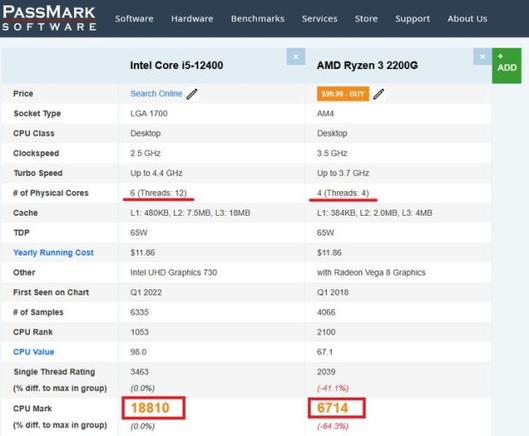
When it comes to computer parts’ performance, most people measure how good their hardware is by running benchmark programs like Cinebench, 3DMark or PassMark PerformanceTest. And when they see high numbers, they get excited. While it is true the higher the number, the better, benchmark scores don’t tell the whole story and they have to be correlated with real-world scenarios in order to mean something for each computer user. For instance, at a quick glance on Passmark’s website, we may see that a 12th gen Intel i5 got a score of around 19000 points, while an AMD Ryzen 3 2200G only reached around 7000 points. That’s a 64% difference in favor of the newer CPU, but what does that really mean for PC users? Are quad-core CPUs still usable today?
Well, let’s start with basic tasks that average users would expect to be able to do on their PC. I’m referring to things like booting up the operating system, opening up programs, web surfing, opening e-mails, editing documents and watching videos. Such tasks don’t require that much CPU processing power and quad-core CPUs have enough power to do all that effortlessly and provide users with a responsive experience. To give an example, an AMD Ryzen 3 2200G CPU can open Firefox in about 3 seconds, while a more powerful Intel Core i5 12400 can do it in 2 seconds. Not much to complain about, I’d say. Moreover, an AMD Ryzen 3 2200G PC can boot up in 10 seconds, provided we’re using a reasonably fast SSD, it can easily play videos at 4K resolution and open PDF files almost instantaneously in Foxit Reader, even if they have over 600 pages. It’s so impressive, that you may ask why bother to upgrade to a more modern 6 core 12 threads CPU, if a quad-core CPU is so responsive.
However, if we add archiving programs to the mix, the ground may start shaking a bit for quad-core CPUs. For instance, while an AMD Ryzen 3 2200G can compress a 346MB file in 30 seconds, an Intel Core i5 12400 can accomplish the same task in almost half that time. In addition to that, if we try to open a 300 pages Microsoft Word document on an AMD Ryzen 3 2200G it may take a full minute, while an Intel Core i5 12400 manages to open it in 36 seconds. That’s a 40% difference in favor of the modern Intel CPU. Some may say that’s a lot, while others may consider the difference not that significant.
Image by Mila Okta Safitri from Pixabay
But, what users should ask themselves is how often do they need to open 300 pages documents or compress large files, because if the answer is once in a blue moon, they won’t really mind the performance difference between an old quad- core CPU and a modern six-core CPU. In the end, it’s about expectation and moderation.
Nevertheless, the above scenarios are barely enough to form a valid opinion on quad-core CPUs. On one side, it’s great that quad-core CPUs are still pretty snappy in day to day tasks, but on the other hand there are plenty of people who also use PCs for more advanced tasks like video encoding, 3D modeling, making games and playing games. So, we have to figure out how quad-core CPUs handle those.
First, video encoding is something single-core CPUs always had trouble dealing with. It’s useful for decreasing file size of videos, but if it takes an eternity to get the job done, we might as well forget about it. As far as I know, it would take hours to encode a 24 minute video on a single-core CPU. So, achieving the same task in about 17 minutes, on an AMD Ryzen 3 2200g CPU, may seem pretty remarkable. Still, if we consider the fact that Intel Core i5 12400 can do it in six minutes, then quad-core CPUs may appear to be the new single-core CPUs. But, it’s not the end of the world, because there’s the alternative of GPU encoding that can speed thing up, provided we have a capable GPU in our PCs.
Anyway, shifting our focus to 3D modeling, I must say I model quite often in Blender on an AMD Ryzen 3 2200G PC and don’t really have much to complain about. My computer doesn’t get sluggish even after populating my 3D world with several objects, texture painting stuff and making basic animations. Although, it’s worth noting that most of the time, I model stuff for video games, which implies not going overboard with the polygon count.
In any case, the thing quad-core CPUs struggles with, when it comes to Blender, is rendering images using the Cycles renderer. This can be worked around by using a powerful GPU for rendering or switching to the EEVEE renderer, which doesn’t look as good, but it sure is faster. In order to understand how much of a difference a 6 core 12 threads CPU makes in the Cycles renderer, compared to a 4 core 4 threads CPU, I rendered a 1024×1024 scene with 100 samples. The scene was done in 1 min 31 sec on the former CPU and 4 min 52 sec on the latter. That’s quite the difference, yet we shouldn’t neglect that apart from rendering using the Cycles renderer, quad-core CPUs can do a good job at 3D modeling.
Moving on, I must say I’ve learnt programming in Godot a few years ago on an AMD Ryzen 3 2200G. And I still use this CPU today for programming 3D video games, with no issues, provided I keep the scenes fairly simple. In any case, when we talk about programming video games, the key is to choose the right software for your PC. For instance, I wouldn’t even dream installing something like Unreal Engine 5 on my AMD Ryzen 3 PC. But, Godot works rather well on it.
Last, but no least, there’s the matter of playing video games on a quad core CPU. In fact, this may the main thing that made people complain about quad core CPUs’ potential or… lack of. The truth is that there are plenty of video games that can be enjoyed on quad core CPUs. Even emulators have respectable performance on those CPUs, so the game library gets even broader. We can also play Xbox 360 video-games on something like an AMD Ryzen 3 2200G.
However, the Achilles’ heel of quad-core CPUs are some AAA games from recent years. It’s either those CPUs don’t have enough processing power for such games, they may lack certain sets of instructions or such modern AAA games are straight poorly optimized. So, it’s more a matter of software that lets down quad-core CPUs and not vice-versa.
All in all, I would say quad-core CPUs are still usable in 2026. While they’re no longer the latest and greatest piece of tech, they’re snappy enough in everyday tasks like surfing the internet and editing documents and they can also offer a decent user experience when it comes to things like 3D modeling and programming, provided they’re not pushed too hard. Obviously, 6 core 12 threads CPUs are more desirable, but I believe there’s still a place for the good old quad-core CPUs.
Mex
#article #benchmark #CPU #entertainment #evolution #technology #tipsOnComputers


 Ancient Origins
 DB 🌱💦
DB 🌱💦

 Science Newsroom - FSE - UG
 News-Cafe.eu blog


 Michael Adzema