Venice of the North.

A throw back from a few years ago.

#amsterdam #dutchhouses #canals #canalhouses #boats #netherlands #cityonwater
Frisch gewaschen. #Friesland #dutchhouses

i29 enlivens 17th-century canal house in Amsterdam with pops of colour

Bursts of blue and green appear inside this centuries-old canal house in Amsterdam that has been renovated by local architecture studio i29.

i29 worked alongside a team of specialists for more than two years to revive the three-floor home, which had been severely neglected since its construction in 1675.

It now features a sequence of bright, white-painted living spaces with colourful interventions that the studio hopes will bring an "unexpected" quality to the interior.

The house dates back to 1675

The ground floor of the house accommodates the kitchen, which has a long oak wood counter running down its centre.

One half of the counter serves as a dining table, while the other half has a stove, sink, and counter space where meals can be prepared.

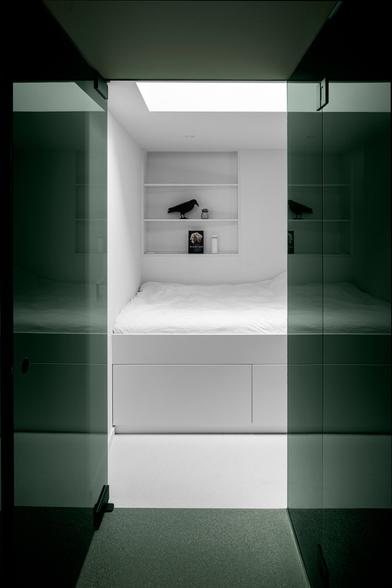
A green volume containing a guest room has been introduced in the kitchen

Just beyond the counter is a glossy, forest-green volume that conceals a guest bedroom, complete with its own en-suite bathroom and access door to the garden.

Towards the other end of the kitchen is an oak-lined stairwell stained dark grey. After the first few steps is a small landing that has been turned into a cosy seating nook.

Just a few furnishings are in the home's living room

The steps eventually leads up to the first-floor living area, which has been minimally finished with a sofa, armchair and an amorphous white pendant lamp.

A wall here has also been lined with greige acoustic fabric.

A bookcase can be pushed back to reveal a secret snug

At the rear of the room is what appears to be a simple bookshelf, but it's actually a secret door.

When pushed back, it reveals a serene, deep-blue snug where inhabitants can go to read and relax during the day.

All surfaces in the snug are a calming shade of blue

A study is also included on his level of the house.

While a majority of the space is grey, a segment of the ceiling, floor and walls has been painted sage green, as has the room's desk and lamp.

Part of the study is painted sage green

The entirety of the third floor is dedicated to the sleeping quarters, which i29 has designed to "radiate comfort and luxury like a true hotel experience".

At the heart of the room is a shiny enclosure that contains the stairwell, and a shower cubicle with two-way mirror walls that allow views out to the canal that runs in front of the house.

A bedroom sits beneath the house's pitched roof

To one side of the enclosure lies the bedroom, set under the peak of the house's original pitched roof.

On the other side is the bathroom, complete with a Japanese-style wooden tub and standalone sink.

A Japanese-style tub and sink feature in the bathroom

i29 is no stranger to using bold hues; the studio recently designed a dentist in Amsterdam that features khaki-green communal areas and fresh white treatment rooms.

In 2020 the studio also revamped the Dutch capital's esteemed Felix Meritis building, finishing its interiors with blue ombre walls, cherry red furnishings and sunshine-yellow seating booths.

Photography is byEwout Huibers.

Project credits:

Restoration: Kodde
Contractor: G.K. Visbeen & Co
Interior builder: Schneider Interieurbouw

The post i29 enlivens 17th-century canal house in Amsterdam with pops of colour appeared first on Dezeen.

#residential #all #interiors #amsterdam #netherlands #houses #i29 #renovations #dutchhouses

i29 enlivens 17th-century canal house in Amsterdam with pops of colour

Bursts of blue and green appear inside this centuries-old canal house in Amsterdam that has been renovated by local architecture studio i29.

Dezeen

Thermo-ash cladding gives tone and texture to Dutch forest house

Dezeen promotion: wooden cladding and decking brand Thermory's thermo-ash cladding wraps the interior and exterior of a contemporary country home in the Netherlands designed by Maas Architecten.

Modern House by the River is a family residence located in a forest clearing on the edge of the river IJssel in Gelderland.

Maas Architecten chose to use Thermory's wooden cladding both inside and outside, to help the house fit into its woodland setting.

The house is made up of three single-storey volumes

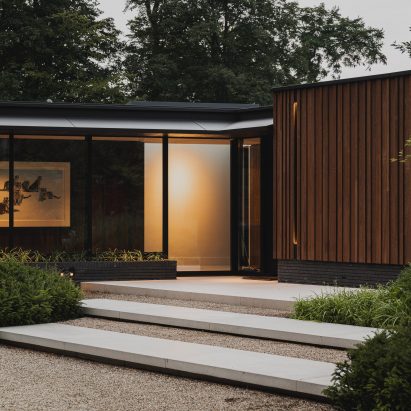
The thermo-ash cladding gives a rich brown tone to walls and ceilings. It is contrasted by crisp white surfaces that help to create a balance of light and dark.

"The deep brown tone and texture of the timber cladding contrast beautifully against the white facade, floor-to-ceiling windows, and the lush green surroundings," said Thermory.

Timbers of varying thickness give texture to the exterior walls

The house takes its cues from modernist architecture, and is made up of three flat-roofed, single-storey volumes.

To negotiate the slope of the landscape and allow room for a basement, one of these volumes is set slightly lower than the others, giving a more dynamic quality to the layout of the interior.

The ash surfaces continues inside the house

The largest of the volumes is rendered white while the other two are wrapped in the ash cladding, which features various thicknesses to give it a more textural quality.

This cladding is designed to provide a protective outer skin. Not only is ash a highly durable wood, it has been thermally treated to give it an extra layer of stability.

"Thermal modification enhances wood using heat and steam," said the brand. "During the thermal modification process, the wood's density decreases and its structure changes, which gives thermally modified wood products many advantages: increased dimensional stability, increased biological resistance, better heat and sound insulation, lighter weight, and moreover, it is a chemical-free process."

The house is organised over a split-level floor plan

For the interior, which was designed by Amsterdam-based design studio Grand&Johnson, it is the same two volumes that are lined with wood. The aim was to create a feeling of continuity between inside and out.

Clever joinery helps to give depth to the surfaces, many of which integrate doorways and storage spaces. There are also some slatted areas, which offer variety.

Shelving and storage are set into recesses within the wooden wall surfaces

The darkness of the wood is complemented by large pale-toned floor tiles, contemporary lighting fixtures and minimal glazing, which includes a 30-metre-long window wall facing the river.

"The tranquility and simplicity that the house exudes fits perfectly into its environment," said the brand.

Slatted timber surfaces feature in some spaces

"Opting for a dark shade of timber doesn’t make the house look sombre," it added.

"Light floors and walls balance the deep shades of the wood and big windows offer delighting views of the surrounding nature."

The cladding supplier for Modern House by the River was InterFaca.

Photography is byFlare Department

Partnership content

This article was written by Dezeen for Thermory as part of a partnership. Find out more about Dezeen partnership contenthere.

The post Thermo-ash cladding gives tone and texture to Dutch forest house appeared first on Dezeen.

#residential #all #architecture #promotions #netherlands #houses #dutchhouses #maasarchitecten

Thermo-ash cladding gives tone and texture to Dutch forest house

Wooden cladding and decking brand Thermory's thermo-ash cladding wraps the interior and exterior of a contemporary country home in the Netherlands.

Dezeen

Holiday Home by Orange Architects is a timber-clad cabin with a flexible interior

Dutch office Orange Architects has completed a compact holiday home on the island of Texel in the Netherlands, featuring an interior that adapts to its occupants' changing needs throughout the day.

Rotterdam-based Orange Architects designed the holiday cabin for a site nestled in a forest, from which the owners can walk to the North Sea coast in just ten minutes.

The holiday home is located on the island of Texel

The building is clad externally in black-stained timber and features an irregular roof form that rises on one side to accommodate a loft-level sleeping area.

The house occupies just 70 square metres of its woodland site and is carefully positioned in response to the prevailing climate.

Its northern elevation is more closed-off to protect it from cold winds, while the southern elevation opens up to allow sunlight to stream in.

The cabin is clad in black timber

Inside the building, light-coloured birch panelling creates a warm contrast to the black exterior.

Rather than using walls to separate the living areas, the architects employed a system of movable wooden panels that can divide the interior into dedicated functional zones if needed.

Light coloured birch furnishings inside contrast with the black exterior

During the day, when there is less need for private spaces, the ground-floor living room, bedroom, entrance hall and shower area form a single open space.

In the evening, the rotating birch screens can be used to separate the bedroom and transform the shower and sink area into an en-suite bathroom.

"By allowing the interior to be transformed, the space inside is optimised, keeping it compact and efficient, avoiding unused rooms during the daytime," Orange Architects said.

Despite its compact footprint, the house's interior feels bright and spacious due to the use of light-coloured timber and the height of the main living area.

Windows incorporated into the southern elevation extend to five metres, while skylights positioned above the bedroom, library and attic allow plenty of natural light to enter.

An outside deck can be accessed via floor to ceiling doors

Doors can be opened to connect the living room with a south-facing deck. The outdoor space is lined with vertical slats that can be rotated to form a protective screen when the wind blows.

The building was prefabricated by a specialist contractor on the mainland before being dismantled and transported to the island.

This method allowed the house to be quickly assembled on-site, with the interior fittings added to an already watertight building envelope.

Wooden panels can divide the interior into separate rooms

Black timber cabins are a popular typology for remote hideaways. You can see ten more examples in our black-cabin round up, which features cabins from around the world, from Norway to Brazil.

Recently, Office of McFarlane Biggar Architects + Designers designed a cabin clad in black-stained cedar for a site on British Columbia's Bowen Island, while Studio Puisto created a timber cabin that is raised above the ground in a Finnish forest.

Photography is bySebastian van Damme.

The post Holiday Home by Orange Architects is a timber-clad cabin with a flexible interior appeared first on Dezeen.

#residential #all #architecture #netherlands #holidayhomes #dutchhouses #blackhouses #cabins

Holiday Home by Orange Architects is a timber-clad cabin with a flexible interior

Dutch office Orange Architects has completed a compact holiday home on the island of Texel, featuring an interior that adapts to its occupants' changing needs throughout the day.