Can Trump Force Blue Cities to Cooperate With ICE?

Feb. 2, 2026, 6:00 a.m. ET

Hosted by Michael Barbaro, Featuring Hamed Aleaziz and Ernesto Londoño, Produced by Anna FoleyAlex SternRikki Novetsky and Mooj Zadie, Edited by Michael Benoist and Liz O. Baylen, Contains music by Rowan Niemisto Elisheba Ittoop and Dan Powell, Engineered by Chris Wood.

Tom Homan, President Trump’s border czar, traveled to Minneapolis a few days ago with a message: the faster local officials cooperate with federal immigration agents, the faster those agents will leave.

Hamed Aleaziz and Ernesto Londoño, New York Times reporters, explain why that kind of cooperation is so difficult to pull off.

On Today’s Episode

Hamed Aleaziz, who covers the Department of Homeland Security and immigration policy in the United States for The New York Times.

Ernesto Londoño, a reporter for The New York Times based in Minnesota.

Tom Homan, President Trump’s border czar, last week in Minneapolis. One of his assignments is to broker a deal for more cooperation with local law enforcement. Credit… Jamie Kelter Davis for The New York Times.

Background Reading

Listen to and Follow ‘The Daily’

Apple Podcasts | Spotify | Amazon Music | YouTube | iHeartRadio

Unlock full access to New York Times podcasts and explore everything from politics to pop culture. Subscribe today at nytimes.com/podcasts or on Apple Podcasts and Spotify.

Feedback

Tune in, and tell us what you think at [email protected]. For corrections, email: [email protected]. Follow our hosts on X: Michael Barbaro @mikiebarb, Rachel Abrams @RachelAbramsNY and Natalie Kitroeff @Nataliekitro

The Daily is made by Rachel Quester, Lynsea Garrison, Clare Toeniskoetter, Paige Cowett, Michael Simon Johnson, Brad Fisher, Chris Wood, Jessica Cheung, Stella Tan, Alexandra Leigh Young, Lisa Chow, Eric Krupke, Marc Georges, M.J. Davis Lin, Dan Powell, Sydney Harper, Michael Benoist, Liz O. Baylen, Asthaa Chaturvedi, Rachelle Bonja, Diana Nguyen, Marion Lozano, Rob Szypko, Elisheba Ittoop, Mooj Zadie, Patricia Willens, Rowan Niemisto, Jody Becker, Rikki Novetsky, Nina Feldman, Carlos Prieto, Ben Calhoun, Susan Lee, Lexie Diao, Mary Wilson, Alex Stern, Sophia Lanman, Shannon M. Lin, Diane Wong, Devon Taylor, Alyssa Moxley, Olivia Natt, Daniel Ramirez, Brendan Klinkenberg, Chris Haxel, Maria Byrne, Anna Foley and Caitlin O’Keefe.

Our theme music is by Jim Brunberg and Ben Landsverk of Wonderly. Special thanks to Sam Dolnick, Paula Szuchman, Lisa Tobin, Larissa Anderson, Julia Simon, Mahima Chablani, Elizabeth Davis-Moorer, Jeffrey Miranda, Maddy Masiello, Isabella Anderson, Nina Lassam, Nick Pitman and Kathleen O’Brien.

We aim to make transcripts available the next workday after an episode’s publication. You can find them at the top of the page.

Editors’ Picks

    Hamed Aleaziz covers the Department of Homeland Security and immigration policy for The Times.

    Ernesto Londoño is a Times reporter based in Minnesota, covering news in the Midwest and drug use and counternarcotics policy. He welcomes tips and can be reached at elondono.81 on Signal.

    The Daily – The New York Times – Feb 2, 2026 – via Spotify…

    Continue/Read Original Article: https://www.nytimes.com/2026/02/02/podcasts/the-daily/ice-minnesota-minneapolis-homan.html

    #BlueCities #DemocraticCities #Democrats #ErnestoLondono #February22026 #Force #HamedAleaziz #Podcast #Spotify #TheDaily #TheNewYorkTimes #Trump



    Trump’s campaign of retribution: At least 470 targets and counting – Reuters

    A REUTERS SPECIAL REPORT

    Trump’s campaign of retribution:
    At least 470 targets and counting

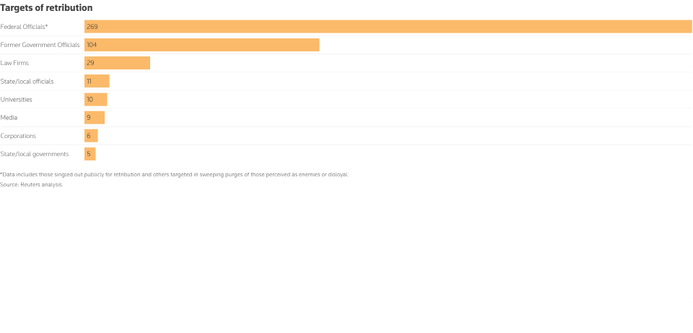
    Reuters documented at least 470 targets of retribution under Trump’s leadership – from federal employees and prosecutors to universities and media outlets. The list illuminates the sweeping effort by the president and his administration to punish dissent and reshape the government.

    By PETER EISLER, NED PARKER, LINDA SO and JOSEPH TANFANI

    Another 224 people were caught up in broader retribution efforts – not named individually but ensnared in crackdowns on groups of perceived opponents. Nearly 100 of them were prosecutors and FBI agents fired or forced to retire for working on cases tied to Trump or his allies, or because they were deemed “woke.” This includes 16 FBI agents who kneeled at a Black Lives Matter protest in 2020. The rest were civil servants, most of them suspended for publicly opposing administration policies or resisting directives on health, environmental and science issues.

    The retribution took three distinct forms.

    Most common were punitive acts, such as firings, suspensions, investigations and the revocation of security clearances.

    Reuters found at least 462 such cases, including the dismissal of at least 128 federal workers and officials who had probed, challenged or otherwise bucked Trump or his administration.

    The second form was threats. Trump and his administration targeted at least 46 individuals, businesses and other entities with threats of investigations or penalties, including freezing federal funds for Democratic-led cities such as New York and Chicago.

    Trump openly discussed firing Federal Reserve Chair Jerome Powell for resisting interest rate cuts, for instance. Last week, he threatened to have six Democratic members of Congress tried for sedition – a crime he said is “punishable by DEATH” – after the lawmakers reminded military personnel they can refuse “illegal orders.” This week, the Defense Department threatened to court-martial one of them, U.S. Senator Mark Kelly, a former Naval officer.

    The third form was coercion. In at least a dozen cases, organizations such as law firms and universities signed agreements with the government to roll back diversity initiatives or other policies after facing administration threats of punishment, such as security clearance revocations and loss of federal funding and contracts.

    It’s a campaign led from the top: Trump’s White House has issued at least 36 orders, decrees and directives, targeting at least 100 individuals and entities with punitive actions, according to the Reuters analysis.

    Trump openly campaigned on a platform of revenge in his latest run for the presidency, promising to punish enemies of his Make America Great Again movement. “For those who have been wronged and betrayed, I am your retribution,” he said in a March 2023 speech. Weeks later, while campaigning in Texas, he repeated the theme. “I am your justice,” he said.

    Today, the White House disputes the idea that the administration is out for revenge. It describes recent investigations and indictments of political adversaries as valid course corrections on policy, necessary probes of wrongdoing and legitimate policy initiatives.

    Editor’s Note: Read the rest of the story, at the below link.

    Continue/Read Original Article Here: Trump’s campaign of retribution: At least 470 targets and counting

    #2025 #224People #470Targets #America #DemocraticCities #DonaldTrump #Education #FBI #FBIFirings #Firings #FreezingFunding #History #Investigations #Libraries #Library #LibraryOfCongress #Opinion #PeterEisler #Politics #Resistance #Retribution #Reuters #RevokeSecurityClearances #Science #Suspensions #Trump #TrumpAdministration #TrumpSCampaign #UnitedStates #WhiteHouse

    Trump’s deployments of National Guard troops reignite a 200-year-old Constitutional debate – PBS News

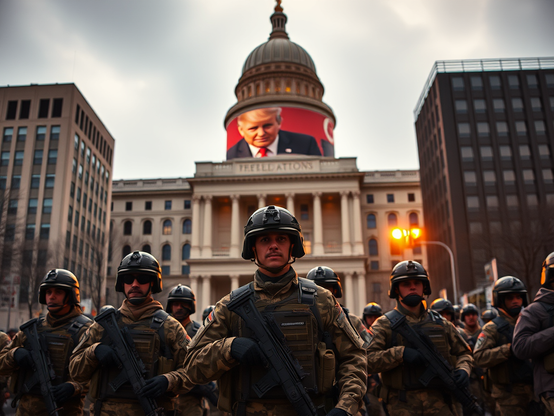
    Members of the National Guard walk past a building displaying a banner with an image of President Donald Trump, in Washington, D.C., Oct. 18, 2025. Photo by Leah Millis / Reuters.

    By — Andrea Katz, The Conversation

    Trump’s deployments of National Guard troops reignite a 200-year-old Constitutional debate

    Politics Oct 22, 2025 1:15 PM EDT, This article originally appeared on The Conversation.

    If you’re confused about what the law does and doesn’t allow the president to do with the National Guard, that’s understandable.

    As National Guard troops landed in Portland, Oregon, in late September 2025, the state’s lawyers argued that the deployment was a “direct intrusion on its sovereign police power.”

    READ MORE: U.S. appeals court says Trump can take command of Oregon National Guard troops, though deployment blocked for now

    Days before, President Donald Trump, calling the city “a war zone,” had invoked a federal law allowing the government to call up the Guard during national emergencies or when state authorities cannot maintain order.

    The conflict throws into relief a question as old as the Constitution itself: Where does federal power end and state authority begin?

    One answer seems to appear in the 10th Amendment’s straightforward language: “The powers not delegated to the United States by the Constitution, nor prohibited by it to the States, are reserved to the States respectively, or to the people.” This text is considered to be the constitutional “hook” for federalism in our democracy.

    The founders, responding to anti-Federalist anxieties about an overbearing central government, added this language to emphasize that the new government possessed only limited powers. Everything else – including the broad “police power” to regulate health, safety, morals and general welfare – remained with the states.

    Yet from the beginning, the text has generated plenty of confusion. Is the 10th Amendment merely a “truism,” as Justice Harlan Fiske Stone wrote in 1941 in United States v. Darby, restating the Constitution’s structure of limited powers? Or does it describe concrete powers held by the states?

    Turns out, there’s no simple answer, not even from the nation’s highest court. Over the years, the Supreme Court has treated the 10th Amendment like the proverbial magician’s hat, sometimes pulling robust state powers from its depths, other times finding it empty.

    10th Amendment’s broad range

    The arguments over the 10th Amendment for almost 200 years have applied not only to the National Guard but to questions about how the federal and state governments share powers over everything from taxation to government salaries, law enforcement and regulation of the economy.

    For much of the 19th century, the 10th Amendment remained dormant. The federal government’s weakness and limited ambitions, especially on the slavery question, meant that boundaries were rarely tested before the courts.

    The New Deal era brought this equilibrium crashing down.

    The Supreme Court initially resisted the expansion of federal power, striking down laws banning child labor in Hammer v. Dagenhart in 1918, setting a federal minimum wage in 1923 in Adkins v. Children’s Hospital, and offering farmers subsidies in U.S. v. Butler in 1937. All these decisions were based on the 10th Amendment.

    WATCH: Conservative constitutional lawyer weighs in on Trump’s aggressive use of executive power

    But this resistance wore down in the face of economic crisis and political pressure. By the time of the Darby case in 1941, which concerned the Fair Labor Standards Act and Congress’ power to regulate many aspects of employment, the court had relegated the 10th Amendment to “truism” status: The Amendment, wrote Stone, did nothing more than restate the relationship between the national and state governments as it had been established by the Constitution before the amendment.

    The 1970s marked an unexpected revival. In the 1976 decision in National League of Cities v. Usery, a dispute over whether Congress could directly exercise control over minimum wage and overtime pay for state and local government employees, the court held that Congress could not use its commerce power to regulate state governments.

    But that principle was abandoned nine years later, with the court doubling back on its position. Now, if the states wanted protection from federal overreach, they would have to seek it through the political process, not judicial intervention.

    Yet less than a decade later, the court reversed course again. The modern federalism renaissance began in the ’90s with a pair of divided opinions stating that the federal government cannot force the states to enforce federal regulatory programs: this was the “anti-commandeering principle.”

    The 10th Amendment’s meandering path

    In recent decades, the court, led by Chief Justice John Roberts, has invoked the amendment to protect state power in varied, even surprising contexts: states’ entitlement to federal Medicaid spending; state authority over running elections, despite patterns of voter exclusion; even legalization of sports gambling.

    On the other hand, in 2024, Colorado was barred by the court from excluding Trump from the presidential ballot as part of its power to administer elections.

    That brings us back to the present, where Trump has deployed National Guard troops to Los Angeles to quell protests against immigration enforcement, and bids to send them to Portland and Chicago as well.

    From the point of view of federalism, two factors lend this conflict some constitutional complexity.

    Continue/Read Original Article: https://www.pbs.org/newshour/politics/trumps-deployments-of-national-guard-troops-reignite-a-200-year-old-constitutional-debate

    #10thAmendment #2025 #America #ConstitutionalCrisis #DemocraticCities #DonaldTrump #Education #Health #History #Libraries #Library #LibraryOfCongress #NationalGuard #OnlyBlueCities #Opinion #PBSNews #Politics #Resistance #Science #SCOTUS #StatesRights #Trump #TrumpAdministration #USConstitution #UnitedStates

    Trump calls on supporters to 'guard the vote' in Democratic-run US cities

    Donald Trump, the frontrunner for the Republican presidential nomination, told his supporters on Saturday to "go into" Philadelphia and two other Democratic-run cities to "guard the vote" in 2024, repeating his unfounded claims of widespread election fraud in 2020 as justification for the call to action.

    Reuters