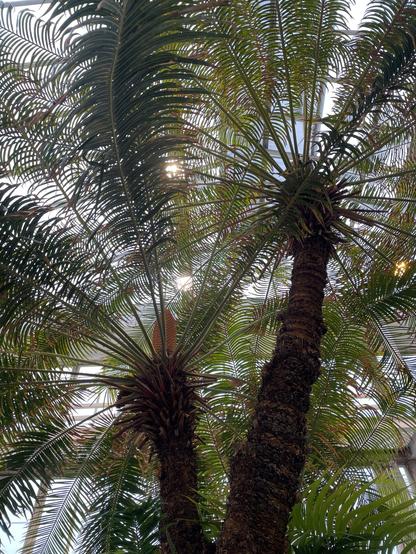
 Charring Auh
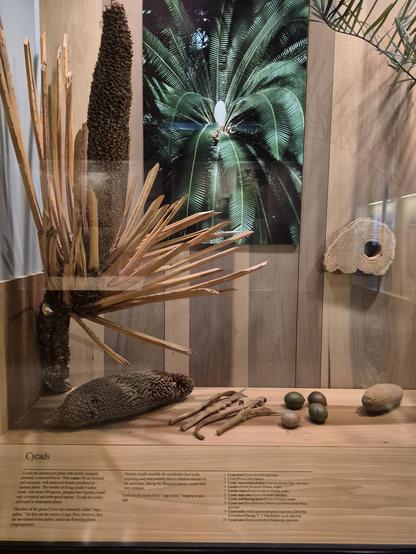
#Cycads /ˈsaɪkædz/—constituting the division Cycadophyta—are seed plants with a stout, woody cylindrical trunk with a crown of large, hard, stiff, evergreen and usually pinnate (feather-shaped) leaves. The species are dioecious, that
These ancient #plants attract #pollinators by getting hot https://www.npr.org/2025/12/11/nx-s1-5637486/ancient-heat-producing-plants-glow-infrared-scent-not-color
Infrared radiation is an ancient #pollination signal: Wendy Valencia-Montoya et al. https://www.science.org/doi/10.1126/science.adz1728
"long before brightly colored flowers evolved, these plants would metabolically rev themselves up when they had pollen at the ready. Nocturnal #insects such as #beetles could then see the heat from afar and home in on the target. These heat-producing #cycads exist today in tropical forests around the world"
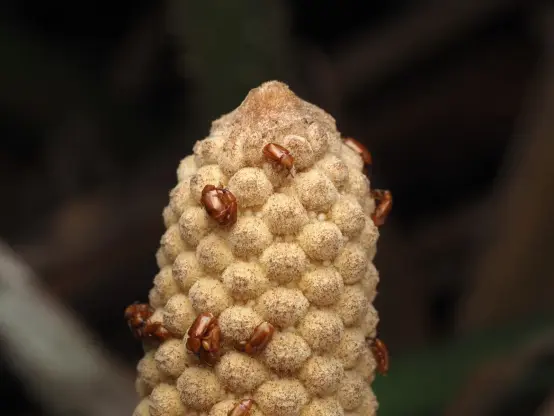
Cycads, an ancient plant group, attract beetle pollinators by producing heat, becoming hotter than the ambient temperature by 15-25 degree Fahrenheit. The beetles sense the heated-up plants via infrared radiation.
"A study published today in Science reveals that cycads, tropical plants that resemble palms, attract beetles using infrared radiation generated by their conelike reproductive structures. [...] [T]he results offer a window into “the earliest form of pollination”—a prototype for what is today one of the most transformative ecological interactions on Earth."
My 25 years of palaeoart chronology...
Some zooms into my "The Salt Lake Severn" painting (2022) of the Severn Estuary during the Middle Triassic, featuring Thecodontosaurus, cycads, and ferns. Commissioned by the Clevedon Pier Trust.
#Art #Painting #PaleoArt #PalaeoArt #SciArt #SciComm #DigitalArt #Illustration #Dinosaurs #Birds #Reptiles #Palaeontology #Paleontology #Thecodontosaurus #Cycads #Ferns #Triassic #JurassicPark #JurassicWorld


My 25 years of palaeoart chronology...
Into 2022 with a painting of the Severn Estuary during the Middle Triassic, called "The Salt Lake Severn," featuring Thecodontosaurus, cycads (Dioonitocarpidium), ferns (Thaumatopteris), and dust devils.
#Art #Painting #PaleoArt #PalaeoArt #SciArt #SciComm #DigitalArt #Illustration #Dinosaurs #Birds #Reptiles #Palaeontology #Paleontology #Thecodontosaurus #Cycads #Ferns #Triassic #JurassicPark #JurassicWorld

Preparing some herbarium sheets for display in our new dinosaur gallery. All of these plant groups – a fern, cycad, and horsetails – were around during dinosaur times.
Installation of this new gallery has been a little delayed but we're planning to open in October if all goes to plan.
#NottNatHist #plants #leaves #herbarium #museum #display #ferns #horsetails #cycads #WollatonHall #botany
 Lukas VFN 🇪🇺
 jakalopes
 Soh Kam Yung
 Atlas Obscura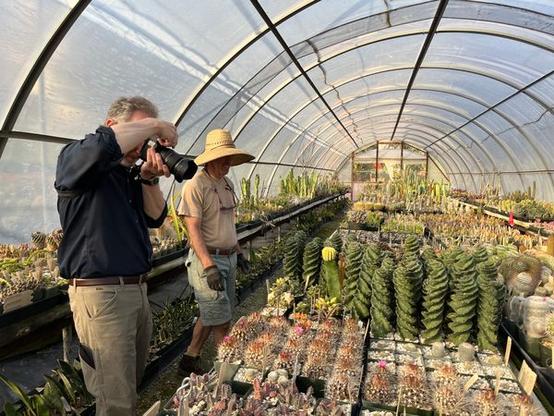
 Bob Nicholls Art
 George the Gorilla
 Ste Cook