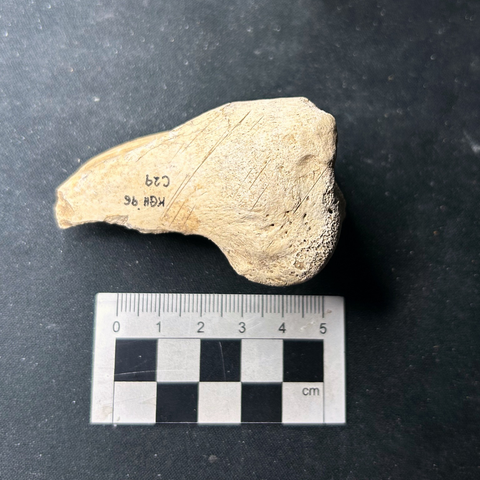
More from Killuragh cave, Ireland. This distal humerus (fore leg) bone from a pig of wild boar found in the same pit fill as Arctic lemming, Irish mountain hare and wood mouse. Hopefully we can get it radiocarbon dated. Very visible parallel fine cut incised marks on the bone associated with butchering practices by humans. #IrishCaveBones #pigs #cutmarks #wildboar #irisharchaeology #cavearchaeology #archaeology #zooarchaeology

Happy #FossilFriday 🐘

Here is the partial skeleton of a straight-tusked elephant from Marathousa 1, a Lower #Paleolithic site in the Megalopolis basin, Southern Greece. This skeleton belonged to a male individual in its late adulthood (around 60 years) and shows evidence of #cutmarks😯 It is also one of at least two individuals of this taxon found in Marathousa 1!

Read the paper by Konidaris et al. 2018 ⬇️

https://doi.org/10.1016/j.quaint.2017.12.001

πŸ“· Panagopoulou et al. 2015

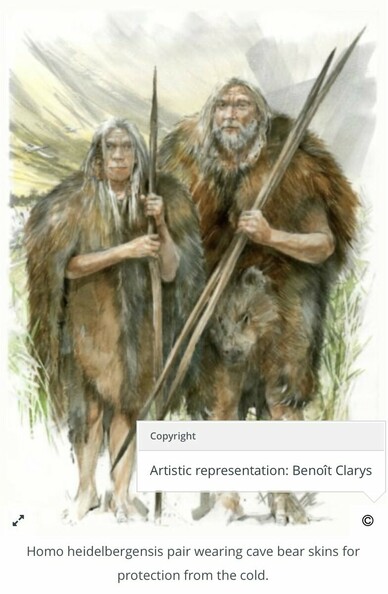
In Germany we have saying about lazily "lying on a bearskin" πŸ₯±πŸ» - and apparently that's been a thing for at least 300,000 years ...

(As #CutMarks on #CaveBear bones discovered at the #Paleolithic site of #SchΓΆningen in Lower Saxony suggest:)

https://uni-tuebingen.de/en/university/news-and-publications/press-releases/press-releases/article/humans-have-been-using-bear-skins-for-at-least-300000-years

Humans have been using bear skins for at least 300,000 years | University of TΓΌbingen

Among such traces are, for instance, #CutMarks on human bones - whose origin and meaning, admittedly, could have a variety of possible reasons ... of which the removal of flesh (physical "#excarnation") *might* be one.

This rather recent study on skull fragments from the Pre-Pottery Neolithic site of #GΓΆbekliTepe may illustrate that point:

https://www.science.org/doi/10.1126/sciadv.1700564