 Dust^2
"Nanoplastics are suspected to pollute every environment on Earth."
Well, a very good morning to you, too Leonie Jurkschat, et. al.
Using a citizen science approach to assess nanoplastics pollution in remote high-altitude glaciers published by Nature Scientific Reports in January 2025.

Using a citizen science approach to assess nanoplastics pollution in remote high-altitude glaciers - Scientific Reports
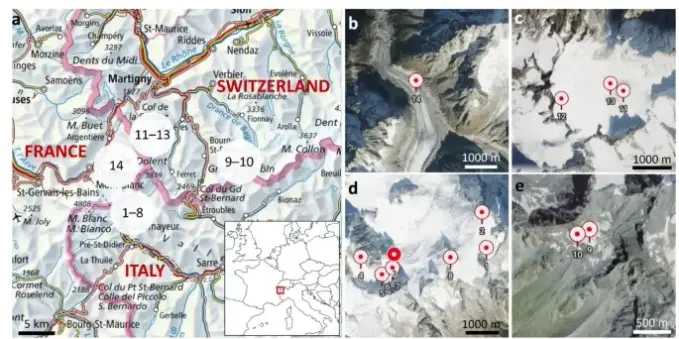
Nanoplastics are suspected to pollute every environment on Earth, including very remote areas reached via atmospheric transport. We approached the challenge of measuring environmental nanoplastics by combining high-sensitivity TD-PTR-MS (thermal desorption-proton transfer reaction-mass spectrometry) with trained mountaineers sampling high-altitude glaciers (“citizen science”). Particles < 1 μm were analysed for common polymers (polyethylene, polyethylene terephthalate, polypropylene, polyvinyl chloride, polystyrene and tire wear particles), revealing nanoplastic concentrations ranging 2–80 ng mL− 1 at five of 14 sites. The dominant polymer types found in this study were tire wear, polystyrene and polyethylene particles (41%, 28% and 12%, respectively). Lagrangian dispersion modelling was used to reconstruct possible sources of micro- and nanoplastic emissions for those observations, which appear to lie largely to the west of the Alps. France, Spain and Switzerland have the highest contributions to the modelled emissions. The citizen science approach was found to be feasible providing strict quality control measures are in place, and is an effective way to be able to collect data from remote and inaccessible regions across the world.