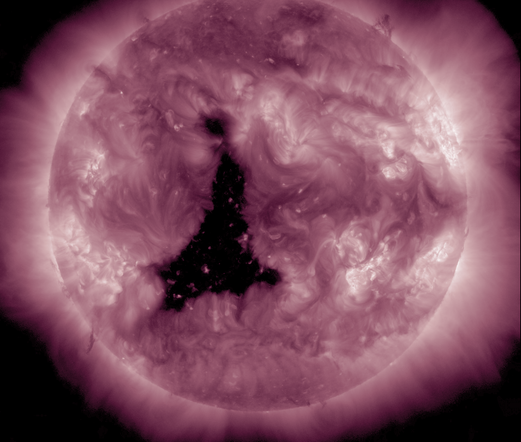
Watch a Coronal Hole form on the Sun!
https://youtube.com/shorts/c6EPpn04f7I?si=vXyL6mlPgJ7bjSJc
#sun
#astronomy
#coronalhole
#suneducationalvideo
#educationalshorts
"Activity on our Sun has picked up in a big way. Not only do we have this "triple threat" of storms arriving over the next couple of days, but we also have a big #coronalhole that should begin sending us some fast wind next week. " - Dr. #TamithaSkov
Space Weather
On the sun... a very large coronal hole is now facing Earth, as can be seen in this image of the sun which highlights the solar atmosphere. A stream of solar wind will be pouring out of this coronal hole into space a bit like a rotating water sprinkler does with water in the garden. The solar wind will take 2-4 days to travel from the sun to Earth and may or may not cause strong auroras when it arrives, depending upon its magnetic orientation (it needs to be opposite to Earth's magnetic field to cause good aurora).
via #SolarHam
Space Weather Update
March 23, 2023 @ 01:05 UTC
"Below is a look at the visible solar disk as we head into Thursday. Solar activity during the past 24 hours remained at low levels. The chances for a major solar flare during the next day will be slim.
"Minor (G1) to Moderate (G2) storming will be possible during the next 24-72 hours due to the combination of an anticipated coronal hole stream along with at least one coronal mass ejection (CME) passing close to Earth. Aurora sky watchers at higher latitudes should be alert. Should storm conditions reach moderate (G2) levels, aurora could be visible as far south as the norther tier United States."
“A coronal hole (51) located towards the center of the Sun will become geoeffective early this week. A solar wind stream flowing from this zone could contribute to active geomagnetic conditions (Kp4) with a chance for minor (G1) storming beginning Nov 30th and into Dec 1st.”