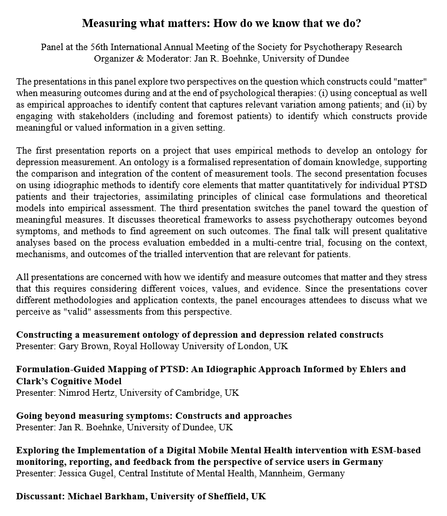
In a week's time #SPRKrakow2025 will be over already.

I am grateful to my colleagues for joining me for the panel
"Measuring what matters: How do we know that we do?"

#PsychotherapyResearch #Measurement #HRQOL #CoreOutcomes #DundeeUni
@paperbag1

Discussant: Michael Barkham, University of Sheffield, UK

Talks:

Constructing a measurement ontology of depression and depression related constructs
Presenter: Gary Brown, Royal Holloway University of London, UK

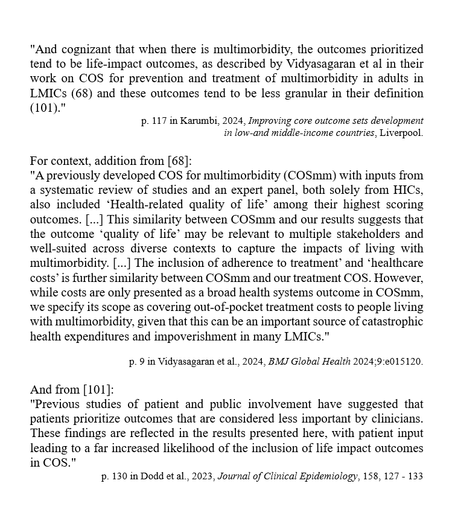
Interesting #PhDthesis investigating the inclusion of #LMIC stakeholders in core outcome set development, pointing to continued lack of involvement, strategies, and missed opportunities to enhance COS utility
https://livrepository.liverpool.ac.uk/3186985/

#COMET #Psychometrics #CoreOutcomes #CoreOutcomeSet

Improving core outcome sets development in low-and middle-income countries

Background Standardizing outcomes and their measurement is a crucial aspect of evidence-based medicine. A core outcome set (COS) is a standardized set of outcomes that researchers should measure and report. The use of COS has the potential to reduce research waste, enhance knowledge translation, and ensure that patient-relevant outcomes are always reported. However, most COS work has been led by high-income countries (HICs), leaving a gap in low- and middle-income countries (LMICs). This thesis aims to fill this gap by exploring ways to improve the development and use of COS in LMICs, using the neonatal COS development process in Kenya as a model. Methodology: To understand current practice, I undertook a systematic review to describe the extent of inclusion of LMIC stakeholders in the development and use of COS (. I conducted two online surveys to explore views on including LMIC stakeholders in COS development and use. Survey 1 targeted COS developers from HICs, and Survey 2 targeted LMIC stakeholders. In survey 2, I presented three existing COS (Pre-eclampsia, COVID-19 and Palliative care) as case scenarios, and I asked respondents whether they would use the COS (with reasons). To explore whether an existing COS, agreed predominantly by HIC stakeholders, should be adopted or adapted for the Kenyan context, I undertook key informant interviews with clinicians working in newborn units and policymakers in Kenya to understand what outcomes are important to them. I also undertook focused group discussions with caregivers/mothers who had had their neonates admitted previously to newborn units. This collaborative approach helped me understand the key outcomes from their perspective. I finally conducted a consensus meeting with key stakeholders to generate an adapted COS for use in Kenya. Key findings From the systematic review, only one in five (75 of 380, 20%) COS included stakeholders from LMICs, with only four COS projects originating from LMICs. In survey 1, 37 (49%) responses were received from 75 COS developers, 29 of whom had published them between 2015 and 2020. In survey 2, there were 81 respondents from LMICs; 26 had experience using a COS, and nine had been involved in COS development. Across the two surveys, personal research interests were a key driver for initiation/participation in a given COS project; LMIC stakeholders were most frequently involved in determining the ‘what to measure’ stage of COS development as opposed to the other COS development stages like scoping and how to measure. Respondents suggested that the sensitization of stakeholders on the usefulness of COS in LMICs, translation of Delphi and COS materials into local languages, and enhancement of feasibility of outcome measurements would help get more LMIC participants to be part of COS development. The key informant interviews and Focused Group Discussions (FGD) yielded 16 outcomes (survival, length of stay in hospital, ability to feed or weight gain or growth, cognitive ability, visual impairment or retinopathy of prematurity (ROP), impact on caregivers and wider family, financial costs to the caregiver, pain, adverse events due to medicine, respiratory distress, quality of life, sepsis, future wellbeing, jaundice, necrotizing enterocolitis (NEC), ability to touch/palpate). These outcomes were subjected to a consensus-building workshop and a final set of 12 outcomes (survival, length of stay in hospital, ability to feed or weight gain or growth, cognitive ability, visual impairment or ROP, impact on caregivers and wider family, financial costs to the caregiver, pain, adverse events due to medicines, respiratory distress, quality of life, sepsis/infections) were agreed upon. Seven outcomes were similar to the HIC COS (survival, cognitive ability, visual impairment or ROP, adverse events due to medicines, respiratory distress, quality of life and sepsis/infections). In contrast, four outcomes (NEC, brain injury on imaging, hearing impairment, and general gross motor ability) were not included in this COS. Conclusion: Although LMIC stakeholders have been increasingly included in COS development and use over time, more work is required to test the proposed strategies for enhancing COS development and use in LMICs. This could be coupled with other methodological enhancements, such as documenting the adoption or adaptation of existing COS in an LMIC setting, which has the potential to enhance COS utility, as demonstrated in this thesis.

This week's edition of AI helps me to write a #FakeAbstract in response to ludicrous #conference invites has #ChatGPT 3.5 meet " #Nanomaterials #Conference 2024 "

If interested in the work they "contacted" me about:
https://www.medrxiv.org/content/10.1101/2024.01.29.24301589v1

#CoreOutcomes #HRQL #GlobalHealth

Core outcome sets for trials of interventions to prevent and to treat multimorbidity in low- and middle-income countries: the COSMOS study

Introduction The burden of multimorbidity is recognised increasingly in low- and middle-income countries (LMICs), creating a strong emphasis on the need for effective evidence-based interventions. A core outcome set (COS) appropriate for the study of multimorbidity in LMIC contexts does not presently exist. This is required to standardise reporting and contribute to a consistent and cohesive evidence-base to inform policy and practice. We describe the development of two COS for intervention trials aimed at the prevention and treatment of multimorbidity in LMICs. Methods To generate a comprehensive list of relevant prevention and treatment outcomes, we conducted a systematic review and qualitative interviews with people with multimorbidity and their caregivers living in LMICs. We then used a modified two-round Delphi process to identify outcomes most important to four stakeholder groups with representation from 33 countries (people with multimorbidity/caregivers, multimorbidity researchers, healthcare professionals, and policy makers). Consensus meetings were used to reach agreement on the two final COS. Registration: <https://www.comet-initiative.org/Studies/Details/1580>. Results The systematic review and qualitative interviews identified 24 outcomes for prevention and 49 for treatment of multimorbidity. An additional 12 prevention, and six treatment outcomes were added from Delphi round one. Delphi round two surveys were completed by 95 of 132 round one participants (72.0%) for prevention and 95 of 133 (71.4%) participants for treatment outcomes. Consensus meetings agreed four outcomes for the prevention COS: ([1][1]) Adverse events, ([2][2]) Development of new comorbidity, ([3][3]) Health risk behaviour, and ([4][4]) Quality of life; and four for the treatment COS: ([1][1]) Adherence to treatment, ([2][2]) Adverse events, ([3][3]) Out-of-pocket expenditure, and ([4][4]) Quality of life. Conclusion Following established guidelines, we developed two COS for trials of interventions for multimorbidity prevention and treatment, specific to LMIC contexts. We recommend their inclusion in future trials to meaningfully advance the field of multimorbidity research in LMICs. KEY MESSAGES What is already known on this topic? What this study adds How this study might affect research, practice, or policy ### Competing Interest Statement The authors have declared no competing interest. ### Funding Statement This research was funded by the National Institute for Health Research (NIHR) Grants 17/63/130 NIHR Global Health Research Group: Improving Outcomes in Mental and Physical Multimorbidity and Developing Research Capacity (IMPACT) in South Asia and Grant NIHR203248 Global Health Centre for Improving Mental and Physical Health Together using UK aid from the UK Government to support global health research. The views expressed in this publication are those of the author(s) and not necessarily those of the NIHR or the UK government. Oscar Flores-Flores is supported by the Fogarty International Center and National Institute of Mental Health (NIMH) of the National Institutes of Health (NIH), United States under Award Number K43TW011586. The content is solely the responsibility of the authors and does not necessarily represent the official views of the National Institutes of Health. This work was also supported by the Global Alliance for Chronic Diseases (GACD) Multimorbidity Subgroup and by members of the World Psychiatric Association Comorbidity Section. The GACD also part funded the DelphiManager software. The NCD Alliance provided advice on engaging people with multimorbidity and publicised the study. ### Author Declarations I confirm all relevant ethical guidelines have been followed, and any necessary IRB and/or ethics committee approvals have been obtained. Yes The details of the IRB/oversight body that provided approval or exemption for the research described are given below: Health Sciences Research Governance Committee at the University of York (HSRGC/2020/409/D: COSMOS). Approvals were also obtained from relevant in-country ethics committees for all participating interview sites. I confirm that all necessary patient/participant consent has been obtained and the appropriate institutional forms have been archived, and that any patient/participant/sample identifiers included were not known to anyone (e.g., hospital staff, patients or participants themselves) outside the research group so cannot be used to identify individuals. Yes I understand that all clinical trials and any other prospective interventional studies must be registered with an ICMJE-approved registry, such as ClinicalTrials.gov. I confirm that any such study reported in the manuscript has been registered and the trial registration ID is provided (note: if posting a prospective study registered retrospectively, please provide a statement in the trial ID field explaining why the study was not registered in advance). Yes I have followed all appropriate research reporting guidelines, such as any relevant EQUATOR Network research reporting checklist(s) and other pertinent material, if applicable. Yes All data produced in the present study are available upon reasonable request to the authors [1]: #ref-1 [2]: #ref-2 [3]: #ref-3 [4]: #ref-4

medRxiv

The International Society for Quality of Life Research’s Standards and Best Practices Committee has published a perspective on the #FDA proposed core set of patient-reported outcomes (PROs) for collection in #cancer trials:
https://link.springer.com/article/10.1007/s11136-023-03396-z

They constitute a minimum expectation for PRO data collected in oncology trials. The proposal can be found here:
https://www.fda.gov/media/149994/download

To learn more about #CoreOutcomes, see #Comet
https://www.comet-initiative.org/Patients

#ISOQOL #Registration #RCT

International Society for Quality of Life Research commentary on the US Food and Drug Administration draft guidance for industry on core patient-reported outcomes in cancer clinical trials - Quality of Life Research

In June 2021, the US Food and Drug Administration (FDA) released a draft guidance for industry on core patient-reported outcomes (PROs) and related considerations for instrument selection and trial design in registrational cancer clinical trials, building on prior communications about the use of PROs to assess efficacy and tolerability in oncology drug development. The International Society for Quality of Life Research (ISOQOL) Standards and Best Practices Committee led an initiative to draft a commentary about the guidance, focusing on its positive aspects and areas that would benefit from additional clarification and consideration. For comprehensiveness, the authors reviewed existing public comments on the draft guidance, and the commentary underwent a thorough review process through three ISOQOL Special Interest Groups (Psychometrics, Clinical Practice, and Regulatory and Health Technology Assessment Engagement) followed by the ISOQOL Board. The goal of this commentary is to situate this new and relevant guidance document within the context of recent regulatory efforts on PROs and highlight areas in which further work may ultimately benefit the field.

SpringerLink