#Zoology #EvolutionaryBiology #ComparativePhysiology #Biomechanics #sflorg
https://www.sflorg.com/2026/02/zoo02202601.html
Could the newborn warty birch caterpillar be one of the world's smallest, and youngest, territorial critters, and how do impaired arachnids cope when suddenly relieved of a couple of limbs?
Find the answers to these and many other fascinating questions in the JEB 2025 highlights collection
In his ECR Spotlight, Sulayman Lyons explains how learning about the natural world led to an appreciation for the feats animals perform, what he likes so much about research & why cheetahs are his favourite animal
https://journals.biologists.com/jeb/article/227/7/jeb247765/346530
ECR Spotlight is a series of interviews with early-career authors from a selection of papers published in Journal of Experimental Biology and aims to promote not only the diversity of early-career researchers (ECRs) working in experimental biology but also the huge variety of animals and physiological systems that are essential for the ‘comparative’ approach. Sulayman Lyons is an author on ‘ Highland deer mice support increased thermogenesis in response to chronic cold hypoxia by shifting uptake of circulating fatty acids from muscles to brown adipose tissue’, published in JEB. Sulayman conducted the research described in this article while a PhD student in Dr Grant McClelland's lab at McMaster University, Hamilton, Canada. He is now a Postdoctoral Fellow in the lab of Dr Jacqueline Beaudry at University of Toronto, Canada, investigating how animals can partition metabolic substrates to fuel metabolism.
In his ECR Spotlight, Jordan Glass recalls how attending the SICB annual meeting as a Master's student inspired him to take up environmental physiology and how he overcomes his aversion to writing by setting aside time each day for writing projects
#science #biology #zoology #comparativephysiology
https://journals.biologists.com/jeb/article/227/7/jeb247756/346494
ECR Spotlight is a series of interviews with early-career authors from a selection of papers published in Journal of Experimental Biology and aims to promote not only the diversity of early-career researchers (ECRs) working in experimental biology but also the huge variety of animals and physiological systems that are essential for the ‘comparative’ approach. Jordan Glass is an author on ‘ A thermal performance curve perspective explains decades of disagreements over how air temperature affects the flight metabolism of honey bees’, published in JEB. Jordan conducted the research described in this article while a Graduate student in Jon F. Harrison's lab at Arizona State University, USA. He is now a Postdoctoral research fellow in the lab of Michael E. Dillon at the University of Wyoming, USA, investigating how environmental factors affect the performance of pollinating insects to determine when they can be active and where they can live.
It's chilly up in the mountains and Sulayman Lyons & Grant McClelland have discovered that deer mice that make their homes on mountain tops burn fat in brown adipose tissue to keep warm, rather than shivering like their low altitude cousins
#science #biology #zoology #comparativephysiology
https://journals.biologists.com/jeb/article/227/7/jeb247818/346531
Even on a sunny day, it never gets too hot at the top of Colorado's Mount Blue Sky, perched on the eastern edge of the mighty Rocky Mountains in the USA. With the warmest days nudging above 13°C and oxygen levels around 50% of those at sea level, life can be a struggle, especially for the smallest mammals that have to keep their tiny bodies warm in the chilly mountain conditions. But no one seems to have told the robust deer mice (Peromyscus maniculatus) that make their homes at these inhospitable heights. They seem perfectly prepared for the travails of high-altitude life. Sulayman Lyons from McMaster University, Canada, explains that the hardy mountain dwellers fuel their high-octane metabolism with fats carried in their blood. However, it wasn't clear which heat-generating tissues the fats were destined for. Would the miniature mountaineers depend on their shivering muscles to maintain their body temperature in the cold thin air, or would they redirect fuel to specialised heat-generating fat stores, known as brown adipose tissue, located between their shoulder blades to remain warm? Lyons and Grant McClelland, also from McMaster University, injected some of the hardy mountain mice, which were used to living at 5°C in thin air, with a tiny dose of a special radioactive fat, 14C-bromopalmitate, which the body cannot burn, to find out where the fat lodged when the mountain mice were generating the huge amounts of heat required when pushed to their limits at –10°C. After 12 mins in the thin super-chilly air, Lyons collected samples of several of the mice's muscles, in addition to some of their white fat, liver, heart and their heat-generating brown fat. Then, Lyons measured the radioactivity that had accumulated in the different tissues, and it was clear that the mice were directing the fat that fuels their heat-generating metabolism to the brown adipose tissue. So, when faced with extreme cold at high altitude, the mountain deer mice fuel their brown adipose tissue with fats, rather than shivering, to generate warmth.Lyons and McClelland then checked where fuel fats ended up when mountain mice that had been kept warm (30°C) in well oxygenated air – as if living at sea level – for several months were transferred suddenly to the chilly mountain conditions. This time, the mice directed the metabolism-fuelling fats to their muscles, as they shivered to remain warm. And when Lyons checked how the different tissues were consuming various fuels, he confirmed that the heat produced by the rodents’ brown fat was largely powered by the fats carried in the blood.So, mountain deer mice that are used to the cold thin air at altitude adjust their bodies to fuel heat production by burning fat in brown adipose tissue, while high-altitude deer mice that have adjusted to a warmer lifestyle at sea-level switch to fat-fuelled shivering to generate warmth when plunged suddenly into chilly high-altitude conditions. However, when the team checked how low altitude deer mice, which usually reside at 650 m, cope with perishing high-altitude conditions, those mice were unable to switch to burning fat to maintain their body temperature as they shivered to keep warm, ‘which may suggest that highland deer mice have evolved a mechanism to better regulate fat metabolism associated with heat production in cold, low oxygen environments’, says Lyons.

Do honey #bees adjust their metabolic rate depending on the air temperature? Some thought not but others thought they did. Now Jordan Glass & Jon Harrison show that the bees do adjust their metabolic rates to ensure that their #muscles always run smoothly
#science #biology #zoology #entomology #comparativephysiology
https://journals.biologists.com/jeb/article/227/7/jeb247741/346493
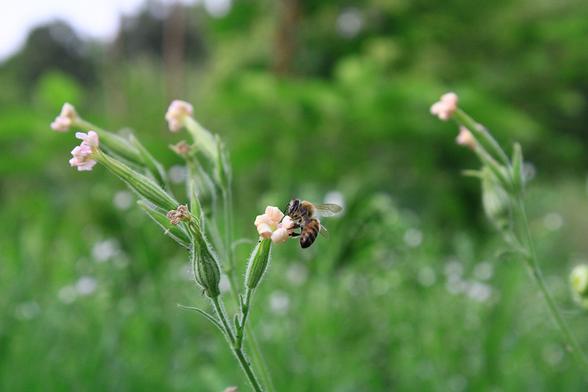
Bumbling about visiting blooms, honey bees are the epitome of a peaceful summer's day. But the enigmatic insects are at the crux of an intense scientific debate. Do honey bees vary their metabolic rate when flying at different air temperatures? After all, insects are at the mercy of the temperature of their surroundings, which affects their metabolism and the amount of power their muscles can produce. But bees shiver to warm up their flight muscles before take-off, so maybe their metabolism isn't affected by the temperature of the air? Jordan Glass (University of Wyoming, USA) and Jon Harrison (Arizona State University, USA) explain that the evidence could point in either direction. Some researchers suspected that the industrious insects drop their metabolic rates in high temperatures, while others suggested that air temperature has no impact on the insects’ metabolic rates. With the jury out, Glass and Harrison decided to revisit the results of experiments dating back to 1980 to resolve the issue of whether honey bees alter their flight metabolism depending on the temperature of the air.‘Extracting and interpreting metabolic and body temperature data from these older studies was tricky’, says Glass, explaining that some of the measurements had to be obtained from hand-drawn figures, and the bees had all been flown at different temperatures. In Bernd Heinrich's lab (University of Vermont, USA) in 1980, the bees flew at 20 and 42°C, while others in 2005 flew over temperatures ranging from 18 to 39°C. A study from Harrison's own lab in 2001 recorded the metabolic rate of winter bees – which have the lowest metabolic rates – flying at 24°C and, in an additional study in 2002, the bees flew in heliox – which has a lower density than air – forcing them to work their hardest to remain aloft. Glass also performed a new set of experiments, in which he monitored the metabolic rates of 160 bees flying at 20, 30 and 40°C. And, in each experimental series, dating back four decades, the respective researchers had measured the temperature of the insects’ flight muscles to record the temperature at which they were running.Collating the newly measured metabolic rates and those from Heinrich's lab on a graph, Glass realised that instead of having no effect on the flying bee's metabolism, the air temperature had a definite impact. The bees were clearly working harder at lower air temperatures and made less effort as the air temperature rose. And when Glass reframed the bees’ exertions in the context of the temperature of their muscles, the reason for the disagreement over the impact of air temperature on the bee metabolic rates became apparent. The bees in Heinrich's 2005 study had flight muscle temperatures close to the optimal operating temperature (∼39°C), masking the effect that air temperature has on their metabolic rates.But why do bees flying in cooler air put in more effort than bees flying in milder conditions? After all, hovering bees carrying no nectar or pollen have 20–30% more power left in the tank – to allow them to carry heavy loads – so they should not be affected by the air temperature. Glass suspects that the answer lies in the bees’ need to run their flight muscles at their optimal temperature. ‘The most obvious explanation is that bees beat their wings faster, but over a shallower angle, when flying at cooler air temperatures to warm their flight muscles to the optimal temperature’, says Glass, adding that he also recorded bees beating their wings more slowly on hot days to prevent their muscles from overheating.Either way, honey bees adjust their metabolic rate as the temperature of their surroundings changes to ensure that their muscles run smoothly in heat waves and dismal summers.
In our relaunched Conversation series, Frank van Breukelen tells us about the the common tenrec, which defies the physiology rule book by #hibernating at a body temperature of 28C while also being capable of being active with a body temperature of just 12C
#science #biology #zoology #comparativephysiology
https://journals.biologists.com/jeb/article/227/8/jeb247781/346529
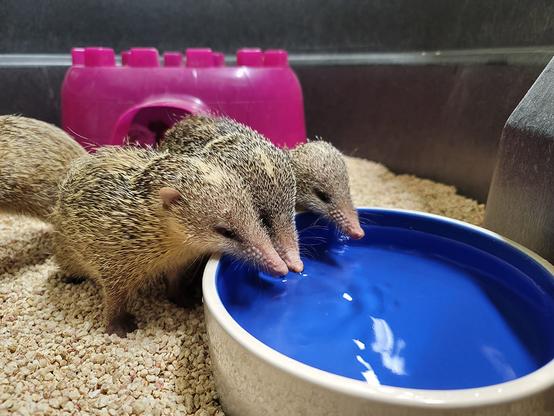
Tenrec ecaudatus (the common tenrec) is a small mammal (250 g–2 kg) that is native to Madagascar and has been introduced to other islands in the Indian Ocean. Tenrecs dine on insects, small reptiles, amphibians and mammals in the wild, but also consume fruit and vegetation and are thought to hibernate for up to 8 months. However, unlike other hibernators, which periodically arouse from torpor during hibernation, tenrecs do not and are notoriously difficult to keep in captivity. Frank van Breukelen, custodian of the only known colony of captive tenrecs, tells Journal of Experimental Biology about these extraordinary creatures and the challenges that he has faced learning about their unconventional physiology and how to care for them.
In her ECR Spotlight, Harriet Goodrich tells us how a series of fortuitous events led her to join the Institute for Marine and Antarctic Studies in lutruwita as a lecturer and how building a supportive network of like-minded kind colleagues is essential for success
#biology #zoology #science #comparativephysiology
https://journals.biologists.com/jeb/article/227/7/jeb247554/346301
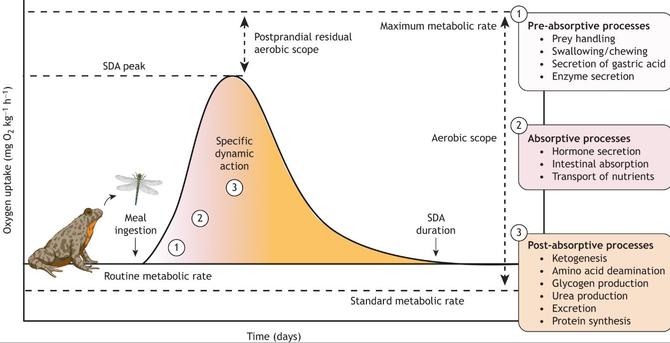
ECR Spotlight is a series of interviews with early-career authors from a selection of papers published in Journal of Experimental Biology and aims to promote not only the diversity of early-career researchers (ECRs) working in experimental biology but also the huge variety of animals and physiological systems that are essential for the ‘comparative’ approach. Harriet Goodrich is an author on ‘ Specific dynamic action as the energy cost of digestion or growth?’, published in JEB. Harriet is a lecturer in aquaculture production and aquatic animal physiology at the University of Tasmania, Australia, investigating how integrative, comparative and eco-physiology can be used as a tool to address global challenges in aquaculture production, fisheries management and conservation.
In their Commentary, Harriet Goodrich & co discuss the mechanisms underlying the rise in metabolism during digestion. Apparently protein synthesis is the main contributor
#comparativephysiology #science #zoology #Biology
https://journals.biologists.com/jeb/article/227/7/jeb246722/346302
Summary: This Commentary summarises conflicting perspectives on the relationship between the specific dynamic action (SDA) and animal growth, and proposes research directions aimed at determining the nature of the SDA.