Unveiling the Coma Cluster Structure: From the Core to the Hubble Flow

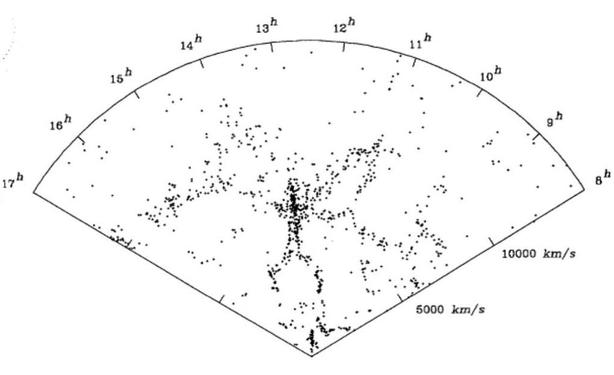
The Coma cluster, embedded in a cosmic filament, is a complex and dynamically active structure in the local Universe. Applying a density-based member selection (dbscan) to data from the Sloan Digital Sky Survey (SDSS), we identify its virilised core and zero-velocity boundary. Cross-correlating with the Cosmicflows-4 (CF4) catalogue enables a velocity-distance analysis, incorporating radial infall models and redshift-independent distance estimators. This reveals, for the first time, the Hubble flow surrounding Coma, a first step to investigate the entanglement between the dark matter in bound objects and the dark energy driving the expansion of their surroundings. The distance to the Coma centre is determined as $69.959 \pm 0.012 \, h^{-1}~\text{Mpc}$. From dbscan, we infer a virial radius of $r_{\rm vir} = \left(1.95 \pm 0.12\right)\,h^{-1}~\text{Mpc}$ and a turnaround of $r_{\rm ta} \geq 4.87~{h}^{-1}~\mbox{Mpc}$. Combining the SDSS redshifts with the CF4 distances, we estimate the Hubble constant to be $H_0 = (73.10 \pm 0.92)~\mbox{km}/\mbox{s}/\mbox{Mpc}$. However, with different calibrations for the distance moduli, $H_0$ varies between $[72, 80]$ km/s/Mpc. Mass estimates via caustics, the virial theorem, and the Hubble-flow method yield $M = [0.77, 2.0] \times 10^{15}\,h^{-1}\,M_{\odot}$, consistent with prior studies. Our systematic approach maps the structure of Coma into the local Hubble flow and shows the degeneracies between dynamical parameters such as the Hubble constant, the virial radius, and the total mass.

arXiv.org
Dark Energy Camera probes the Coma Cluster, an inspiration for the theory of dark matter

The Dark Energy Camera has captured an image of the dazzling Coma Cluster, named after the hair of Queen Berenice II of Egypt. Not only significant in Greek mythology, this collection of galaxies was also fundamental to the discovery of the existence of dark matter.

Phys.org
Cosmic dark matter web detected in Coma cluster

The Subaru Telescope has spotted the terminal ends of dark matter filaments in the Coma cluster stretching across millions of light years. This is the first time that strands of the cosmic web spanning the entire universe have been directly detected. This provides new evidence to test theories about the evolution of the universe.

Phys.org
Längster Sternenstrom im Kosmos entdeckt. Sternenband im Coma-Galaxienhaufen ist zehnmal länger als die Milchstraße – aber wie entstand es? #Sternenstrom #Astronomie #Galaxienhaufen #Kosmos #ComaCluster #Sterne
https://www.scinexx.de/news/kosmos/raetsel-um-laengsten-intergalaktischen-sternenstrom/
Längster Sternenstrom im Kosmos entdeckt

Nie zuvor gesehenes Phänomen: Astronomen haben im Coma-Galaxienhaufen einen intergalaktischen Sternenstrom entdeckt, der Rätsel aufgibt. Denn dieses Band

scinexx | Das Wissensmagazin

#Astronomers using the #JamesWebbSpaceTelescope have discovered a thread-like arrangement of 10 #galaxies that existed just 830 million years after the Big Bang. The 3 million light-year-long structure is anchored by a luminous #quasar—a galaxy with an active, #supermassiveblackhole at its core. The team believes the filament will eventually evolve into a massive #clusterofgalaxies, much like the well-known #ComaCluster in the #nearbyuniverse.

https://phys.org/news/2023-06-webb-earliest-strands-cosmic-web.html

Webb identifies the earliest strands of the cosmic web

Galaxies are not scattered randomly across the universe. They gather together not only into clusters, but into vast interconnected filamentary structures with gigantic barren voids in between. This "cosmic web" started out tenuous and became more distinct over time as gravity drew matter together.