Looking at Collabra today (essentially Libre Office for Android and IOS)

After getting rid of Google docs/Drive, it leaves me with No document editor on my phone, and sometimes especially if I am on the move and can't use a laptop, it is a useful ability to have.

Ok, so I have to put the docs on my phone, or have a USB-C Flash Drive, but I have no problem with that, just means another place they are backed up.

https://www.collaboraonline.com/collabora-office-android-ios/

#LibreOffice #Collabra #Android #IOS #DocumentEditing

Collabora Office for Android and iOS

Collabora Office For Mobile Powerful productivity in your pocket Google Play Apple App Store APK F-Droid Your documents on the go Collabora Office for iOS and Android is the mobile office suite of Collabora Office, based on LibreOffice, the world’s most widely used Open Source office suite. Today’s world of work is far more distributed […]

Collabora Online and Collabora Office

@cwts colleague Wolfgang Kaltenbrunner just published paper about peer review in psychology https://doi.org/10.31235/osf.io/wfs9v.

The paper presents fascinating analysis of peer review practices in terms of tension between gift-giving and accumulation. Analysis is based on case studies of three publishing outlets: #PsychologicalScience, #Collabra and @PeerCommunityIn #RegisteredReports.

Recommended reading if you're interested in #OpenScience, #OpenData, #OpenPeerReview, #Preprinting or #RegisteredReports!

OSF

#Existential philosophy and psychology assume that strong negative thoughts about #death influences many aspects of our lives, often #unconsciously.

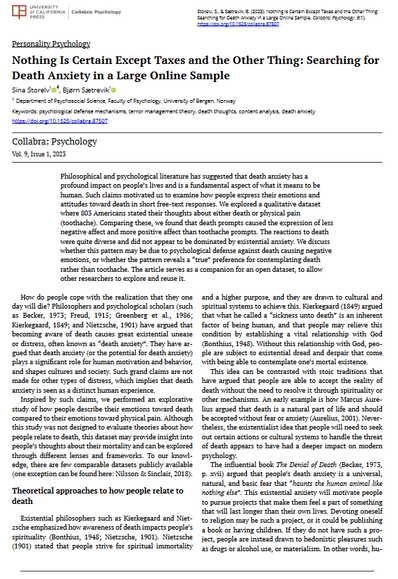
In an article just published in #Collabra: Psychology (n=803), we found that "death" was seen as less negative and more positive than "toothache". We found little to indicate #DeathAnxiety or #DefenseMechanisms. Article and dataset are #OpenAccess. This is Sina Storelv's first first authored paper!

https://online.ucpress.edu/collabra/article/9/1/87507/197342/Nothing-Is-Certain-Except-Taxes-and-the-Other
@collabraoa

Nothing Is Certain Except Taxes and the Other Thing: Searching for Death Anxiety in a Large Online Sample

Philosophical and psychological literature has suggested that death anxiety has a profound impact on people’s lives and is a fundamental aspect of what it means to be human. Such claims motivated us to examine how people express their emotions and attitudes toward death in short free-text responses. We explored a qualitative dataset where 803 Americans stated their thoughts about either death or physical pain (toothache). Comparing these, we found that death prompts caused the expression of less negative affect and more positive affect than toothache prompts. The reactions to death were quite diverse and did not appear to be dominated by existential anxiety. We discuss whether this pattern may be due to psychological defense against death causing negative emotions, or whether the pattern reveals a “true” preference for contemplating death rather than toothache. The article serves as a companion for an open dataset, to allow other researchers to explore and reuse it.

University of California Press

👫 How can we elicit experiences of closeness in romantic relationships?

A thread on a #preregistered study with a mix of #experienceSampling (time & event sampling) and ecological momentary interventions.

(Published by @[email protected], Lara Cristoforo, Lisa Wolf & me at #Collabra:

 https://doi.org/10.1525/collabra.38599.

Open data & open materials: https://osf.io/agchm)

1/

Eliciting Short-Term Closeness in Couple Relationships With Ecological Momentary Interventions

Relationship closeness is considered an important psychological variable for studying couple relationships, and is often postulated as cause for important relationship outcomes. The current study evaluates four micro-interventions for their suitability to experimentally elicit feelings of closeness towards one’s partner. Using participants’ smartphones, and a combination of experience sampling, event sampling, and ecological momentary interventions, individuals reported for a week on their experiences of closeness before and after completing daily either a neutral task or a task meant to enhance relationship closeness. The closeness tasks included showing physical affection, sharing a childhood memory, looking each other in the eyes for five minutes, and discussing shared life achievements. Results of intention-to-treat analyses on a within-person level showed that closeness increased from pre- to post-measurement on average more strongly on days of any of the four examined closeness conditions than on days of the neutral control conditions. Interindividual variability of this effect was observed, emphasizing the relevance of using within-person designs to evaluate such interventions. Exploratory analyses showed that effect sizes declined across time within the day. This study provides instruments for research on causal effects of closeness in everyday relationship life, and an evidence basis for smartphone-delivered interventions in practitioner settings.

University of California Press

🚨New paper in #Collabra
with @MarekMcGann @EricIgou & Elaine Kinsella

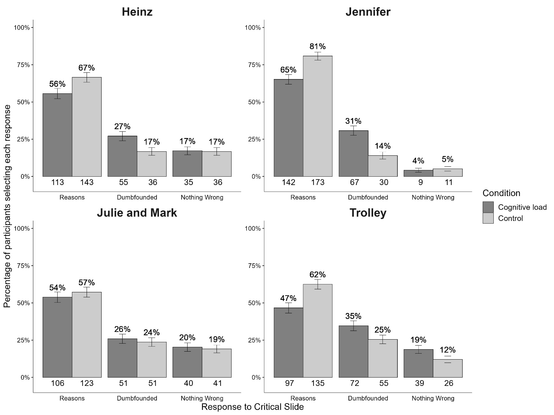
In a #moral #dumbfounding task, participants were less likely to give reasons while under cognitive load (in 3 out of 4 scenarios).

#moralpsychology

https://doi.org/10.1525/collabra.73818

Cognitive Load Can Reduce Reason-Giving in a Moral Dumbfounding Task

Moral dumbfounding occurs when people defend a moral judgment, without reasons in support of this judgment. The phenomenon has been influential in moral psychology, however, despite its influence, it remains poorly understood. Based on the notion that cognitive load enhances biases and shortcomings in human judgment when elaboration is beneficial, we hypothesized that under cognitive load, people would be less likely to provide reasons for a judgment and more likely to be dumbfounded (or to change their judgment). In a pre-registered study (N = 1686) we tested this prediction. Our findings suggest that cognitive load reduces reason-giving, and increases dumbfounding (but does not lead to changes in judgments). Our results provide new insights into the phenomenon of moral dumbfounding while also advancing theory in moral psychology.

University of California Press