🌍✨ #nextGEMS is coming to an end – but our journey has only just begun.

After four incredible years, the Horizon 2020 Next Generation Earth Modelling Systems project is wrapping up. Together, we set out to make kilometre-scale global #ClimateSimulations a reality — and we did it.

💡 None of this would have been possible without our extraordinary community:

▪️ Scientists from across the globe, pushing the boundaries of climate #modelling.
▪️ Industry and policy stakeholders, helping us connect our science to real-world needs.
▪️ Our organisational team, keeping everything on track.
▪️ LATEST THINKING (lt.org) and all the talented #ScienceCommunicators and visual creators who helped share our story.

From Hamburg to Madrid, our #hackathons became so much more than coding sessions — they were spaces to #collaborate, to socialise, to co-create, and to inspire each other.

We are deeply grateful for the friendships made, the knowledge shared, and the breakthroughs achieved. And we’re excited to watch, in the years ahead, how nextGEMS will continue to shape #ClimateScience, #adaptation planning, and the digital twins of the future.

💪 Let’s keep building on this momentum. Let’s keep working together — across disciplines, sectors, and borders — to tackle the challenges of our changing climate.

🗒️Read our final blog post here ➡️ https://nextgems-h2020.eu/nextgems-wrapping-up-four-years-at-the-frontiers-of-climate-modelling/
#ClimateScience #H2020 #Collaboration

@cinea_EU

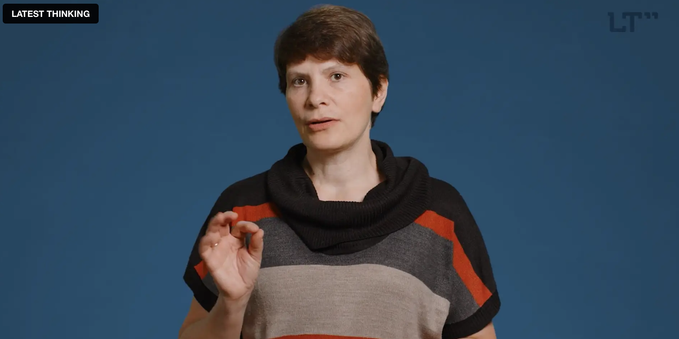
🌦️ “The small-scale matters for the large-scale!” - C. Hohenegger

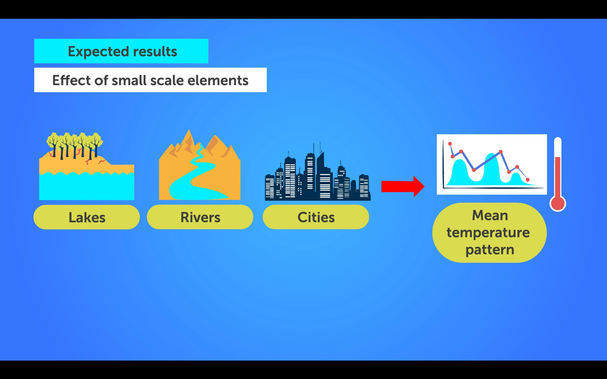
When the Storms & Land group began their #nextGEMS journey, their mission was clear: find out how explicitly resolving #storms and land-surface features at km-scale changes our understanding of #ClimateVariability.

Over the past four years, under the leadership of Cathy Hohenegger (MPI-M), the team explored how precipitation and #temperature patterns over land are shaped by fine-scale features, such as rivers and soil moisture, and how these effects can differ dramatically from coarser #ClimateSimulations.

The results? Surprising, and a reminder that small details can have global consequences.

▶️ Watch the full video, titled "Small-scale resolution reshapes our understanding of land-climate dynamics", in our Media Library (Project outcomes) to hear Cathy explain the discoveries and their significance.

#ClimateModeling #H2020 #EarthSystemScience #StormResolvingModels

@cinea_EU
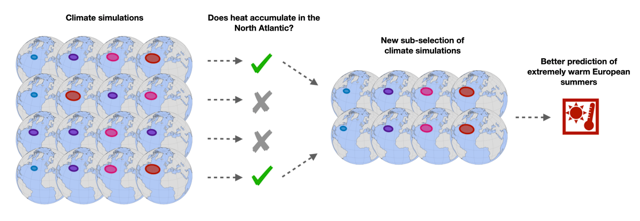
☀️🥵 In #Europe, people are increasingly exposed to extreme #heat events–with serious consequences for human health, ecosystems,& agriculture.🌱 These events can be better predicted if anomalies in the North Atlantic heat transport 🌊🌡️ are properly taken into account, according to a study by #MPIM researchers Lara Wallberg et al. They present a new filtering technique that, when applied to ensemble #ClimateSimulations , improves the predictions. 📖 Read more: https://agupubs.onlinelibrary.wiley.com/doi/10.1029/2024GL111895
©L.Wallberg/MPIM

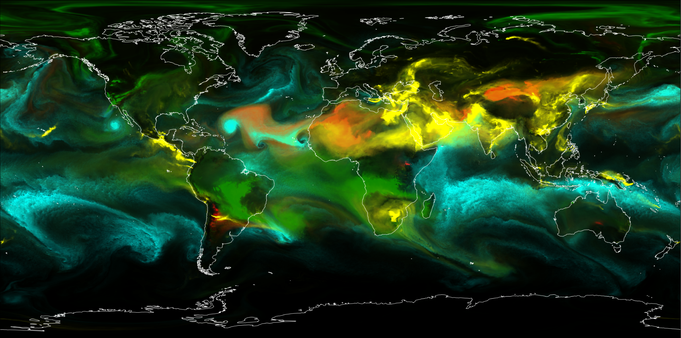
🌬️ Ever heard of atmospheric turbulence? 🌪️ It’s the irregular, chaotic flow of air in our atmosphere. Even though most natural flows are turbulent, we still have much to learn about this phenomenon. Understanding #AtmosphericTurbulence is crucial for improving #ClimateSimulations.

📹 Check out this fascinating research video by scientists Jakub Nowak and Marta Wacławczyk to learn more: https://buff.ly/3KqVNlG

#ClimateScience #StormsResolving #Weather #Research #ScienceExplained

Research video: Studying Atmospheric Turbulence

In this research video, scientists unveil the complex nature of atmospheric turbulence within the Earth's atmosphere.