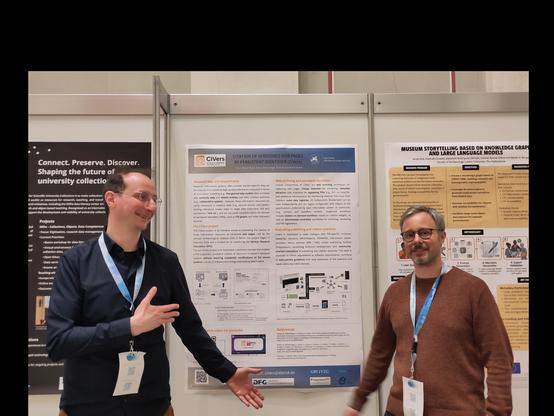
The poster โ€œThe CiVers-Project: Bridging research texts and fine-grained research dataโ€, presented at #CAA2026 in Vienna, is now available #openaccess.

๐Ÿ‘‰ Check it out here: https://doi.org/10.34780/cifa5ycy

#CiVers #DigitalHumanities
#ResearchData #OpenScience #opensource #research #digitalpreservation #webarchiving
Poster (CAA 2026, Wien): The CiVers-Project. Bridging research texts and finegrained research data - iDAI.repo

This poster was presented at the CAA (Computer Applications and Quantitative Methods in Archaeology) International Conference 2026, held in Vienna, Austria, from 31 March to 4 April 2026.

We presented #CiVers at #CAA2026 in Vienna (Mar 31โ€“Apr 4) with a poster! ๐ŸŽ‰
๐Ÿ” By combining #WebArchiving change detection, and #metadata extraction, CiVers enables reliable citation of versioned web pages using persistent identifiers (PIDs).
๐Ÿฅ… Our goal: make web-based #research resources citable, traceable, and reproducible.
Letโ€™s connect! ๐Ÿคฒ

Photo Credits: Lisa Steinmann.

๐Ÿ“ฃ New blog post! ๐Ÿ“

October 14, we hosted our first #CiVers workshop at the @dai_weltweit in Berlin ๐Ÿ›๏ธ This was a great opportunity to exchange ideas on citing versioned web resources and managing research data in #archaeology and the #humanities

Read more about what we discussed ๐Ÿ‘‡
๐Ÿ”— https://www.dainst.org/blogs/noslug/253

#Metadata #Research #OpenScience #DigitalPreservation #WebArchiving #DigitalHumanities

DAI - CiVers: Versionierte Webzitation leicht gemacht

๐Ÿชง On Tuesday, October 14, the CiVers team will host its first workshop at the @dai_weltweit in Berlin.

Weโ€™ll bring together project partners and experts from digital humanities ๐Ÿ’ป and research infrastructure ๐Ÿ”ง to discuss research data repositories and approaches for citing web resources.๐Ÿ“„

Looking forward to the exchange!
#CiVers #DigitalHumanities #OpenScience #Research #opensource

Did you know that web pages can be captured in different formats for archiving?

๐Ÿ“ฆ WARC / WACZ Archives โ€” Standard formats for full web archive collections
๐ŸŒ HTML Snapshots โ€” Complete DOM capture at the moment of archiving
๐Ÿ”— SingleFile HTML โ€” Self-contained HTML with embedded resources
๐Ÿ—‚๏ธ MHTML (MHT) โ€” Browser-supported single-file archive with HTML and assets

#CiVers is planned to support these formats, particularly those suitable for long-term #digitalpreservation #webarchiving #archives

Last week we explored the essentials of citability: versioning, PIDs, and #metadata But how can these be applied to existing web resources so researchers can cite them? ๐Ÿค”

๐Ÿ› ๏ธ Many resources in #archaeology and #DigitalHumanities werenโ€™t built for this. Redesigning them would be costly and time-consuming.

๐Ÿ’ก #CiVers is developing tools to create versioned snapshots and assign PIDs, without altering existing infrastructures.

Read more in our #openaccess article:
๐Ÿ”— https://doi.org/10.34780/6k764r03

Terms and concepts of publishing and citing information resources in archaeology and beyond. A perspective from the CiVers project and the iDAI.world. | Forum for Digital Archaeology and Infrastructure

๐Ÿ” Letโ€™s dig deeper into what makes a web #Research resource citable. For #CiVers, the essentials are:

โŒ› Versioning: capture a resource at a specific point in time
๐Ÿ”— Persistent Identifiers (PIDs): provide a stable, unique reference
๐Ÿ“ Rich #metadata : describe content so humans and machines can find it again

These principles are at the heart of our first #openaccess article: read it here!
๐Ÿ”— https://doi.org/10.34780/6k764r03

#DigitalHumanities #Archaeology #OpenScience

Terms and concepts of publishing and citing information resources in archaeology and beyond. A perspective from the CiVers project and the iDAI.world. | Forum for Digital Archaeology and Infrastructure

๐Ÿ” Research resources in archaeology and the humanities are rich, web-based, and constantly evolving, but they often lack reliable, citable versions of their content.

๐Ÿ’ก CiVers develops tools to generate versioned snapshots of web resources and assign Persistent Identifiers (PIDs) for precise, long-term citation without changing existing web application infrastructures.

๐Ÿ“– Learn more in our first article:
https://doi.org/10.34780/6k764r03

#CiVers #DigitalHumanities #Archaeology #opensource #Research

Terms and concepts of publishing and citing information resources in archaeology and beyond. A perspective from the CiVers project and the iDAI.world. | Forum for Digital Archaeology and Infrastructure

๐Ÿ“š First publication from CiVers!

๐Ÿค” How can we reliably cite resources of web-based research databases in archaeology and the humanities?

๐Ÿ’ก In our new article, we present the CiVers approach: creating versioned, citable web resources using Persistent Identifiers (PIDs).

๐Ÿง  Read the full open-access paper here:
๐Ÿ”— https://doi.org/10.34780/6k764r03

#CiVers #DigitalHumanities #WebArchiving #OpenScience #PID #DigitalPreservation

Terms and concepts of publishing and citing information resources in archaeology and beyond. A perspective from the CiVers project and the iDAI.world. | Forum for Digital Archaeology and Infrastructure

๐Ÿ“ข Hello Mastodon! ๐Ÿ‘‹
Weโ€™re CiVers Citation of Versioned Web Pages by Persistent Identifier

Web pages change. Links rot. Academic references break. Weโ€™re fixing that. ๐Ÿ› ๏ธ

๐Ÿ’ป CiVers develops software and methodologies to make web content reliably citable with PIDs and versioning

๐Ÿ”— DFG-funded @dfg_public project at the DAI Berlin @dai_weltweit with Heidelberg University Library @uniheidelberg, GBV @vzg_gbv and DataCite @datacite

#WebArchiving #OpenScience #DigitalHumanities #PID #DataCite #CiVers