Ewan Martin Quirk on Instagram: "#ReallyBigThings #DeconstructingPatriarchy #WesternSocialDemocracy #IdentityConstruction #SocialEngineering #Ecocide #permaculture #PublicGood #decarbonisation #soilbuilding #CarbonNegativeDesign #CO2trapping #ecologicalretrofitting #naturalsystems #decolonisationistoilinhonourofourcommonfutures #maywegranteachotherunderstanding"

10 Likes, 0 Comments - Ewan Martin Quirk (@imanxmani) on Instagram: "#ReallyBigThings #DeconstructingPatriarchy #WesternSocialDemocracy #IdentityConstruction #SocialEngineering #Ecocide #permaculture #PublicGood #decarbonisation #soilbuilding #CarbonNegativeDesign #CO2trapping #ecologicalretrofitting #naturalsystems #decolonisationistoilinhonourofourcommonfutures #maywegranteachotherunderstanding"

Instagram

Dezeen's top 10 low-carbon buildings of 2021

As part of our review of 2021, here are 10 examples of low-carbon architecture including buildings made of 3D-printed clay, recycled materials and biomaterials.

The most climate-friendly of these projects are net-zero or even carbon negative, meaning they will remove as much or more CO2 from the atmosphere as they will emit throughout their expected lifespan.

This is possible by making use of carbon-sequestering biomaterials, circular design principles and passive, renewable technologies for heating, cooling and energy.

As a result, the buildings not only minimise operational emissions but also the embodied carbon from materials and construction.

Read on for 10 projects that showcase how to incorporate these sustainable strategies.

Photo is by Iago Corazza

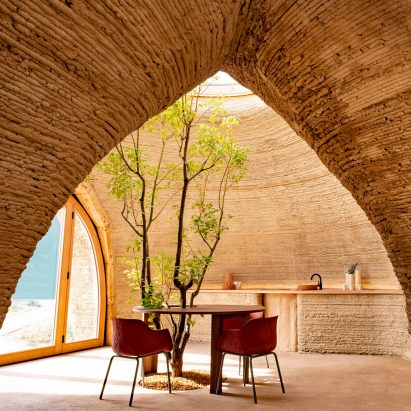
Tecla house, Italy, by Mario Cucinella Architects and WASP

Raw local clay was 3D printed in 350 layers to form this prototype home, which fuses ancient building techniques with modern technology.

The clay provides natural thermal insulation and can be recycled time and time again, with the aim of providing low-cost emergency housing for climate refugees without contributing to global warming.

Find out more about the Tecla house ›

Photo is by Patrick Degerman

Sara Kulturhus Centre, Sweden, by White Arkitekter

This cultural centre in Skellefteå designed by White Arkitekter is the second-tallest wooden tower in the world, sequestering more carbon in its timber construction than it will emit throughout its lifetime.

Highlighted as an "exemplary sustainable project" by the UK Green Building Council as part of its COP26 virtual pavilion, the carbon-negative complex is heated by a geothermal pump and powered by 1,200 square metres of solar panels, supplemented with renewable energy from the grid.

Find out more about Sara Kulturhus Centre ›

Photo is by Tommaso Riva

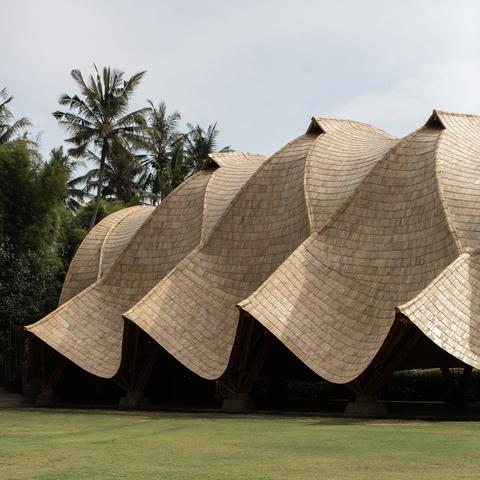
The Arc, Indonesia, by Ibuku

Fast-growing bamboo is bent into 14-metre-high arches to form the self-supporting, double-curved roof of the gymnasium at Bali's Green School, which was engineered to use minimal material while providing maximum floor space.

Vents at the canopy's apex allow warm air to escape while openings around the base provide natural ventilation, eliminating the need for air conditioning in the island's tropical climate.

Find out more about The Arc ›

Photo is by Jonathan Hillyer and Gregg Willett

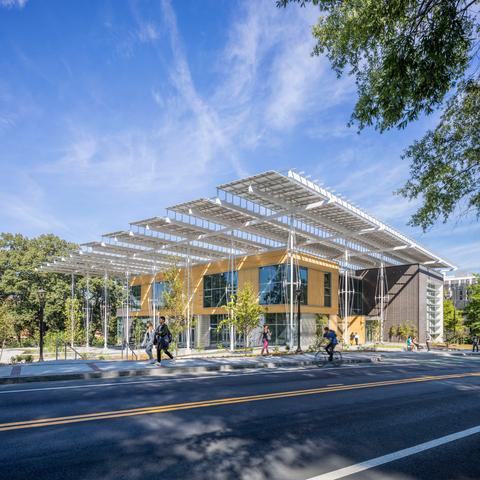
Kendeda Building, USA, by Miller Hull Partnership and Lord Aeck Sargent

Made with salvaged materials such as recycled masonry and wood from discarded movie sets, the mass-timber Kendeda Building was conceived as both a learning centre and a teaching tool to educate students of Atlanta's Georgia Institute of Technology about sustainable design.

Described as a "regenerative building", it produces more electricity via its photovoltaic canopy and recycles more water than it uses, with purified rainwater funnelled into sinks and showers before once again being treated and channelled to support vegetation in a nearby wetland.

Find out more about Living Landscape ›

Photo is by Iwan Baan

2021 Serpentine Pavilion, England, by Counterspace

South African studio Counterspace designed this year's Serpentine Pavilion as a mashup of different migrant community spaces around London, rendered in plywood that was wrapped around a steel frame and finished with black-stained cork panels.

Although the project was criticised for its use of emissions-intensive concrete for the foundation, an AECOM report shared with Dezeen showed that the building still removed 31 tonnes of carbon from the atmosphere through its biomaterials, making it carbon-negative up to the point of dismantling.

Find out more about the 2021 Serpentine Pavilion ›

Glyndebourne Croquet Pavilion, England, by BakerBrown Studio

This wind-powered garden pavilion for the Glyndebourne opera house will make use of circular economic principles in order to minimise its carbon footprint, incorporating local waste materials and a reversible design that allows the building to be disassembled and its components reused.

Diseased ash trees will be salvaged to form the structure, with its interior panelled in the venue's own discarded champagne corks bound together by mycelium and the exterior clad in tiles made from waste oyster and lobster shells.

Find out more about the Glyndebourne Croquet Pavilion ›

Photo is by Morley von Sternberg

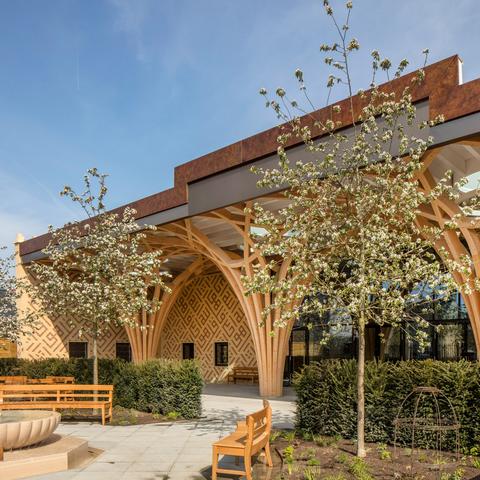
Cambridge Central Mosque, England, by Marks Barfield Architects

Shortlisted for the 2021 Stirling Prize, this mosque in Cambridge makes use of timber as a carbon-storing material to form its structural walls and tree-like pillars, which join to create the octagonal canopy holding the roof.

The place of worship is naturally lit and ventilated throughout the year, with solar panels covering all of the building's cooling and hot water needs as well as 13 per cent of the heating, while harvested rainwater is used to flush the toilets.

Find out more about the Cambridge Central Mosque ›

Living Landscape, Iceland, by Jakob+MacFarlane and T.ark

This mixed-use building, set in a former landfill site in Reykjavik, started construction in 2021 as one of 49 different net-zero urban developments which are being financed as part of the Reinventing Cities competition by global network C40 Cities.

Making use of a prefabricated cross-laminated timber (CLT) structure will reduce the building's embodied carbon footprint by almost 80 per cent compared to a typical concrete building, while operational emissions are minimised through an integrated waste-heat recovery system, comprehensive insulation and a renewable energy supply.

Find out more about Living Landscape ›

Photo is by Oscar Vinck and Jeroenvander Wielen

Exploded View Beyond Building, the Netherlands, by Biobased Creations

Algae textiles, 3D-printed sewage tiles and insulation made from reeds feature in this showhome built by Biobased Creations using 100 different biomaterials and showcased as part of Dutch Design Week.

All of its components, including the timber frame, are demountable and either already commercially available or coming to market soon, in a bid to show that plant-based materials are a viable option for new housing developments.

Find out more about the Exploded View building ›

Campo Urbano, Italy, by Arney Fender Katsalidis

A disused railway site in Rome is set to be turned into a low-carbon neighbourhood as part of a redevelopment project by Arney Fender Katsalidis, which will combine retrofits and reversible biomaterial buildings running on a mixture of locally produced biomass power and rooftop photovoltaics.

By designing the neighbourhood as a car-free, 15-Minute City where locals can find all the essentials for their day-to-day life within a short walk or cycle, the scheme considers not just embodied and operational carbon but also consumption-based emissions generated by the lifestyles of building users.

Find out more about Campo Urbano ›

The post Dezeen's top 10 low-carbon buildings of 2021 appeared first on Dezeen.

#2021review #yearlyreviews #all #architecture #roundups #carbonnegativedesign #carbonneutraldesign #netzero #embodiedcarbon

Dezeen's top ten low-carbon buildings of 2021

As part of our review of 2021, Dezeen takes a look back at 10 examples of low-carbon architecture from this year that minimise both embodied and operational emissions.

Dezeen

Coldplay announces "net-zero carbon" Music of the Spheres world tour

Coldplay has announced its next world tour will have a net-zero carbon footprint and released a sustainability plan that includes direct-air carbon capture technology by Climeworks.

The British band accompanied the announcement of its Music of the Spheres tour with a detailed list of environmental initiatives that it said would reduce carbon emissions by 50 per cent compared to its last tour.

It also pledged to use various carbon-removal methods to offset the remaining carbon emissions.

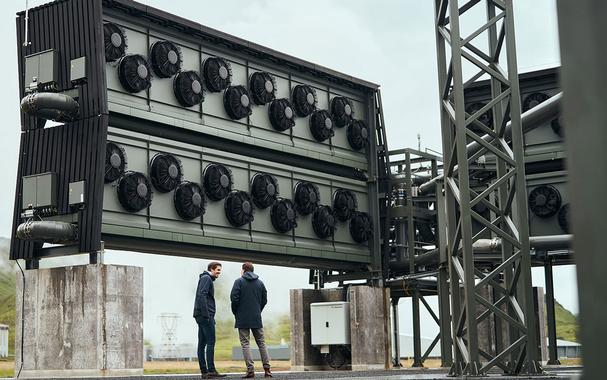
Coldplay's sustainability plan includes a partnership with Climeworks for carbon capture and storage

"We have set ourselves a science-led target of 50 per cent reduction in our CO2 emissions using the 'absolute contraction' method," the band said.

"We pledge to drawdown any unavoidable emissions according to the Oxford Principles for Net-Zero Aligned Carbon Offsetting."

The plan includes a partnership with Swiss company Climeworks, whose machines remove carbon dioxide from the air and store it safely or package it for commercial use in products such as fizzy drinks.

Climeworks is the only technological carbon removal approach included in the plan, which otherwise focuses on nature-based options such as reforestation, rewilding, soil restoration and seagrass meadow restoration to offset emissions generated by the tour.

"Coldplay has announced their next tour Music of the Spheres World Tour to have at minimum a net-zero carbon footprint and as such have built a portfolio of solutions to help them achieve this goal by the end of the new touring cycle," said Climeworks in a statement.

Kinetic dancefloors and sustainable aviation fuel among technologies to cut emissions

Coldplay's target of a 50 per cent reduction in emissions is in comparison to the band's most recent tour in 2016-17.

To achieve this, it will power its concerts through fully renewable energy, generated by solar installations, waste cooking oil, a kinetic stadium floor and electricity-generating power bikes that fans can use to actively charge the show battery.

This first-of-its-kind mobile rechargeable show battery will charge the show with renewable energy and was made in collaboration with BMW from recyclable BMW i3 batteries.

To reduce emissions from transport, Coldplay will avoid charter flights and pay a surcharge to use or supply Sustainable Aviation Fuel (SAF.) The fuel is made from renewable waste materials.

It has also pledged to adapt the show design so that local equipment and materials can be used as much as possible, minimising freight emissions, while the stage will be built from low-carbon, reusable materials including bamboo and recycled steel.

Each venue will be provided with a "sustainability rider" setting out the best environmental practices, while fans will be encouraged to use low-carbon transport to and from the shows via an official tour app that rewards them with discounts.

Climeworks partnership shows "measurable benefits" of carbon removal technology

To compensate for all the tour emissions that could not be cut, Coldplay's plan also includes a portfolio of mostly nature-based measures to remove and store carbon from the atmosphere.

Climeworks said Coldplay chose to use its technological approach to carbon capture because the band was "convinced by its permanence and measurable benefits".

The Climeworks' Orca plant is the world's largest direct air capture and storage site

"It is already proven that carbon removal at scale is a must on the current emissions pathway and technological solutions will be needed," said Climeworks co-CEO and co-founder Christoph Gebald.

"We are very inspired to see public figures like Coldplay seizing the magnitude of the challenge and acting boldly by working towards ambitious emissions reduction and removing the unavoidable part."

Announcement follows 2019 tour hiatus due to global warming concerns

Coldplay announced in 2019 that it was quitting touring until it could find a way to do it more sustainably.

The band has spent the intervening time developing this plan, which also includes sustainable pyrotechnics and biodegradable confetti and is detailed in full on the band's website.

"We've spent the last two years consulting with environmental experts to make this tour as sustainable as possible, and, just as importantly, to harness the tour’s potential to push things forward," said Coldplay.

"We won't get everything right, but we're committed to doing everything we can and sharing what we learn. It's a work in progress and we're really grateful for the help we've had so far."

Coldplay has a partnership with climate change researchers at Imperial College London's Grantham Institute to quantify the impact of the tour on the environment.

The Music of the Spheres world tour will start in Costa Rica on 18 March 2022 and then travel to the Dominican Republic, Mexico, USA, Germany, Poland, France, Belgium and the UK.

The post Coldplay announces "net-zero carbon" Music of the Spheres world tour appeared first on Dezeen.

#all #design #technology #news #music #carbonnegativedesign #carbonneutraldesign #carboncapture #sustainability #climeworks #netzero #carboncaptureandstorage

Coldplay announce net-zero Music of the Spheres world tour

Coldplay has announced their next world tour will be carbon-neutral or better, with a sustainability plan including direct-air carbon capture through Climeworks.

Coldplay announces "net-zero carbon" Music of the Spheres world tour

Coldplay has announced its next world tour will have a net-zero carbon footprint and released a sustainability plan that includes direct-air carbon capture technology by Climeworks.

The British band accompanied the announcement of its Music of the Spheres tour with a detailed list of environmental initiatives that it said would reduce carbon emissions by 50 per cent compared to its last tour.

It also pledged to use various methods to offset the remaining carbon emissions.

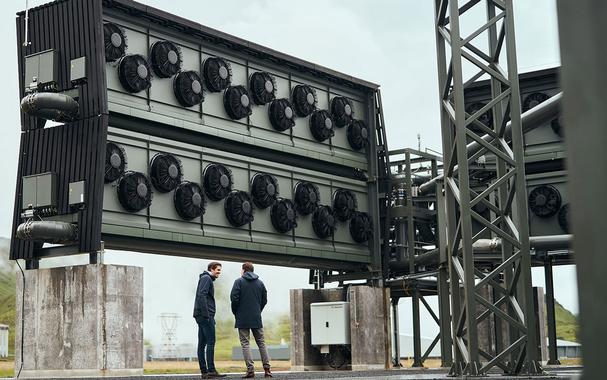
Coldplay's sustainability plan includes a partnership with Climeworks for carbon capture and storage

"We have set ourselves a science-led target of 50 per cent reduction in our CO2 emissions using the 'absolute contraction' method," the band said.

"We pledge to drawdown any unavoidable emissions according to the Oxford Principles for Net-Zero Aligned Carbon Offsetting."

The plan includes a partnership with Swiss company Climeworks, whose machines remove carbon dioxide from the air and store it safely or package it for commercial use in products such as fizzy drinks.

Climeworks' is the only technological carbon removal approach included in the plan, which otherwise focuses on nature-based options such as reforestation, rewilding, soil restoration and seagrass meadow restoration to offset emissions generated by the tour.

"Coldplay has announced their next tour Music of the Spheres World Tour to have at minimum a net-zero carbon footprint and as such have built a portfolio of solutions to help them achieve this goal by the end of the new touring cycle," said Climeworks in a statement.

Kinetic dancefloors and sustainable aviation fuel among technologies to cut emissions

Coldplay's target of a 50 per cent reduction in emissions is in comparison to the band's most recent tour in 2016-17.

To achieve this, it will power its concerts through fully renewable energy, generated by solar installations, waste cooking oil, a kinetic stadium floor and electricity-generating power bikes that fans can use to actively charge the show battery.

This first-of-its-kind mobile rechargeable show battery will charge the show with renewable energy and was made in collaboration with BMW from recyclable BMW i3 batteries.

To reduce emissions from transport, Coldplay will avoid charter flights and pay a surcharge to use or supply Sustainable Aviation Fuel (SAF.) The fuel is made from renewable waste materials.

It has also pledged to adapt the show design so that local equipment and materials can be used as much as possible, minimising freight emissions, while the stage will be built from low-carbon, reusable materials including bamboo and recycled steel.

Each venue will be provided with a "sustainability rider" setting out the best environmental practices, while fans will be encouraged to use low-carbon transport to and from the shows via an official tour app that rewards them with discounts.

Climeworks partnership shows "measurable benefits" of carbon removal technology

To compensate for all the tour emissions that could not be cut, Coldplay's plan also includes a portfolio of mostly nature-based measures to remove and store carbon from the atmosphere.

Climeworks is the only technological approach to carbon capture that is used in the plan, which the Swiss company says is because the band was "convinced by its permanence and measurable benefits".

The Climeworks' Orca plant is the world's largest direct air capture and storage site

"It is already proven that carbon removal at scale is a must on the current emissions pathway and technological solutions will be needed," said Climeworks co-CEO and co-founder Christoph Gebald.

"We are very inspired to see public figures like Coldplay seizing the magnitude of the challenge and acting boldly by working towards ambitious emissions reduction and removing the unavoidable part."

Announcement follows 2019 tour hiatus due to global warming concerns

Coldplay announced in 2019 that it was quitting touring until it could find a way to do it more sustainably.

The band has spent the intervening time developing this plan, which also includes sustainable pyrotechnics and biodegradable confetti and is detailed in full on the band's website.

"We've spent the last two years consulting with environmental experts to make this tour as sustainable as possible, and, just as importantly, to harness the tour’s potential to push things forward," said Coldplay.

"We won't get everything right, but we're committed to doing everything we can and sharing what we learn. It's a work in progress and we're really grateful for the help we've had so far."

Coldplay has a partnership with climate change researchers at Imperial College London's Grantham Institute to quantify the impact of the tour on the environment.

The Music of the Spheres world tour will start in Costa Rica on 18 March 2022 and then travel to the Dominican Republic, Mexico, USA, Germany, Poland, France, Belgium and the UK.

The post Coldplay announces "net-zero carbon" Music of the Spheres world tour appeared first on Dezeen.

#all #design #technology #news #music #carbonnegativedesign #carbonneutraldesign #carboncapture #sustainability #climeworks #carboncaptureandstorage

Coldplay announce net-zero Music of the Spheres world tour

Coldplay has announced their next world tour will be carbon-neutral or better, with a sustainability plan including direct-air carbon capture through Climeworks.

See how hemp is cultivated, processed and used to build a house in this movie

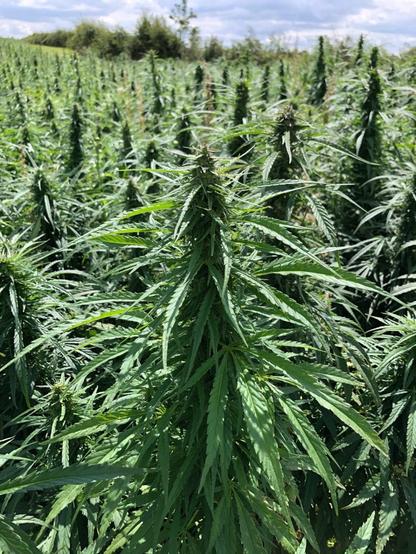
This short film shows how hemp was grown on a Cambridgeshire farm and turned into construction materials that sequester carbon.

The movie was made at Margent Farm, which was bought by film producer Steve Barron to grow hemp for his own home on the property.

It shows how fast-growing hemp was planted, harvested and processed into hempcrete and bioplastic cladding on the home, which is called Flat House.

Hemp has been cultivated for centuries in many societies

The woody inner section of the plant's stem, called shives, was processed into hempcrete by chopping it up and mixing it with lime. It was used at Flat House as a non-load-bearing wall infill and insulation material.

Hemp-based bioplastic was used to clad the outside of the home. This is made from the strong outer fibres of the plant's stem mixed with bio-resin and pressed into corrugated sheets.

Fast-growing hemp is a highly versatile raw material as well as an effective way of sequestering atmospheric carbon, according to Cambridge university researcher Darhsil Shah, who advised Barron on how to make construction materials from the plant.

"Numerous studies estimate that hemp is one of the best CO2-to-biomass converters," Shah told Dezeen in an interview last month. "It's even more effective than trees."

"Industrial hemp absorbs between 8 to 15 tonnes of CO2 per hectare of cultivation," he explained. "In comparison, forests typically capture 2 to 6 tonnes of CO2 per hectare per year depending on the number of years of growth, the climatic region, the type of trees."

Barron estimated that the house stores 24 tonnes of atmospheric carbon that was absorbed by the hemp via photosynthesis as it grew.

"The house is pretty much made of hemp and it has locked in atmospheric carbon," Barron told Dezeen, adding that it took 100 days to grow the hemp on eight acres, or 3.2 hectares, of land. "I guess that's 24 tonnes of carbon," he said.

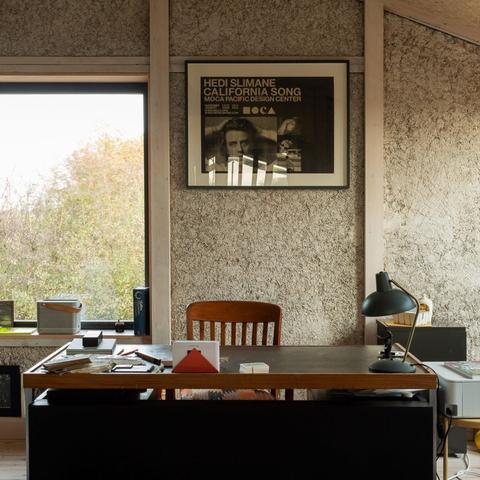
Hempcrete panels were left exposed to add texture and warmth to Flat House

Hemp is becoming increasingly sought-after by architects looking for natural, carbon-storing products. However, UK farmers are battling to legally cultivate the crop.

Hemp farmers need a hard-to-obtain Home Office licence to grow hemp, which is restricted by drug-control laws.

This is despite the fact that industrial hemp, which is a variety of cannabis, contains very low levels of the psychoactive agent tetrahydrocannabinol (THC) that is present in sister plant marijuana.

"We've probably had three or four hundred architects who have emailed us," said Barron. "They're desperate for a natural material and a carbon-zero way of building houses. Everybody's looking for it. The market's definitely there but it needs deregulation."

The video was produced by Oliver Barron.

Carbon revolution

This article is part of Dezeen'scarbon revolution series, which explores how this miracle material could be removed from the atmosphere and put to use on earth. Read all the content at: www.dezeen.com/carbon.

The sky photograph used in the carbon revolution graphic is byTaylor van Riper via Unsplash.

The post See how hemp is cultivated, processed and used to build a house in this movie appeared first on Dezeen.

#all #videos #hempcrete #oneminutevideos #carbonnegativedesign #hemp

"We are already carbon negative by some long stretch" says furniture maker Sebastian Cox

Creating furniture from locally sourced wood has allowed Sebastian Cox to make his company and his employees carbon negative, the British designer claims.

Last year, Cox stored 100 tonnes of carbon dioxide in timber products such as furniture, kitchens and treehouses, he calculates. Now, he's on track to "smash" this record in 2021.

"As a company, we emit far less than 100 tonnes," Cox told Dezeen. "So we are already carbon negative by some long stretch, to the point that we're taking responsibility for our staff's carbon footprint, too."

Cox takes a holistic approach to design, taking time to understand his raw materials in a way that is both philosophical and scientific. In an opinion column for Dezeen published as part of our carbon revolution series, he imagined how a tree would view climate change.

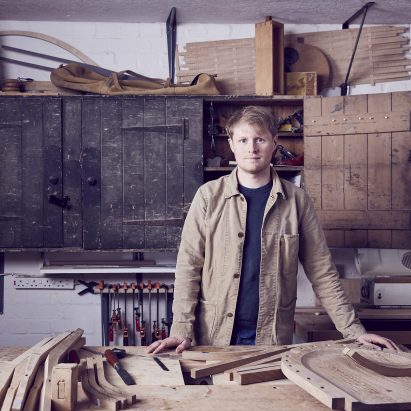
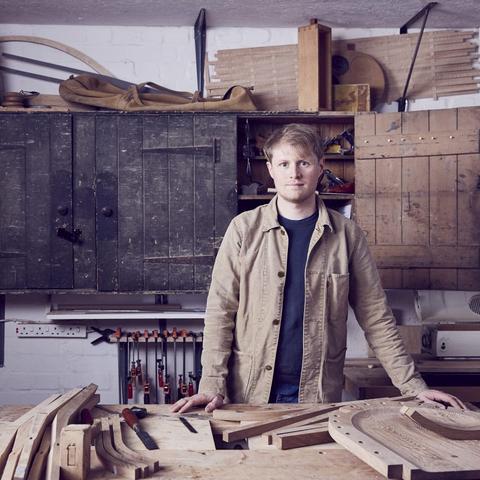
Sebastian Cox (top) runs a small workshop in London (above)

"They would surely be enjoying the extra CO2 in the atmosphere, which increases their mass," he wrote, adding that the discovery of fossil fuels was a blessing for them as this "saved millions of acres of temperate forest since our prime energy source switched from land-hungry wood to buried fossil energy".

He went on to describe the principle of hygroscopy by which carbon in the soil can help water retention, which helps woodlands stay cool and fertile.

Cox sees atmospheric carbon as "a resource to regenerate our earth"

"For every one gram of extra carbon in soils, eight grams of extra water can be held there too because of the complex hygroscopic structure of soil carbon," he wrote.

"The design community should be leading the material world into an intense period of re-greening and cooling our planet, and it should start by finding ways to make the excess carbon we have in our skies a resource to be used to regenerate our earth."

Like all plant matter, wood is 50 per cent carbon once the water content has been removed. Like furniture maker Takt and shoe brand Allbirds, Cox has created a lifecycle calculator for estimating the amount of the element that is both stored and emitted by his supply chain and the small London workshop where he employs 12 people.

He has also created a carbon counting spreadsheet for his staff, encouraging them to estimate and reduce the annual emissions they generate in their private lives through everything from flying to eating meat.

Using wood can enable designers to get carbon neutral "very quickly"

This year, with the coronavirus pandemic restricting air travel, Cox expects that his products will sequester enough CO2 to offset the emissions generated not just by his business but by his whole team.

"If you employ solid wood, you're going to be getting towards carbon neutral or carbon negative very quickly," he said.

"This is the wonderful thing about wood. It doesn't require heavy heating, you don't have to melt it, you don't have to boil it," Cox continued.

"You've literally got solid carbon that comes in and with a light bit of working becomes a useful product."

Cox, who founded his studio and workshop in 2010, creates furniture using timber from his own managed woodland in Kent.

The 4.5-acre forest is never cut down faster than it can regenerate itself in order to preserve it as a carbon sink and a refuge for wildlife. Cox bolsters his supply with wood from other sustainably managed forests in the south of England.

By turning this wood into durable, modern heirlooms, the designer hopes to store the carbon that was sequestered by the trees for generations to come, as well as highlighting the untapped potential lying in the UK's 3.2 million acres of forest.

More than 40 per cent of this area is neglected and unmanaged, while 87 per cent of the timber used in the country is imported.

"We need to put commercial value in woodlands"

Commercialising and maintaining these forests through techniques such as coppicing, in which trees are cut close to the base to encourage rapid regrowth while encouraging biodiversity by allowing light to reach the forest floor, would allow them to grow faster and lock away more carbon as well as creating a potential economic benefit of £20 million a year.

"We need to put commercial value in woodlands and therefore give a financial incentive for managing them," Cox said.

"For me, it's not about saying: we've got this bit of land that is now sequestering carbon for us, let's lock it up and throw away the key," he continued.

"It's about saying: we're going to allocate this land to biodiversity and carbon services. Now, what else can we do with it without disrupting those cycles?"

Cox uses wood from his own managed woodland in Kent to make his furniture

Cox was able to create his life cycle calculator purely based on his own electricity bills and numbers he found in online databases, mitigating the cost of working with an external screening company, which can be prohibitive for a small business.

"Most of the information I've got is just from extensive googling," he said.

"I wanted to create something that was entirely self-led, based on research and a spreadsheet, which I adapt as new data is released."

Carbon stored by trees "can vary so much"

Although this means the final figures aren't independently verified, the designer says they help to provide his studio with a workable estimate.

"It's very much guesswork because we're learning now that the carbon stored by different trees can vary so much depending on the amount of water they had access to," Cox said.

"It can fluctuate a lot but we put in a fairly conservative middle-ground figure."

Most of the company's emissions come from drying the wood and transporting it to the London workshop via lorry.

Cox has already managed to reduce this figure by weaning the timber yards he works with off of red diesel, which is a subsidised, dirtier form of the fossil fuel used by off-road vehicles. Instead, he sends them waste sawdust from his workshop to heat the kilns that dry the wood at around 70 degrees Celsius "like a very cool oven".

"The lorry that comes with the wood also takes our sawdust away," Cox explained. "The drying of the wood is carbon neutral because we're drying it with a waste product. We are obviously releasing that waste as carbon but it's not from a fossil source."

The remaining emissions can largely be traced back to the energy needed to power the workshop itself.

Currently, this comes from non-renewable sources via the energy grid as Cox's studio is part of the larger Thames Side Studios industrial estate, where the landlord claims tariffs can't be changed for individual tenants.

Cox uses "very low energy machinery"

But according to the designer, the carbon stored in the wood still cancels out the associated emissions, as for every kilogram of CO2 his machines emit, another eight are stored in the timber they are processing.

"We use very, very low energy machinery to process the wood into furniture," he said. "And if you're working with solid wood, three-quarters of the material never gets worked or machined."

"There's some carbon tied up in things like screws and glue," Cox added. "But really, that's relatively small because the majority of the material we use is wood."

Sebastian Cox is also in the process of becoming certified as a B Corporation, which involves undertaking an extensive self-assessment of the company's impact on the environment, the community and its workers.

"They make you turn around to your suppliers and your customers to say: 'We're making changes. What can you do?'" Cox explained.

"I think that sort of give-and-take relationship is really essential."

Carbon revolution

This article is part of Dezeen'scarbon revolution series, which explores how this miracle material could be removed from the atmosphere and put to use on earth. Read all the content at: www.dezeen.com/carbon.

The sky photograph used in the carbon revolution graphic is byTaylor van Riper via Unsplash.

The post "We are already carbon negative by some long stretch" says furniture maker Sebastian Cox appeared first on Dezeen.

#carbonrevolution #all #design #wood #sebastiancox #carbonnegativedesign

"We are already carbon negative by some long stretch" says furniture maker Sebastian Cox

Creating furniture from locally sourced wood has allowed Sebastian Cox to make his company and his employees carbon negative, the British designer claims.

Hemp "more effective than trees" at sequestering carbon says Cambridge researcher

Hemp can capture atmospheric carbon twice as effectively as forests while providing carbon-negative biomaterials for architects and designers, according to Cambridge University researcher Darshil Shah.

"Numerous studies estimate that hemp is one of the best CO2-to-biomass converters," said Shah, who is senior researcher at the Centre for Natural Material Innovation at Cambridge.

"It's even more effective than trees," he said. "Industrial hemp absorbs between 8 to 15 tonnes of CO2 per hectare of cultivation."

"In comparison, forests typically capture 2 to 6 tonnes of CO2 per hectare per year depending on the number of years of growth, the climatic region, the type of trees etc."

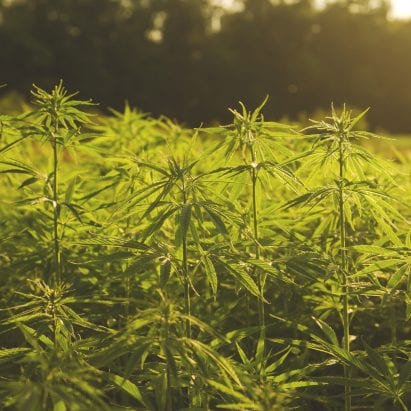
Darshil Shah (above) conducts research into biomaterials made from hemp (top) at the Centre for Natural Material Innovation at Cambridge

Carbon-negative bioplastics and construction materials made from the plant can be used to "replace fibreglass composites, aluminium and other materials in a range of applications," he added.

The Centre for Natural Material Innovation, part of Cambridge University's Department of Architecture, conducts research into biomaterials in order to "transform the way we build to achieve zero carbon emissions."

Hemp is a "multi-purpose crop"

Shah's work covers engineered wood, bamboo and natural fibre composites as well as hemp, which he described as "a multi-purpose crop that offers materials and resources in multiple forms."

Hemp, or industrial hemp, is a variety of the Cannabis sativa plant but contains very low levels of the psychoactive compound tetrahydrocannabinol (THC) compared to marijuana, which is another variety.

The fast-growing plant has been grown for thousands of years for its fibres, which were traditionally used for rope, textiles and paper.

Today it is increasingly being used to make bioplastics, construction materials and biofuels as well as products containing cannabidiol (CBD), an active ingredient that is touted for its alleged health benefits.

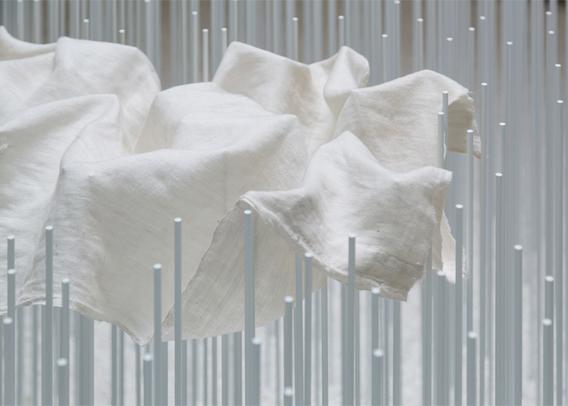
Japanese designer Yuseke Seki has used hemp to produce delicate textiles

The strong, stiff fibres that form the outside of the stem can be used to produce bioplastic products including automotive parts and even wind-turbine blades and cladding panels, Shah said.

"With the hemp bioplastic cladding panels, we find that they are a suitable alternative to aluminium, bitumen-plastic and galvanised steel panels, requiring only 15 to 60 per cent of the energy in its production."

The shives, which are the woody inner part of the stem, can be used to make "hempcrete", a non-load-bearing wall infill and insulation material.

Benjamin Hubert has used hemp to create a tile-based partition system for textile company Woven Image

Shah pointed out that in contrast to conventional agriculture, which emits large amounts of carbon, hemp farms do the opposite.

"Agricultural land in the UK, on average, emits around 3 tonnes of CO2 per hectare per year," he said. "Hemp offers an incredible scope to grow a better future." In addition, hemp produces more usable fibres her hectare than forestry.

"We can produce bioplastics that can replace fibreglass composites"

Shah recently collaborated with film-maker Steve Barron, who has converted the 53-acre Margent Farm in Cambridgeshire to hemp production and used the crop to build his own house.

The farm grows industrial hemp organically, which further reduces emissions compared to conventional agriculture, where between 30 and 40 per cent of emissions come from fertilisers and pesticides.

Film-maker and hemp-farmer Steve Barron has built a house using the plant

Shah is working with the farm to develop new carbon-negative materials that could be used in manufacturing and construction.

"With Margent Farm’s hemp fibres, and using 100 per cent bio-based resins, we can produce bioplastics that can replace fibreglass composites, aluminium and other materials in a range of applications," he said.

"We can use the wealth of textile science knowledge that humans have gathered over thousands of years to produce a range of textile fibre composites with properties suitable for non-structural products."

Carbon revolution

This article is part of Dezeen'scarbon revolution series, which explores how this miracle material could be removed from the atmosphere and put to use on earth. Read all the content at: www.dezeen.com/carbon.

The sky photograph used in the carbon revolution graphic is byTaylor van Riper via Unsplash.

The post Hemp "more effective than trees" at sequestering carbon says Cambridge researcher appeared first on Dezeen.

#carbonrevolution #all #architecture #design #materials #carbonnegativedesign #hemp

Hemp "more effective than trees" at sequestering carbon says Cambridge researcher

Hemp can capture atmospheric carbon twice as effectively as forests while providing carbon-negative biomaterials for architects and designers, according to Cambridge University researcher Darshil Shah.

Dezeen

Ten materials that store carbon and help reduce greenhouse gas emissions

As our carbon revolution series continued this week, here are ten projects that capture carbon including bioplastic cladding and mycelium insulation.

Sequestering carbon that has been removed from the atmosphere in buildings and products is a key way of tackling climate change.

This can be done by taking plant matter such as wood, cork, hemp and algae that has captured atmospheric carbon via photosynthesis and using it directly. Alternatively, it can be turned into other materials that store carbon more permanently.

"What if everything we're surrounded with was removing emissions instead of releasing them?" said Neema Shams of Made of Air, which makes carbon-negative bioplastic from forest and agricultural waste.

The material is carbon-negative because it contains more carbon than was emitted during the material's manufacture and use.

"Climate change is a material problem"

"Climate change is really a material problem in that there's too much carbon in the atmosphere. So how come we can't turn that into our biggest resource?" Shams told Dezeen in the interview conducted as part of the carbon revolution series.

Other products utilise carbon captured from factory chimneys and other industrial processes that emit greenhouse gases.

However, such products cannot be considered carbon negative, since they do not result in a net reduction in atmospheric carbon.

Dezeen's carbon revolution series explores how this miracle material could be removed from the atmosphere and put to use on earth.

Here are ten examples of carbon-storing materials from our archive.

Bioplastic

German brand Made of Air has developed a carbon-negative bioplastic that can be used in cars, interiors and cladding.

The material contains biochar, a carbon-rich substance made by burning biomass without oxygen, which prevents the carbon from escaping as CO2.

"With biochar, if you just left it on the ground and came back a thousand years later, it would look exactly the same," Shams said. "Only if you were to burn it would that carbon be re-released."

The bioplastic was recently used to clad a car dealership in Munich with the installation storing 14 tonnes of carbon, according to Made of Air.

Find out more about Made of Air ›

Mycelium insulation

Start-ups including London-based Biohm are using mycelium to create building insulation that is naturally fire-retardant and removes "at least 16 tonnes of carbon per month" from the atmosphere as it grows.

Mycelium, a biomaterial that forms the root system of fungi, feeds on agricultural waste and in the process sequesters the carbon that was stored in this biomass.

Sustainability expert David Cheshire described mycelium as "part of the solution" to making buildings carbon-negative.

"It's naturally fire retardant," he told Dezeen. "It's actually got better insulation properties than most standard insulation and it's actually sequestering carbon."

Mycelium is fast-growing and cheap to produce in custom-made bioreactors. It can be grown in moulds to create usable products such as packaging and lamps.

It can also be turned into new materials including leather-like products such as Mylo. These in turn can be used to produce handbags and clothes.

Find out more about mycelium insulation ›

Carpet tiles

American carpet-tile manufacturer Interface is aiming to make its entire product range carbon negative by 2040, starting with the Embodied Beauty and Flash Line carpets that were released this year.

They are constructed almost exclusively from recycled plastic and various biomaterials, which the brand says store more embodied carbon than is emitted by the products in their production.

Interface describes the tiles as carbon-negative "from cradle to gate", meaning their lifecycle after they leave the factory is not taken into account.

"It's not carbon-negative for its full lifecycle because elements of transport and end-of-life use we can influence but we can't control at this stage," Interface sustainability leader Jon Khoo told Dezeen.

"So we wanted to focus on going carbon negative with what we can control."

Find out more about Interface tiles ›

Wood

A fully-grown tree can remove 22 kilograms of CO2 from the atmosphere over the course of a year, meaning that the material is carbon negative as long as it is responsibly sourced and that the felled tree is compensated by new planting.

Any carbon stored in the wood needs to be weighed against the emissions generated during transport and processing and replacement trees need to be left growing long enough so they themselves can be harvested and turned into carbon-storing materials.

However, one problem with wood is the tremendous amount of waste produced by the timber industry. Only part of each tree is used and processing timber generates significant amounts of offcuts and sawdust. In addition, only around 10 per cent of timber is recycled.

"Just think about carving wood," said sustainable-design guru Willian McDonough in an interview with Dezeen as part of carbon revolution. "It's a negative process, right? We're cutting away stuff all the time."

Find out more about wood ›

3D-printed wood

Additive manufacturing company Forust has developed a way of turning sawdust and lignin discarded by the timber and paper industries into a 3D printing filament.

By making products from waste, the company hopes to stop additional trees from being cut down as well as preventing the waste wood from decaying or being incinerated, which would re-release the carbon is stored.

"It could save a lot of trees," said McDonough. "It's kind of fun and it's quite beautiful."

Find out more about Forust ›

Olivine sand

Olivine, which is one of the most common minerals on earth, is capable of absorbing its own mass in CO2 when crushed and scattered on the ground.

This means it lends itself to being a fertiliser and a replacement for sand or gravel in landscaping, while the carbonated version (above) can be used as an additive in the production of cement, paper or 3D-printing filaments.

"It absorbs CO2 very easily," said Teresa van Dongen, who has included the mineral in an online library of carbon-capturing materials.

"One tonne of olivine sand can take in up to one tonne of CO2, depending on the conditions. You just have to spread it out and nature will do its job."

Find out more about olivine ›

Concrete

Montreal company Carbicrete has developed a type of concrete that captures carbon in its production while substituting emissions-intensive cement, which is responsible for eight per cent of all greenhouse gas emissions, with waste slag from the steel industry.

Currently, the process relies on captured industrial emissions, meaning that it reduces the amount of new emissions being pumped into the atmosphere but does not reduce atmospheric CO2. However, once the company draws its CO2 from the atmosphere via direct air capture (DAC), this would make the final material carbon-negative.

"It's negative emissions," Carbicrete CEO Chris Stern told Dezeen. "We're taking CO2 out of the system every time we make a block."

Find out more about Carbicrete ›

Bricks

Australian company Mineral Carbonation International injects CO2 into industrial waste such as mine tailings, turning it from a gas into a solid that can then be used to create cement bricks and other building materials.

The process replicates the same mineral carbonation process that takes place in nature as carbon dioxide dissolves in rainwater and reacts with rocks to form new carbonate minerals.

"We're trying to embed emissions into as much of our everyday life as possible," said MCi chief operating office Sophia Hamblin Wang. "We turn waste into new products. And we aim to do it in a way that makes money."

Find out more about Mineral Carbonation International ›

Food

Solar Foods is one of a growing cohort of companies using emissions captured from industrial plants to create foods and drinks. The Finnish company uses microbes to turn carbon dioxide into a meat substitute called Solein.

The CO2 is injected into a fermentation tank together with hydrogen and different nutrients, all of which the microbes consume and turn into protein that is then harvested and dried, resulting in a powder with a similar composition to dried soy.

The carbon dioxide currently comes from industry but could one come from captured atmospheric carbon.

If scaled up, the technology could potentially provide humanity with its protein needs while using a fraction of the land and resources used by traditional agriculture, thereby freeing up more land for afforestation, solar power and other means of tackling climate change.

Producing Solein is entirely free from agriculture," said Solar Foods. "It doesn't require arable land or irrigation and isn't limited by climate conditions."

Find out more about Solar Foods ›

Vodka

Brooklyn-based Air Co uses CO2 to make vodka. The brand breaks down carbon dioxide with water and a proprietary catalyst in a reactor to create ethanol, which is then used to distil vodka.

"We invented a way to capture excess carbon from the air and turn it into ultra-refined, covetable products," Air Co said, although the claim is misleading since the CO2 comes from factory emissions, meaning it reduces rather than reverses greenhouse-gas emissions.

In addition, food and drink only offer short-term storage of carbon, since the product is soon consumed and the carbon returned to the atmosphere via the natural carbon cycle.

Find out more about Air Co vodka ›

Carbon revolution

This article is part of Dezeen'scarbon revolution series, which explores how this miracle material could be removed from the atmosphere and put to use on earth. Read all the content at: www.dezeen.com/carbon.

The sky photograph used in the carbon revolution graphic is byTaylor van Riper via Unsplash.

The post Ten materials that store carbon and help reduce greenhouse gas emissions appeared first on Dezeen.

#carbonrevolution #all #materials #roundups #carbonnegativedesign #carbonneutraldesign

Ten materials that store carbon and help reduce greenhouse gas emissions

As our carbon revolution series continued this week, here are ten projects that capture carbon including bioplastic cladding and mycelium insulation.

Dezeen

Mycelium is "part of the solution" to carbon-negative buildings

Mycelium could soon be used to insulate and fire-proof buildings while sequestering carbon, according to sustainability expert David Cheshire.

The biomaterial, which forms the root systems of fungi, is "a fantastic thing," Cheshire said.

"It's naturally fire retardant," he said. "It's actually got better insulation properties than most standard insulation and it's actually sequestering carbon."

"It's grown on waste from the agriculture industry," he added. "What's not to like?"

Above and top: biomaterials company Biohm produces mycelium insulation panels

Cheshire, who is sustainability director at construction consultant AECOM, spoke to Dezeen last week when discussing the carbon performance of this year's Serpentine Pavilion.

The pavilion, which is built of materials including recycled steel, timber and cork, is carbon-negative, meaning it sequesters more atmospheric carbon in its biomaterials that it emits over its lifecycle.

AECOM testing some "really cool" new mycelium products

While mycelium was eventually rejected due to concerns over its long-term durability, Cheshire said the material showed great promise for future projects.

"We looked at various mycelium products," he said, explaining that the AECOM team investigated a range of innovative biomaterials in an attempt to reduce the building's carbon footprint to a minimum.

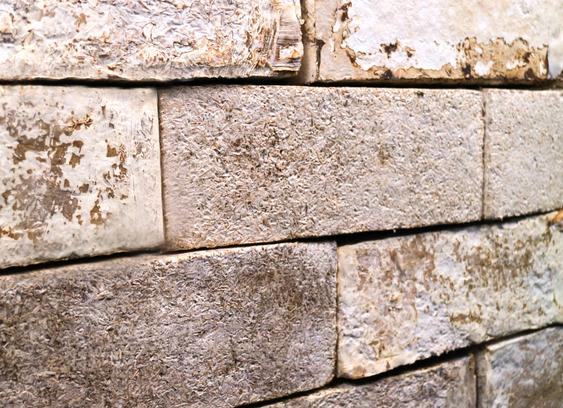
Biohm also produces mycelium bricks to use in construction

"We have been testing out some really cool new technologies and some really cool products that are just coming to market," said Cheshire, who is author of The Handbook to Building a Circular Economy and Building Revolutions, a book that explores how the built environment can become circular.

Mycelium grows in soil or on substrates such as wood in long, thread-like shoots called hyphae.

These can form into hard masses called sclerotia. It is the vegetative part of fungi, whereas the visible part, such as a mushroom, is the fruit.

Mycelium can feed on low-grade agricultural waste, sequestering the carbon stored in the biomass – which would otherwise be burned or composted, returning the carbon to the atmosphere – as it grows.

British designer Sebastian Cox used mycelium to create a range of lamps

Mycelium is biodegradable and non-toxic and provides good insulating, acoustic and fire performance.

It is fast-growing and cheap to produce in custom-made bioreactors where sclerotia can be grown in moulds to create usable products such as and packaging and lamps.

It can also be processed to make new materials including leather-like products such as Mylo. These in turn can be used to produce handbags and clothes.

Mycelium-based materials such as Mylo have been used by brands including Hermès as a vegan alternative to leather

In addition, a wide range of mycelium composite materials are under development.

These can be used to replace "foams, timber and plastics for applications, such as insulation, door cores, panelling, flooring, cabinetry and other furnishings," according to a scientific research paper on the material.

"Mycelium-derived materials have several key advantages over traditional synthetic materials including their low cost, density and energy consumption in addition to their biodegradability and low environmental impact and carbon footprint," said the report.

Stella McCartney has used mycelium-based material Mylo to create a fashion collection

Sustainability guru William McDonough also praised mycelium in an interview with Dezeen earlier this week, conducted as part of the carbon revolution series.

"We've been working with mycelium for many years," McDonaugh said. "They have amazing properties. They can be insulation, packaging, various kinds of acoustic material."

"They can be grown in a factory on agricultural secondaries such as wheat straw or barley straw."

Biohm, a biomaterials company that produces mycelium insulation panels, claims production of the project is carbon-negative, "sequestering at least 16 tonnes of carbon per month".

Carbon revolution

This article is part of Dezeen'scarbon revolution series, which explores how this miracle material could be removed from the atmosphere and put to use on earth. Read all the content at: www.dezeen.com/carbon.

The sky photograph used in the carbon revolution graphic is byTaylor van Riper via Unsplash.

The post Mycelium is "part of the solution" to carbon-negative buildings appeared first on Dezeen.

#carbonrevolution #all #architecture #mycelium #carbonnegativedesign

Mycelium is "part of the solution" to carbon-negative buildings

Mycelium could soon be used to insulate and fire-proof buildings while sequestering carbon, according to sustainability expert David Cheshire.

Atmospheric CO2 is "our biggest resource" says carbon-negative plastic brand Made of Air

Berlin startup Made of Air has developed a bioplastic made of forest and farm waste that sequesters carbon and can be used for everything from furniture to building facades.

The recyclable material is 90 per cent carbon and stores around two tonnes of carbon dioxide equivalent (CO2e) for every tonne of plastic.
By 2050, Made of Air hopes to be storing up to a gigatonne of CO2e a year in the material, which is also called Made of Air.

Company aims to "help reverse climate change"

"While we are a materials company, really in our heart we are a climate company and that's the reason for our existence," the company's chief commercial officer Neema Shams told Dezeen. "We're aiming to help reverse climate change."

Since the material stores more CO2 from the atmosphere than it emits throughout its lifecycle, Made of Air is a carbon-negative material, Shams said.

"We see carbon-negative as what biodegradable was 10 years ago," she explained. "Back then, no one knew what it was, no one knew why it mattered. And now it's pretty ubiquitous."

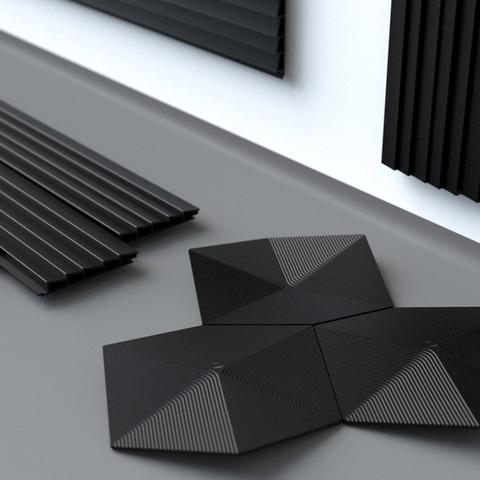
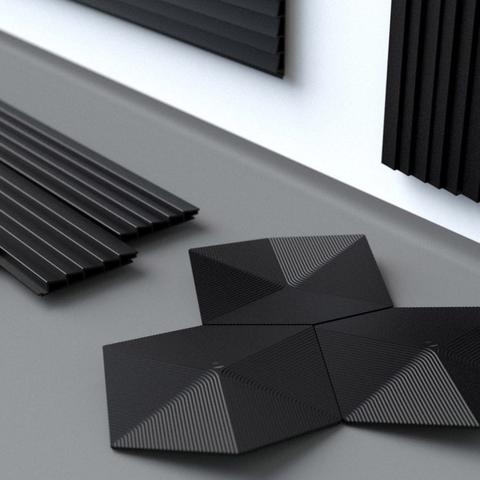
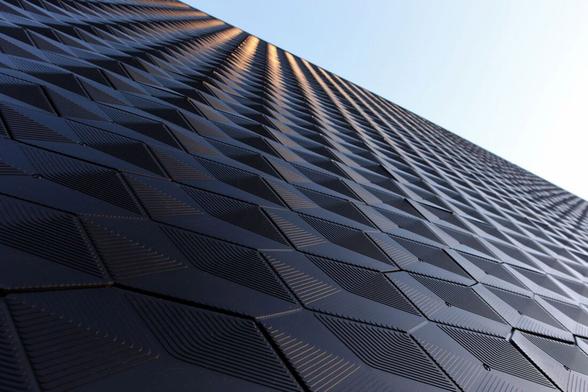
Made of Air's HexChar panels (top image) have been installed on the facade of an Audi dealership in Munich (above)

Made of Air was founded in 2016 by architects Allison ​Dring and Daniel ​Schwaag, who previously collaborated to create a pollutant-absorbing cladding called Prosolve370e.

The new company has identified five sectors where its bioplastic can be used. These are building facades, furniture, interiors, transport and urban infrastructure.

The material has recently been used to create a pair of limited-edition sunglasses in collaboration with H&M.

The company is also in talks with a US furniture maker about creating a "carbon-negative chair" and with automotive manufacturers about creating car parts.

In April, the thermoplastic was installed on a building for the first time. An Audi dealership in Munich was clad in seven tonnes of hexagonal panels the company calls HexChar.

The material is made of biochar

According to Shams, a lifecycle analysis has shown that the dealership's cladding stores 14 tonnes of carbon.

Over the next year, the company is ramping up its production capacity by 100 times to sequester 2,000 tonnes of CO2e each year.

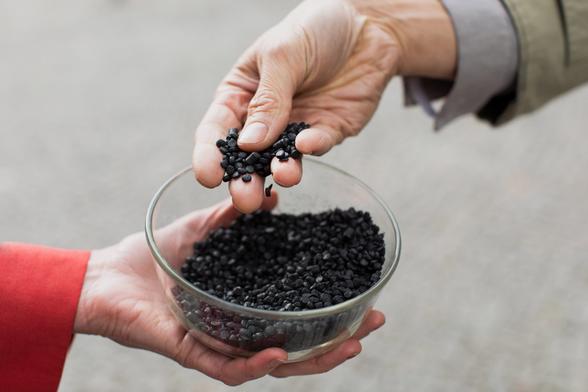
Made of Air is a non-toxic bioplastic made from biochar. This charcoal-like material is almost pure carbon and is made by burning biomass such as forestry offcuts and secondary agricultural materials without oxygen.

Biochar has been produced for centuries and is increasingly being used as a fertiliser as well as a way of sequestering carbon in the soil.

Made of Air mixes biochar with a binder made from sugar cane to create a material that can be melted and moulded like a regular thermoplastic.

Biochar is combined with a sugar cane binder to create thermoplastic granules that can be melted and moulded

"We have a proprietary process that takes the biochar, puts it through a series of steps and combines it with bioplastics to create granules," Shams said.

The granules can then be used in traditional plastic-forming processes such as injection moulding and can be processed using the same machinery as regular plastic.

To make its biochar, Made of Air sources waste from forestry and agriculture businesses based in the countryside around Berlin.

The biomass is then placed in a special furnace, where it is baked in a controlled, oxygen-free environment as part of a process called pyrolysis.

Without the presence of oxygen, the carbon in the biomass cannot form carbon dioxide during combustion, meaning there are no greenhouse gas emissions. Instead, the carbon remains and forms biochar.

The porous, carbon-rich material is highly effective at storing carbon. Unlike decaying biomass, which quickly releases its carbon back into the atmosphere, biochar remains stable for hundreds or even thousands of years.

"With biochar, if you just left it on the ground and came back a thousand years later, it would look exactly the same," Shams said. "Only if you were to burn it would that carbon be re-released."

Made of Air collaborated with H&M on a pair of sunglasses last November

Made of Air is one of a number of companies that view atmospheric carbon as an untapped resource.

Swiss company Climeworks, for example, is building direct air capture machines to create carbon it can sell, while Seattle start-up Nori is building an online marketplace that incentivises people to capture and trade atmospheric carbon.

"What if everything we're surrounded with was removing emissions instead of releasing them?" said Shams. "Climate change is really a material problem in that there's too much carbon in the atmosphere. So how come we can't turn that into our biggest resource?"

Made of Air's biochar plastic is cheaper than regular bioplastics but still more expensive than petroleum-based materials.

Material prices don't reflect "cost to the planet"

Ultimately, Shams believes that government intervention in the form of a carbon tax is needed in order to help products made from captured CO2 replace fossil plastics.

"In the wider capitalist system that we live in, everything needs to be cheap and widely available," she said. "The price of materials doesn't take into account their cost to the planet or to people."

"I think putting a value on the emissions associated with their production and their damage to the environment will be the most useful catalysts not only for us but for the wider sustainable materials space."

Carbon revolution

This article is part of Dezeen'scarbon revolution series, which explores how this miracle material could be removed from the atmosphere and put to use on earth. Read all the content at: www.dezeen.com/carbon.

The sky photograph used in the carbon revolution graphic is byTaylor van Riper via Unsplash.

The post Atmospheric CO2 is "our biggest resource" says carbon-negative plastic brand Made of Air appeared first on Dezeen.

#carbonrevolution #all #products #design #materials #technology #plastic #bioplastic #carbonnegativedesign #carboncapture

Atmospheric CO2 is "our biggest resource" says carbon-capturing plastic brand Made of Air

Berlin-based start-up Made of Air has developed a "carbon-negative" thermoplastic made of forestry and farm waste that can be used for everything from furniture to building facades.