Satellite Collision in Low-Ear...

#satellite #collision #debris #pollution #atmosphere #space #CRASHclock
Original open access article
Thiele et al. 8 Jan 2026, arXiv_astro-ph
An Orbital House of Cards: Frequent Mega-constellation Close Conjunctions

The number of objects in orbit is rapidly increasing, primarily driven by the launch of megaconstellations, an approach to satellite constellation design that involves large numbers of satellites paired with their rapid launch and disposal. While satellites provide many benefits to society, their use comes with challenges, including the growth of space debris, collisions, ground casualty risks, optical and radio-spectrum pollution, and the alteration of Earth's upper atmosphere through rocket emissions and reentry ablation. There is potential for current or planned actions in orbit to cause serious degradation of the orbital environment or lead to catastrophic outcomes, highlighting the urgent need to find better ways to quantify stress on the orbital environment. Here we propose a new metric, the CRASH Clock, that measures such stress in terms of the timescale for a possible catastrophic collision to occur if there are no satellite manoeuvres or there is a severe loss in situational awareness. Our calculations show the CRASH Clock is currently 5.5 days, which suggests there is limited time to recover from a wide-spread disruptive event, such as a solar storm. This is in stark contrast to the pre-megaconstellation era: in 2018, the CRASH Clock was 164 days.

The number of objects in orbit is rapidly increasing, primarily driven by the launch of megaconstellations, an approach to satellite constellation design that involves large numbers of satellites paired with their rapid launch and disposal. While satellites provide many benefits to society, their use comes with challenges, including the growth of space debris, collisions, ground casualty risks, optical and radio-spectrum pollution, and the alteration of Earth's upper atmosphere through rocket emissions and reentry ablation. There is potential for current or planned actions in orbit to cause serious degradation of the orbital environment or lead to catastrophic outcomes, highlighting the urgent need to find better ways to quantify stress on the orbital environment. Here we propose a new metric, the CRASH Clock, that measures such stress in terms of the timescale for a possible catastrophic collision to occur if there are no satellite manoeuvres or there is a severe loss in situational awareness. Our calculations show the CRASH Clock is currently 5.5 days, which suggests there is limited time to recover from a wide-spread disruptive event, such as a solar storm. This is in stark contrast to the pre-megaconstellation era: in 2018, the CRASH Clock was 164 days.

#FYI #PaulBeckwith video lecture and literature review #satellite #collision #cascade #space #CarringtonEvent #RiskAnalysis #CRASHclock
Apocalypse bingo 16. February 2026... Who has the satellites?

Orbital House of Cards – CRASH Clock Metric
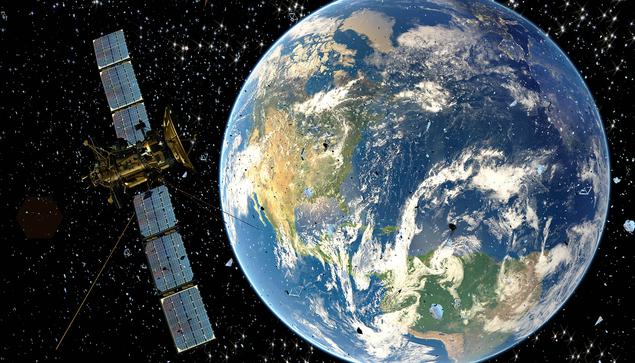
Researchers have updated the possibility that satellites in low earth orbit (LEO) could collapse after accidental collisions quickly cascade into a vicious cycle where initial collisions create a huge vortex of dangerous space debris, which creates even more collisions, and then even more collisions – just like a massive vehicle pileup on an ice covered interstate highway…this cascading collision scenario is known as the Kessler syndrome.
The researchers propose a new metric, the CRASH Clock, that measures the timescale for a possible Kessler like scenario to occur after a severe loss of space situational awareness. They propose the CRASH Clock is currently 5.5 days, which is the window of opportunity to recover/stop a wide spread cascading collision event. https://futurism.com/space/earths-lower-orbit-rapidly-collapse
DL full paper here: https://arxiv.org/abs/2512.09643 #Space #Satellites #LEO #KesslerSyndrome #Kessler #SpaceCraft #CrashClock #SatelliteCollision #SpaceJunk
Update the #crashClock

"Starlink is beginning a significant reconfiguration of its satellite constellation focused on increasing space safety," announced Michael Nicolls, Starlink's vice president of engineering: "We are lowering all Starlink satellites orbiting at ~550 km to ~480 km (~4400 satellites) over the course of...
@sundogplanets Your name shows on screen for a second.

"One of the scariest parts of this project was learning more about Starlink's orbital operations.
I had always assumed they had some kind of clever configuration of the satellites in the orbital shell that minimized conjunctions, and we would see the number of conjunctions grow over time in our simulations. But no! It's just random!
There's no magic here, it's just avoiding collisions by moving a Starlink satellite every 2 minutes. This is bad."
#starlink #crashclock
https://www.theregister.com/2025/12/12/crash_clock_orbit_collision/