Who would have thought an investigation into human milk–based products would find evidence in internal documents from the #Opioid, Food, & #Tobacco industries?
Dig into how the commercialization of HMBPs affects #publichealth:

#infantfeeding #CDoH

https://www.sciencedirect.com/science/article/pii/S0277953625012067

The IDL has a brand-new look!
Our redesigned site makes it easier to explore, search, & read documents with a cleaner layout, faster performance, & improved accessibility.
Missed our open-house demo? Catch the replay here -
https://youtu.be/JZSo_b0iTC8?si=soxg_2103rD_1UTs

#publichealth #CDoH #tobacco #opioids #archives

UCSF Industry Documents Library Open House Webinar Sept 9, 2025

YouTube
#tobaccodocument spotlight:
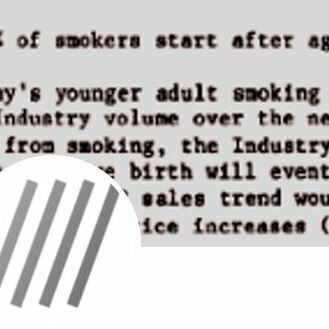
1982 memo from veteran #PhilipMorris scientist voicing concern over noticeable links btwn cigs & cancers: “Associating cigarette smoking with 30% of all cancer deaths should make someone sit up and take notice… Let’s face the facts...”
#archives #CDoH
bit.ly/40PyN8j
New paper uses the #Opioid #Archive to examine clinical decision support algorithms used to assess risk in pain management & the pharmaceutical industry’s role in shaping the digital transformation of opioid prescribing. #PublicHealth #CDoH https://doi.org/10.1007/s11606-025-09600-9
The Rise of Clinical Decision Support Algorithms in Pain Management 2009–2024 - Journal of General Internal Medicine

This paper examines the rise of clinical decision support algorithms used to assess risk in pain management and the opioid industry’s influence on their development and implementation. To understand this influence, we conducted a qualitative study of documents related to the development of a tool that relied on artificial intelligence (AI) to suggest modifications in opioid prescribing, called NarxCare. The study began with keyword searches of the Opioid Industry Document Archive (OIDA), which contained over 3 million documents at the time of the study, to examine the pharmaceutical industry’s role in shaping the digital transformation of opioid prescribing. Our findings highlight industry-driven investments, educational campaigns, corporate policy activities, and the reliance on proprietary data that facilitated the widespread implementation of NarxCare. The increasing reliance on NarxCare raises concerns about its limited transparency, unknown reliability, and potential bias which may disproportionately affect certain patient groups based on race, socioeconomic status, or health conditions. This paper argues that the promotion of technologies like NarxCare allows the pharmaceutical industry to reinforce the narrative that opioids can be effective when prescribed responsibly, using advanced, data-driven strategies. Marketed as tools that assist clinicians in making more informed prescribing decisions, NarxCare contributes to the portrayal of the industry as a responsible actor in the regulation and distribution of opioids. Shifting attention to individual risk factors rather than systemic challenges enables the pharmaceutical industry to sidestep its role in the opioid crisis and evade scrutiny for its influence over regulation, the sponsorship of education and research, lobbying, supply chain control, and public health narratives. While NarxCare aims to improve prescribing safety, it requires critical evaluation in terms of effectiveness, ethical considerations, and the continued influence of the pharmaceutical industry in its design and implementation.

SpringerLink

New Paper Alert! 🎉
Han E, Crosbie E, Ling P, et al. Tobacco industry influence on breast cancer research, policy and public opinion: scoping the Truth Tobacco Industry.

#breastcancer #tobaccoindustry #CDoH #commercialdeterminantsofhealth

https://tobaccocontrol.bmj.com/content/early/2025/04/23/tc-2024-058724

Tobacco industry influence on breast cancer research, policy and public opinion: scoping the Truth Tobacco Industry Documents

Objective Over the last 35 years, there has been growing evidence suggesting a relationship between tobacco use and breast cancer. The tobacco industry’s role in shaping research, policy and public opinion about the relationship is unknown. This study’s objective is to determine if the tobacco industry-funded Council for Tobacco Research (CTR) Records and the Tobacco Institute (TI) Records, housed in the Truth Tobacco Industry Document Archive, contain documents related to internal research about breast cancer and strategies to influence the science and public opinion about breast cancer causes. Methods We applied the situational scoping method, in which community advocates and university researchers collaborate, to (1) identify external events considered by CTR or TI as a threat or opportunity to business interests; (2) select events for further analysis and (3) conduct social worlds/arenas mapping of industry responses to selected events. Results The CTR and TI Records contained 19 719 documents with the search term ‘breast cancer’ ranging from the 1950s to 1998. We analysed nine events relevant to the aim of this research. CTR and TI responded to external threats, pointing out methodological problems in studies they perceived as threatening, or characterising lung cancer as misdiagnosed or metastasised breast cancer. They responded to external opportunities with promoting and funding research focusing on smoking’s ‘protective effects’ over breast cancer, and breast cancer’s genetic, hormonal and dietary causes. Conclusion The CTR and TI Records are a rich source of documents related to tobacco industry efforts to influence breast cancer research, policy and public opinion away from any aetiologic relationship between tobacco use and breast cancer. Data are available upon reasonable request.

Tobacco Control
#CDoH Commercial Determinants of Health - Big #Alcohol versus @who.int and public health NGOs:

RE: https://bsky.app/profile/did:plc:5nql4fiel4zr4hbqdgggrgjv/post/3lm7r64o47s26
Bluesky

Bluesky Social
The Healthy Populations Institute at #DalhousieU is hosting a webinar series on the #CommercialDeterminantsOfHealth in October/November 2024. Hear from global experts on how #CDOH shape our health & what we can do about them to improve #populationhealth More here: https://www.eventbrite.ca/e/hpi-speaker-series-commercial-determinants-of-health-tickets-1016661270227?aff=oddtdtcreator #AcademicMastodon
HPI Speaker Series - Commercial Determinants of Health

An introduction to the Commercial Determinants of Health in Atlantic Canada with global experts.

Eventbrite
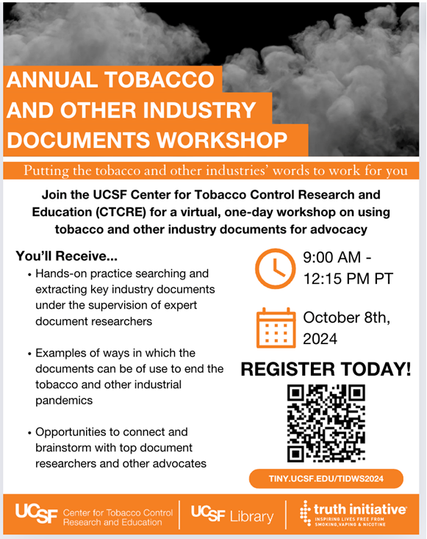
Join us for the UCSF Center for Tobacco Control Research and Education's Annual Tobacco and Other Industry Documents Workshop on October 8th! Register via the link and learn how to effectively utilize #industrydocuments to support advocacy efforts:
https://tiny.ucsf.edu/tidws2024
#tobaccoindustry #opioids #CDoH
Welcome! You are invited to join a webinar: Annual Tobacco and Industry Documents Workshop. After registering, you will receive a confirmation email about joining the webinar.

Welcome! You are invited to join a webinar: Annual Tobacco and Industry Documents Workshop. After registering, you will receive a confirmation email about joining the webinar.

Zoom

A common tactic used by industry to maximise profits is to shape public discourse and information environments, defining problems and solutions to suit their own interests, often undermining public health.

Read WHO's series of case studies, that got contributions from CEO's researchers Nina Holland and Olivier Hoedeman - https://iris.who.int/handle/10665/376957

#NCDs #CDoH #Disinformation #Industryplaybook

"exposure to just 4 classes of product - #tobacco, alcohol, ultra-processed foods & #fossilfuels - are linked to 1 out of every 3 deaths worldwide"
Thank you Nick Chartres, Tracey J Woodruff & Lisa Bero for shining a light on industry influence and commercial determinants of health. #CDoH

https://theconversation.com/we-think-we-control-our-health-but-corporations-selling-forever-chemicals-fossil-fuels-and-ultra-processed-foods-have-a-much-greater-role-227776

We think we control our health – but corporations selling forever chemicals, fossil fuels and ultra-processed foods have a much greater role

Corporations have an incentive to make profits – even if their products hurt or even kill people. Here’s how to stop history repeating.

The Conversation