 Kirst Mason D'Raven
The Man Who Hunted Monsters
Imagine, for a moment, that it is the middle of the nineteenth century.
The Peak District is a very different place. The roads are rougher. The hills seem wilder. The great limestone caverns that draw visitors today are still places of mystery. Local people know the caves. Shepherds know them. Miners know them. But science has yet to unlock their secrets. Stories cling to these places. Monsters are said to have lurked there once. Dragons. Great beasts. Creatures from an age before memory. Most sensible Victorians dismissed such tales with a smile. But William Boyd Dawkins did not. Instead, he picked up a lantern and went looking for them.
The remarkable thing is that he found them. Not living, breathing monsters, perhaps, but something far more extraordinary. Hidden beneath the soil of caves and burial mounds lay the bones of creatures that had once walked across Britain. Cave hyenas. Mammoths. Woolly rhinoceroses. Cave bears. Animals so strange and so distant from modern experience that they might as well have stepped from folklore.
Boyd Dawkins went on to become one of the great explorers of Britain’s prehistoric past. In fact, if Indiana Jones had exchanged his revolver for a geological hammer and his whip for a notebook, the result might have looked something like the Welsh scientist who would become one of Buxton’s most famous adopted sons.
Born in Montgomeryshire, Wales, in 1837, William Boyd Dawkins grew up in a world undergoing enormous change. Geology was transforming humanity’s understanding of time. Ancient assumptions about the age of the Earth were being challenged. New discoveries suggested that human history stretched back far beyond biblical chronology. It was an exciting and often controversial age.
Scientists argued passionately. The Victorian public devoured reports of new discoveries. Newspapers carried accounts of archaeological finds from across Britain and beyond and Boyd Dawkins arrived at exactly the right moment.
Educated at Oxford and later employed by the Geological Survey, he quickly established a reputation as a gifted geologist, archaeologist and palaeontologist. But Boyd Dawkins was far more than a local antiquarian with an interest in caves. During a remarkable career he helped pioneer the emerging field of cave archaeology and played a crucial role in demonstrating that Ice Age animals once roamed Britain. His work contributed to our understanding of mammoths, cave hyenas and the earliest human inhabitants of these islands.
Beyond archaeology, he was involved in surveys connected with the proposed Channel and Humber Tunnels and helped prove the existence of valuable coal deposits beneath Kent, discoveries with significant economic implications for the nation. He became Curator of Manchester Museum and Professor of Geology at Owens College, also in Manchester. His achievements earned him election as a Fellow of the Royal Society, one of the highest honours in British science, and in 1919 he was knighted in recognition of a lifetime devoted to advancing knowledge.
By the early twentieth century, Sir William Boyd Dawkins was recognised as one of Britain’s foremost authorities on the ancient past. Yet it was the caves that held his imagination. And the Peak District proved particularly rich hunting ground.
Today we think of caves as tourist attractions but Boyd Dawkins regarded them as archives. Each layer of sediment was a page. Each fragment of bone a sentence. Each cave a library preserving forgotten worlds. By painstakingly excavating cave deposits, he helped reconstruct landscapes that existed tens of thousands of years before the first written records.
This was detective work on an extraordinary scale. A single tooth might reveal the presence of a predator. A broken bone might tell a story of hunting and scavenging. A stone tool could prove that ancient people once shared the landscape with creatures now extinct. Long before television documentaries brought prehistory into our living rooms, Boyd Dawkins was piecing together these stories from fragments buried in the darkness.
And like all great Victorian scientists, he possessed an appetite for debate. The nineteenth century was not a polite age of quiet academic agreement. Scientific disputes were fought publicly and vigorously. Scholars challenged one another in journals, lectures and newspapers. Letters flew back and forth. Reputations rose and fell. Victorian scientists could be gloriously argumentative and Boyd Dawkins was no exception.
He engaged with some of the greatest intellectual questions of his age. How old was humanity? When did people first arrive in Britain? What relationship existed between prehistoric humans and the extinct animals whose bones surrounded them? The answers mattered. They were helping to reshape humanity’s understanding of itself.
While Mary Anning searched the cliffs of Lyme Regis for the fossilised remains of ancient creatures, Boyd Dawkins searched caves and buried landscapes for evidence of lost worlds. Both were united by a willingness to look beyond accepted wisdom and follow the evidence wherever it led. Yet there was an important difference. Mary Anning’s genius was often overlooked during her lifetime because she was a working-class woman operating within a scientific establishment that rarely welcomed women. Boyd Dawkins, by contrast, achieved recognition and influence. He became one of the leading authorities of his day and was eventually knighted for his contributions to science.
Boyd Dawkins work carried him far across Britain and beyond, but Buxton remained closely associated with his legacy and for local readers, one connection is particularly intriguing. The landscapes that fascinated Boyd Dawkins remain all around us to this day. Ancient burial mounds crown the hills surrounding Buxton. Caves pierce the limestone beneath our feet. Traces of forgotten lives continue to emerge from fields, quarries and excavations.
Among these sites is Fairfield Low, one of the area’s ancient burial mounds. In 1895 the Buxton antiquarian Micah Salt excavated the barrow and discovered human remains. The skull recovered from the site would later find a place in the Boyd Dawkins Study at Buxton Museum, creating an unexpected link between two men fascinated by the distant past. The connection becomes even more interesting when one considers nearby Skellibob Wood.
Local tradition sometimes suggests that the curious name preserves a memory of skeletons discovered in the area, although the true origin of the name remains uncertain. Like so many place names, it sits somewhere between documented history and local folklore. Whether or not the story is literally true, it is exactly the sort of mystery that would have appealed to Boyd Dawkins. Ancient burial mounds. Forgotten bones. Lost names. Fragments of human lives waiting to be rediscovered. He spent much of his career pursuing such clues.
For Boyd Dawkins, the landscape was never simply scenery. It was evidence. Every hill concealed a story. Every cave might preserve a vanished world. Every bone offered another piece of the puzzle. The Peak District we know today was, to him, a vast library waiting to be read.
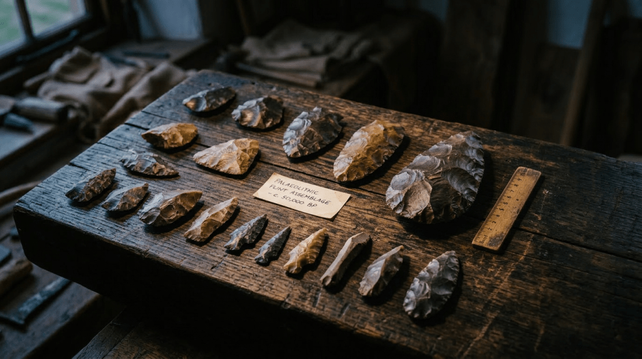
For me, however, Boyd Dawkins was never merely a name in a history book. Years ago now, when I volunteered at Buxton Museum helping to sort and curate parts of the lithics collection alongside my friend Bob Higginbotham, my favourite exhibit was not a fossil, a weapon or a prehistoric artefact. It was a room. The Boyd Dawkins Study.
Unlike most museum displays, it felt personal. It recreated something of the man himself. His study. His books. His possessions. His curiosities. His world. Visitors stepped not simply into an exhibition but into the orbit of a remarkable mind – you could almost imagine him returning at any moment. He had merely stepped out. His books remained. His artefacts remained. His questions remained.
As a folklorist, I have often thought that museums are at their best when they preserve not simply objects but curiosity itself. The Boyd Dawkins Room achieved exactly that. It reminded visitors that every discovery begins with a question.What lived here? Who came before us? What stories lie hidden beneath our feet?
Today, with Buxton Museum closed and its collections packed away, I find myself thinking about that room more often than I expected. Of all the exhibits that disappeared behind storage doors, the thought of Boyd Dawkins’ reconstructed study sitting in boxes somewhere is perhaps the saddest – after all, Boyd Dawkins spent his life recovering lost worlds from scattered fragments. Bones. Teeth. Tools. Clues. Now his own world has become a collection of carefully packed fragments awaiting rediscovery.
I hope one day soon those boxes are opened again. Not simply because the objects deserve to be seen. But because curiosity deserves a home.
And because somewhere in that carefully packed away Victorian study still sits the spirit of a Welshman who entered dark caves looking for monsters and emerged with a deeper understanding of what it means to be human.
#archaeologists #Buxton #BuxtonMuseum #Geology #History #ManchesterMuseum #OwensCollege #PeakDistrict #Science #SirWilliamBoydDawkins