Buxton Museum – From Closure to New Beginnings
Pull up a chair and let me put the kettle on, because this is one of those stories that feels close to home in more ways than one – Buxton has a way of doing that, doesn’t it? The mist rolling down over the hills, the limestone underfoot, the sense that if you dig even a little you will find something older than you expected. Sometimes a fossil, sometimes a story, and sometimes, if you are very lucky, something shaped by human hands thousands of years ago.
Buxton Museum and Art Gallery has always been the place where all those different layers come together. Not in a grand, untouchable way, but in that quietly fascinating, slightly eccentric way that local museums do so well. You could walk in out of the Derbyshire drizzle and find yourself standing in the middle of 360 million years of history, from ancient seas to Roman roads to the tools of people who once walked these same hills with flint in their hands and purpose in their stride.
The museum itself has roots deep in the late nineteenth century, when Buxton was not only a spa town but a place of folklore, culture and curiosity. Like many civic museums of the Victorian and Edwardian era, it was born from the idea that knowledge should be shared, that history and science should not belong solely to scholars but to everyone. Its long time home in the Peak Buildings on Terrace Road became a kind of anchor point for that vision, holding collections that told the story of the Peak District in all its strange and beautiful complexity.
And what a story that is.
The Peak is one of the richest prehistoric landscapes in Britain, a place where Mesolithic hunters once tracked game through woodland that no longer exists, where Neolithic communities raised monuments that still puzzle us, and where Bronze Age burials quietly mark the passing of lives long forgotten. The museum’s archaeological collections have always been central to telling that story, and tucked within them, the lithics collection carries a particular kind of magic. I know this because I, along with my good friend Bob, were once part of the team that sorted them.
There is something about lithics that stops you in your tracks. These are not decorative objects or curiosities. They are tools, shaped with intent, held in real hands, used in moments of survival. When you handle them, even through gloves and careful procedure, there is a flicker of connection. The angle of a blade, the precision of a strike, the quiet evidence of skill passed from one generation to another. The work of curation – sorting, cataloguing and understanding museum artefacts – is meticulous and often unseen, but it is the foundation on which everything else is built. Without that work, the stories remain silent.
Over the years, the museum grew into something much broader than a simple collection of ‘things’. It became a place that told the entire story of the Peak District, from deep geological time through to modern social history. Visitors could move through the corridors from fossils and Blue John stone to Roman jewellery, medieval relics and the industrial heritage that shaped the town itself. It was a place where everything connected if you took the time to look.
A turning point came in 2017 with the redevelopment of the Wonders of the Peak gallery, a project that brought new life and energy into the museum. Funded in part by Arts Council England, it transformed the way the collections were displayed, making them more immersive, more accessible and more engaging for a wider audience. Suddenly, this quiet local museum was drawing over 30,000 visitors a year, hosting exhibitions, workshops and even collaborations with institutions like the British Museum. There was a sense that little old Buxton’s story was not just local after all, but part of something much, much bigger.
The museum also began to shift in how it invited people in. Gone was the stuffy, old fashioned sense that everything must be observed at a distance. In its place came a more hands on approach, encouraging curiosity, exploration and connection. Families, researchers, school groups and the simply curious all found something to hold onto there, whether literally or figuratively.
And then, as so often happens with buildings that have stood a long time, reality intervened. Structural concerns with the Peak Buildings led to the museum’s closure in 2023. It is difficult to overstate how much that changed things. This was not just a case of locked doors. It was the temporary loss of a space that had quietly held the town’s memory for generations.
Behind the scenes, an enormous amount of work began almost immediately. Over 100,000 objects had to be carefully packed, documented and moved into secure storage. Each one handled with the same care it had received on display, perhaps more so, because now it had to endure uncertainty. Staff adapted, shifting their focus to outreach and temporary displays, with Buxton Library becoming a kind of lifeline for keeping the museum’s presence alive in the community.
The community, for its part, did not stay quiet.
In 2024, hundreds of people turned out in support of the museum, a reminder that this was never just a place tourists visited but something woven into everyday life. When a museum like this closes, even temporarily, it leaves a gap you can feel.
Now, in 2026, the story is shifting again, and there is a cautious sense of movement. Funding from Arts Council England has supported plans for a new temporary home near Buxton Library, with exhibition spaces, a shop and areas for activities and education. It is not a permanent solution, but it is a vital step, a way of bringing the collections back into public view and restoring that connection between people and place.
At the same time, Derbyshire County Council has committed to finding a permanent new location within the town centre as part of wider regeneration plans. It is an ambitious goal, and one that will take time. There are practical challenges, funding considerations and the delicate balance of honouring what the museum has always been while allowing it to evolve into something that can serve future generations.
Public consultation has become a key part of that process, with residents invited in 2026 to help shape what the museum should look like and how it should function. That feels fitting. This has always been a shared space, built not just by curators and councils but by the people who visit, contribute and care about it.
There are still questions, of course. Timelines are uncertain, and the move to a permanent home may take several years. Temporary arrangements will bridge that gap, and there will likely be moments of frustration along the way. But what stands out most is not uncertainty, but resilience.
Even now, the work continues. Collections are being researched, conserved and understood in quiet rooms rather than public galleries. Stories are still being pieced together. Knowledge is still growing.
And somewhere, carefully wrapped and waiting, are those lithics. Silent, patient, carrying the imprint of lives lived thousands of years ago. The fact that they have been handled, sorted and interpreted by people who care deeply about them adds another layer to their story. It becomes a chain of connection, from the original maker to the modern curator, from ancient landscape to present day Buxton.
When the museum opens its doors again, whether in a temporary space or a new permanent home, it will not simply be returning to what it was. It will be stepping into something new, shaped by everything it has been through and by the people who refused to let it fade quietly away.
And if you stand there, looking at a piece of worked flint under soft gallery lights, you might just feel it. That sense of continuity. Of hands across time. Of stories waiting patiently to be told again.
#Archaeology #artsAnsCulture #ArtsCouncilEngland #BronzeAge #Buxton #BuxtonLibrary #BuxtonMuseum #community #Derbyshire #DerbyshireCountyCouncil #heritage #lithics #localHistory #Mesolithic #museumNews #Neolithic #PeakDistrict #Prehistory #UKMuseums #WondersOfThePeak Viral Trend Daily
 Kirst Mason D'Raven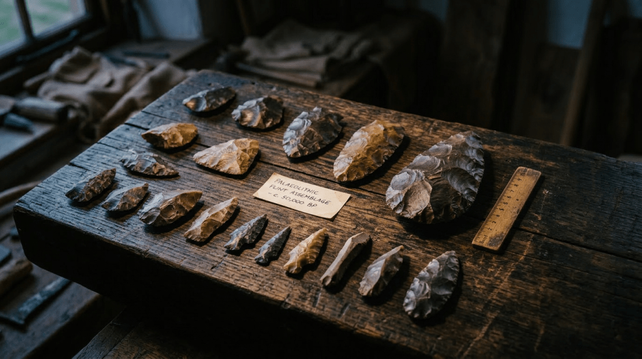
 Global Museum
 VTC News Bot