Global Temperature Report for 2025 - Berkeley Earth

2025 was the 3rd warmest year on Earth since direct observations began, and recent warming appears to be moving faster than expected.

Berkeley Earth

#Berkeley #BerkeleyEarth GlobalTemperature #Report

Folks, congratulations to our achievement! 👏👏👏 🏆 -.-

"We conclude that 2025 was the third warmest year on Earth since 1850. It is exceeded only by 2024 and 2023."

"The last 11 years have included all 11 of the warmest years observed in the instrumental record, with the last 3 years including all of the top 3 warmest."

https://berkeleyearth.org/global-temperature-report-for-2025/

Global Temperature Report for 2025 - Berkeley Earth

2025 was the 3rd warmest year on Earth since direct observations began, and recent warming appears to be moving faster than expected.

Berkeley Earth

#Berkeley #BerkeleyEarth #temperature update

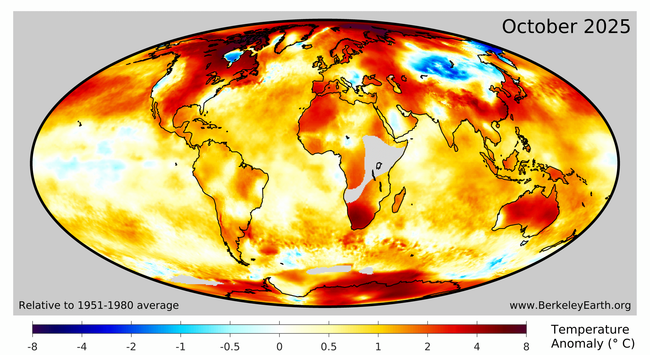
"October 2025 was the third warmest October on record behind 2023 and 2024, with a global average of 1.52 ± 0.08 °C (2.73 ± 0.14 °F) above the 1850-1900 average."

"2025 now has a 94% likelihood to be the third warmest year on record and almost no chance (0.02%) to have an annual average above 1.5 °C."

https://berkeleyearth.org/october-2025-temperature-update/

#climate #ClimateScience #climatechange #ClimateDisruption #globalWarming #globalHeating #ExtremeWeather #polycrisis

October 2025 Temperature Update - Berkeley Earth

October 2025 was the 3rd warmest October on record behind 2023 and 2024. 2025 is likely to become the third warmest year on record. La Niña has returned for now but may be short-lived.

Berkeley Earth
Ars Live recap: Climate science in a rapidly changing world https://arstechni.ca/pXNk #globaltemperatures #BerkeleyEarth #climatechange #Earthscience #Science
Ars Live recap: Climate science in a rapidly changing world

We talked with climate scientist Zeke Hausfather about recent temperature records.

Ars Technica
Ars Live: What’s up with the sudden surge in temperatures? https://arstechni.ca/L6Jp #globaltemperatures #Climatescience #BerkeleyEarth #Science #arslive
Ars Live: What’s up with the sudden surge in temperatures?

Zeke Hausfather of the Berkeley Earth project joins us to talk climate science.

Ars Technica

#FYI #BerkeleyEarth #TemperatureUpdate

"May 2025 was the second warmest May on record, with a monthly global average of 1.33 ± 0.11°C (2.39 ± 0.19 °F) above the 1850-1900 average. This is well below the record set in May 2024, but still above all previous years."

https://berkeleyearth.org/may-2025-temperature-update/

#climate #ClimateScience #climatechange #ClimateEmergency #ClimateCrisis #ClimateBreakdown #climatecatastrophe #globalWarming #globalHeating #ExtremeWeather

May 2025 Temperature Update - Berkeley Earth

May 2025 was the 2nd warmest May on record behind 2024. The chance of record warmth in 2025 has declined to 5%. An ENSO neutral condition continues.

Berkeley Earth

#FYI #BerkeleyEarth #temperature Update March 2025

"...While we measure March 2025 to be 0.02 °C and 0.04 °C warmer than 2024 and 2016, respectively, Copernicus ranked March 2025 as the second warmest March and NOAA reported the third warmest March."

https://berkeleyearth.org/march-2025-temperature-update/

#climate #ClimateScience #climatechange #ClimateEmergency #ClimateCrisis #ClimateBreakdown #climatecatastrophe #globalWarming #globalHeating #ExtremeWeather

March 2025 Temperature Update - Berkeley Earth

March 2025 tied 2024 and 2016 for the warmest March on record. 2025 has a 34% chance to be a record warm. The brief La Niña has ended.

Berkeley Earth
Global #Temperature Report for #2024 - #BerkeleyEarth
Annual average for 2024 is estimated as 1.62 ± 0.06 ° above the average pre-industrial period. The warming spike observed in 2023 and 2024 has been extreme and represents a larger than expected deviation from the previous warming trend.
Recent warming trends and the lack of adequate mitigation measures make it clear that the 1.5 °C goal will not be met.
https://berkeleyearth.org/global-temperature-report-for-2024/
#climate #climatechange #climatecrisis
Global Temperature Report for 2024 - Berkeley Earth

2024 was the warmest year on Earth since direct observations began, and recent warming appears to be moving faster than expected.

Berkeley Earth

#FYI #Berkeley #BerkeleyEarth #climate data update 10. Jan 2025

Global Temperature Report for 2024

"The global annual average for 2024 in our dataset is estimated as 1.62 ± 0.06 °C (2.91 ± 0.11 °F) above the average during the period 1850 to 1900"

https://berkeleyearth.org/global-temperature-report-for-2024/

#climate #ClimateScience #climatechange #ClimateEmergency #ClimateCrisis #ClimateBreakdown #climatecatastrophe #globalWarming #globalHeating #ExtremeWeather

Global Temperature Report for 2024 - Berkeley Earth

2024 was the warmest year on Earth since direct observations began, and recent warming appears to be moving faster than expected.

Berkeley Earth

Grmpf.
I wanted to see the evolution of the temperature difference day-night (DIU) in some regions, eg the Tropics.
Berkely Earth has daily TMIN and TMAX in gridded cells for land-only, based on observations at weather stations and some other calculation magicc to fill in gaps between weather stations https://berkeleyearth.org/data/

Cool, aye?!
But I got suspicious once I had done the data preparation and eagerly looked at the lineplots. ^^

My sanity check was Germany for which DWD has #opendata :
https://opendata.dwd.de/climate_environment/CDC/observations_germany/climate/daily/kl/

Comparing the daily climatology provided by Berkely Earth for German grid cells, I found that only TMIN is trustworthy enough (defined as difference of ±1.5°C in the base average 1951-1980).

(Not trustworthy enough for daily perspectives like in my DIU project, but in monthly averaging it can probably show a trustworthy trend. – While its amplitude should be digested with caution .)

Berkeley's daily TMAX base average ("climatology") is on average 4°C hotter than the base average from DWD's actual station TXK reporting, range from -4 to +12°C.

TMIN can be very off the mark as well: range is from -3 to +33°C.
While the average difference is +2.95°C...

All this is based on their daily "climatology", the 30 year period 1951-1980 and only German grid cells, with only those DWD stations that are still online and were online for at least 20 years in the 30 year period.

cc @RARohde #BerkeleyEarth #DWD #citizenscience

Data Overview - Berkeley Earth

Berkeley Earth provides high-resolution land and ocean time series data and gridded temperature data. Our peer-reviewed methodology incorporates more temperature observations than other available products, and often has better coverage. Global datasets begin in 1850, with some land-only areas reported back to 1750. The newest generation of our products are augmented by machine learning techniques […]

Berkeley Earth