 Alan Rockefeller
Beauveria sp. found last night in Monteverde, Costa Rica on a Saturniidae caterpillar. In white light an 365 nanometer UV light.
Mushroom Observer # 579083 / iNaturalist # 299745988
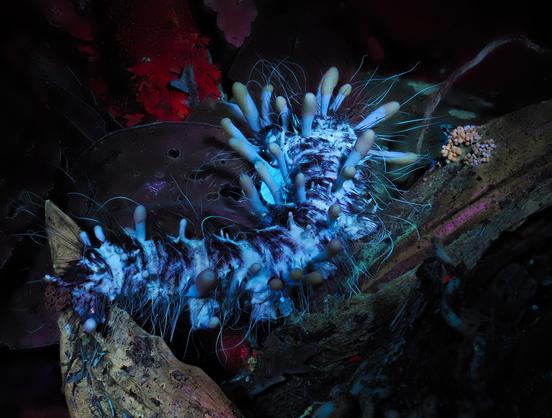
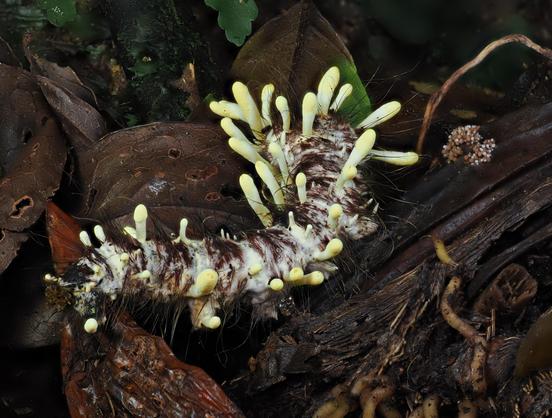
Beauveria sp. found last night in Monteverde, Costa Rica on a Saturniidae caterpillar. In white light an 365 nanometer UV light.
Mushroom Observer # 579083 / iNaturalist # 299745988
#Fungus 'hacks' natural #immune system to cause #neurodegeneration in #fruit_flies.
#Beauveria #Drosophila #Toll-1_receptor
https://phys.org/news/2025-02-fungus-hacks-natural-immune-neurodegeneration.html
Guten Morgen! Was war gestern schön was hat euch gefreut? Es sind #diekleinenDinge die zählen.
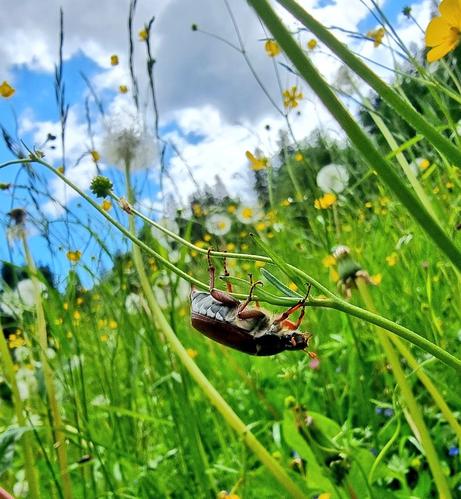
Hier: Ich war gestern den ganzen Tag draußen. Dabei einige (wenige) Maikäfer gefunden, bei uns ist heuer kein Flugjahr. Das Problem sind v.a. die Larven die 3-4 Jahre im Boden Wurzeln fressen und starke Schäden verursachen. Zu Bekämpfung verwendet man einen Pilz, der die Engerlinge befällt. Diesen Pilz arbeitet man in den Boden ein wodurch Engerlinge verpilzen. #fungifact #Biodiversität #beauveria
Scientists develop #bio_pesticide from #fungi to control a #beetle and protect Eucalyptus plantations.
#Gonipterus #Beauveria #Metarhizium #bioinsecticides
https://phys.org/news/2023-12-scientists-bio-pesticide-fungi-beetle-eucalyptus.html

Gonipterus platensis, or the Eucalyptus snout beetle, has a heavy impact on Eucalyptus forest plantations worldwide, and are mostly controlled using the micro wasp Anaphes spp, although control rates rarely become financially viable. This led a team of scientists to look for naturally infecting pathogenic fungi to tackle the Eucalyptus snout beetle problem.

Background The entomogenous fungus Beauveria bassiana is used as a biological insecticide worldwide, wild B. bassiana strains with high pathogenicity in the field play an important role in controlling insect pests via not only screening of highly virulent strains but also natural infection, but the pathogenicity degeneration of wild strains severely affected aforementioned effects. Previous studies have showed that multiple factors contributed to this phenomenon. It has been extensively proved that the mycovirus infection caused hypovirulence of phytopathogenic fungi, which has been used for plant disease biocontrol. However, it remains unknown whether the mycovirus epidemics is a key factor causing hypovirulence of B. bassiana naturally in the field. Methods Wild strains of B. bassiana were collected from different geographic locations in Jilin Province, China, to clarify the epidemic and diversity of the mycoviruses. A mycovirus Beauveria bassiana chrysovirus 2 (BbCV2) we have previously identified was employed to clarify its impact on the pathogenicity of host fungi B. bassiana against the larvae of insect pest Ostrinia furnacalis. The serological analysis was conducted by preparing polyclonal antibody against a BbCV2 coat protein, to determine whether it can dissociate outside the host fungal cells and subsequently infect new hosts. Transcriptome analysis was used to reveal the interactions between viruses and hosts. Results We surprisingly found that the mycovirus BbCV2 was prevalent in the field as a core virus in wild B. bassiana strains, without obvious genetic differentiation, this virus possessed efficient and stable horizontal and vertical transmission capabilities. The serological results showed that the virus could not only replicate within but also dissociate outside the host cells, and the purified virions could infect B. bassiana by co-incubation. The virus infection causes B. bassiana hypovirulence. Transcriptome analysis revealed decreased expression of genes related to insect epidermis penetration, hypha growth and toxin metabolism in B. bassiana caused by mycovirus infection. Conclusion Beauveria bassiana infected by hypovirulence-associated mycovirus can spread the virus to new host strains after infecting insects, and cause the virus epidemics in the field. The findings confirmed that mycovirus infection may be an important factor affecting the pathogenicity degradation of B. bassiana in the field.
#Pathogenic #fungus found to infect dung #beetles in Australia.
https://phys.org/news/2023-06-pathogenic-fungus-infect-dung-beetles.html
#Pathogenic #fungus found to infect dung #beetles in Australia.
https://phys.org/news/2023-06-pathogenic-fungus-infect-dung-beetles.html
 CellBioNews
 Sigrid Neuhauser
 Pestinfo