 Michael Horne
Latest #beadweaving #mayke - a twisted rope bracelet. All done today. For my mother in law.
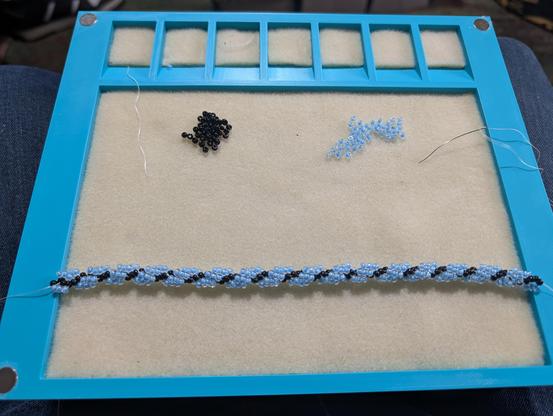
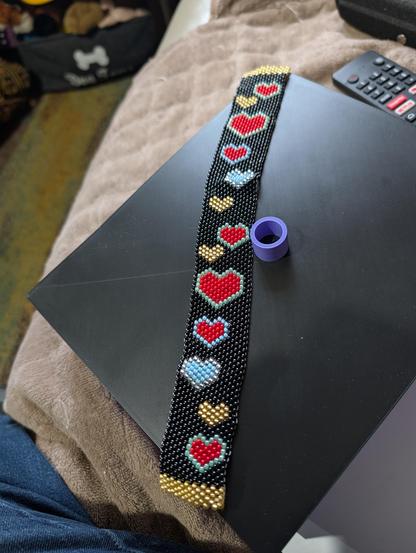
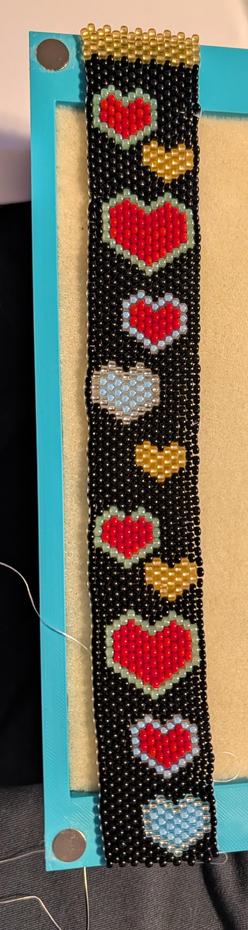
More work on my latest #beadweaving project. This is a bracelet for my mother in law. About 2.5" left to go! #mayke. Done in 8s seed beads in even count peyote. Going quite well!
 Gwen Fisher
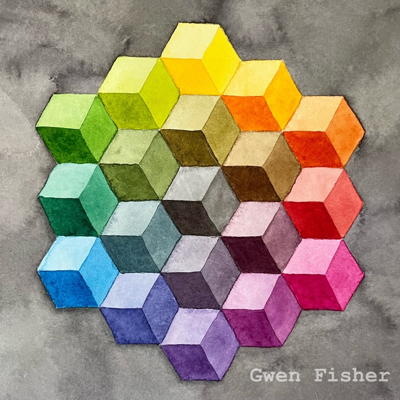
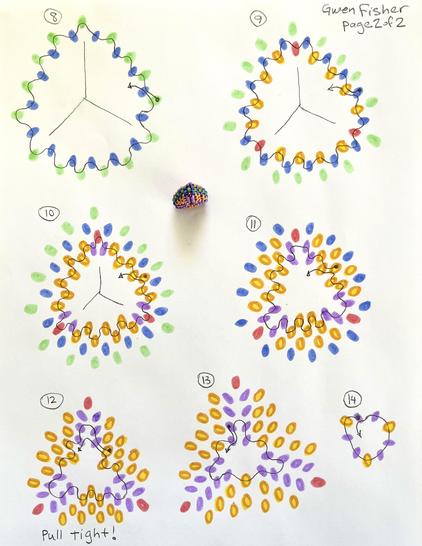
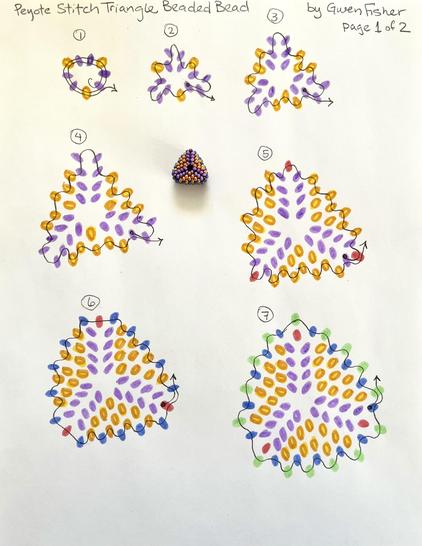
These diagrams show how to weave a puffy triangle beaded bead with peyote stitch and seed beads. If you want to make a longer beaded bead, using cellular automata on the sides, I recommend starting and ending that on the rounds of all blue beads.
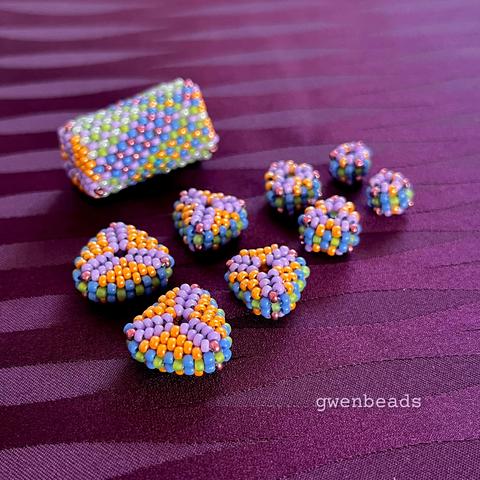
Nothing brings me joy quite like a new strand of matching beaded beads. After drawing the diagrams for the flat triangle beaded beads, I stitched a whole strand. This strand features 9 different beaded beads in graduated sizes and a rainbow of colors. The largest bead in the center has a design created with cellular automata as described in my new book “Beading with Algorithms: Cellular Automata in Peyote Stitch.” I used the algorithm called Dot Arrays with a cycle of period three. The beads are light and hollow, and they make a pleasing clink when they knock together.
Find my book “Beading with Algorithms” available directly from the publisher, World Scientific. https://www.worldscientific.com/worldscibooks/10.1142/14357#t=aboutBook
Find this strand of beads here: https://gwenbeads.etsy.com/listing/4508611218

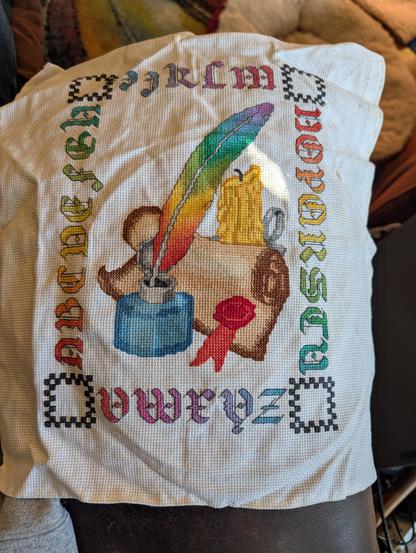
Yay! Finished my #crossstitch #embroidery. Just need to wash it and frame it now! The next crafting thing is to learn #beadweaving from my wife and mother in law. :-)
We found so much to include that the book ended up a full third longer than I had originally planned. It took years longer than I originally expected. But it was a labor of love, a passion project, something we made because we wanted to make something beautiful and inspiring. I can hardly believe it’s finally finished. I hope you will love it too.
Link to order the book: https://www.worldscientific.com/worldscibooks/10.1142/14357#t=aboutBook
There’s a 30% off code
RECMATH30
It’s preorder. The release date is the end of February. 2/2
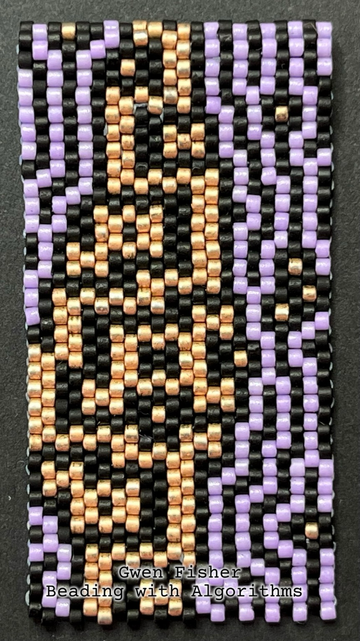
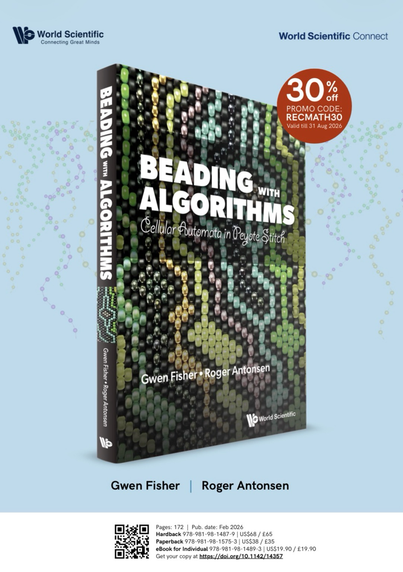
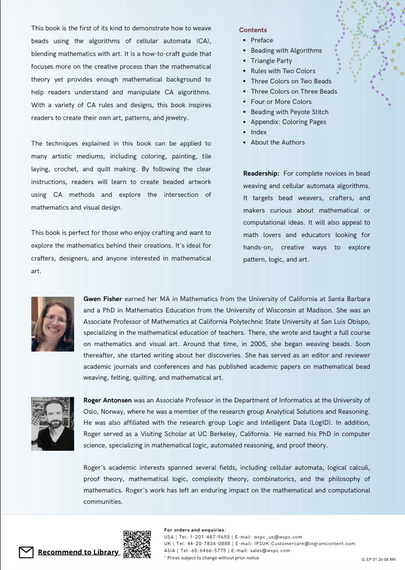
Twelve years. I started this project twelve years ago, and today I hold the result in my hand. It’s a book that combines bead weaving with math called, “Beading with Algorithms: Cellular Automata in Peyote Stitch.” With help from mathematician and artist Roger Antonsen, graphic designer Zelda Lin, a handful of talented proof readers, and the good people from World Scientific Publishing Company, my dream of combining my loves of math, art, and teaching into a book is finally a reality.
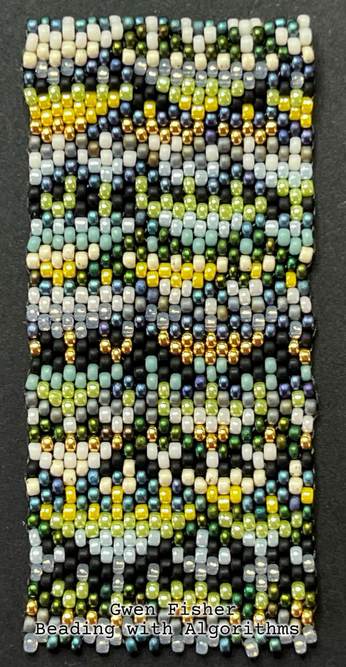
This book is the first of its kind, a recipe book of algorithms that can be used and combined to generate colorful patterns in peyote stitch beadwork in any size and shape you desire. These algorithms could also be applied to other pixelated art forms like tile laying, embroidery, crochet, and quilts. We included projects like bracelets, pill pouches, pendants, beaded beads, and key chains. We also included a bunch of different grids that you can photocopy and color with markers.
Of course I’m biased, but I think it’s a really beautiful book. We included multiple colorful images on almost every page, 172 pages in all. It was a huge layout challenge, but Zelda nailed it. My original goal was to write 128 pages on how to use algorithms to make beaded jewelry, but the more we explored the space, the more we found. Not just millions of algorithms, the space of possibilities is infinite. So of course, we couldn’t include them all. But we used math and Roger’s custom software that he wrote for this project to help us find dozens of the easiest algorithms and more than a hundred more in increasing levels of complexity. We included all of our favorites. 1/2
 Nadiia Omelchuk🇺🇦
✨️🧵🪡 When my hands create this beauty, my mind rests. This process is my little light and my work. The autumn pumpkin🎃 made of beads is almost ready to go to its new owner.
If you like what I do, support me!
Sharing saves lives, and ordering gives me the opportunity to create further.
From Ukraine, with faith.💙💛
More of my work here:
https://www.etsy.com/shop/NadiiaJewelryArt
I'm waiting for you on Etsy or in DM📩
#HandmadelnUkraine #AutumnCoziness #DOINGTHINGILOVE #Beadweaving #SupportUkraine #Halloweenjewerly

 Three Moose In A Trenchcoat
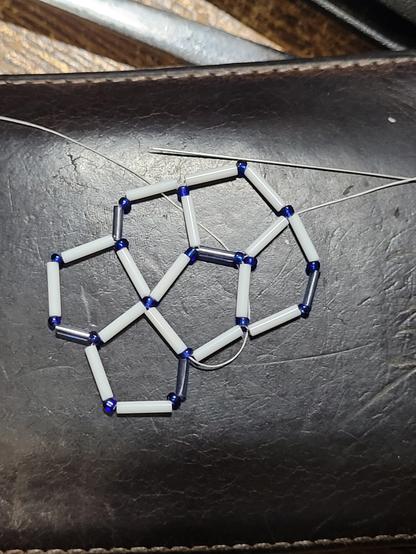
In tonight's episode of Will It Bead: Snub square pentagonal tiling, AKA Cairo tiling. Using 9 and 6mm bugle beads as the main lines and 11/0 seed beads as points.
I have plans for this certain type of netting...