Interesting #novelty #coin of the day: This piece has a #Plague doctor on one side - this was a volunteer or an actual doctor, though the duty was often more to record accurate numbers of deaths than curing people (though some charged promising cures). Although often a #caricature, beaked masks like this have been dated to the 1700s: https://en.wikipedia.org/wiki/Plague_doctor Wearing a modern medical coat & stethoscope (invented in 1816).
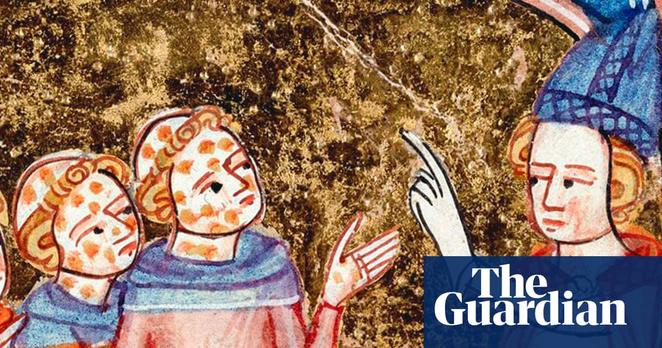
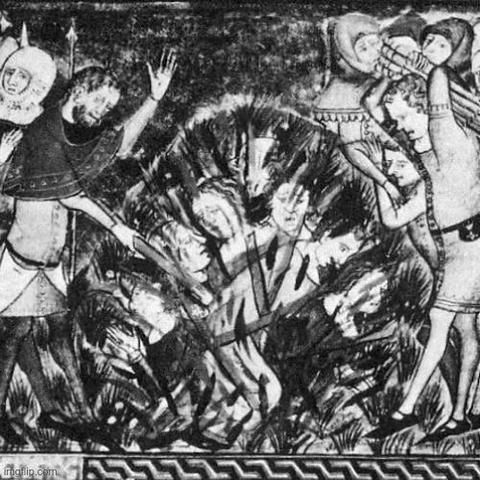
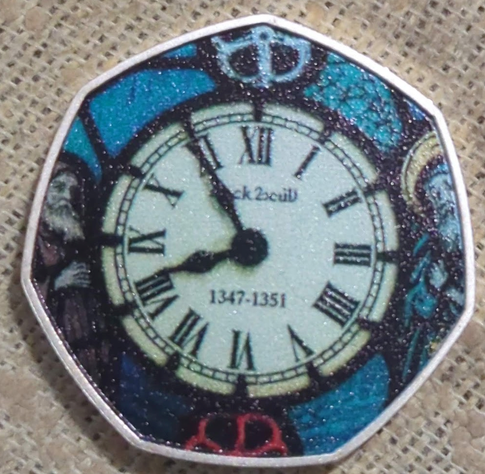
The other side has a #clock at 8:55 (Does anyone know a potential reason for that?) with the dates 1347-1351 in the centre - that was the rough years of the #Black #Death in Europe: https://en.wikipedia.org/wiki/Black_Death
I can't read the text above the centre?
The piece itself is an Equilateral curve heptagon (7-sided), about 25mm diameter, similar to a 1991-1994 Jamaica 25 cents: https://en.numista.com/6476 & about 3mm thick.
I'll tag #Histodons since the theme is historical, though the piece isn't.
#Numismatics #CoinCollecting #BlackDeath #Pandemic #History @numismatics @histodons
 Liam O'Mara IV, PhD
 Claire Barnes
 MediaFaro Magazine
 Guitar Calavera
 K(A) Noise
 Wen
Wen
 CoinOfNote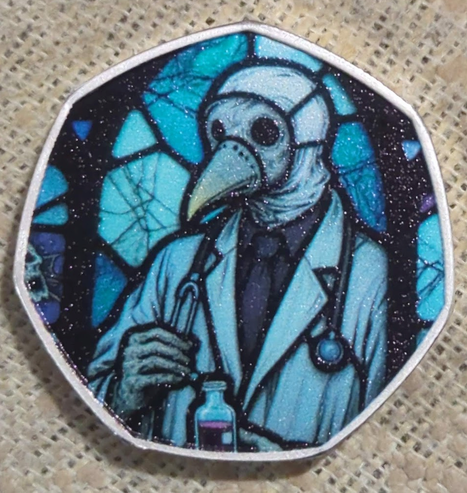
 Minoru Saba