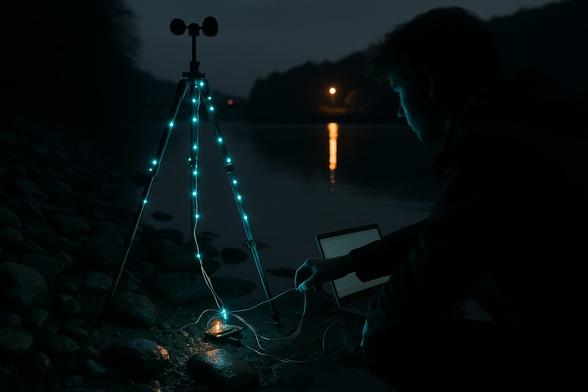
3D printable #anemometer, made with @FreeCAD!
"WindNerd One: Build your own accurate #wind #sensor with #3Dprinting and reliable electronics." #FreeCAD https://windnerd.net/en
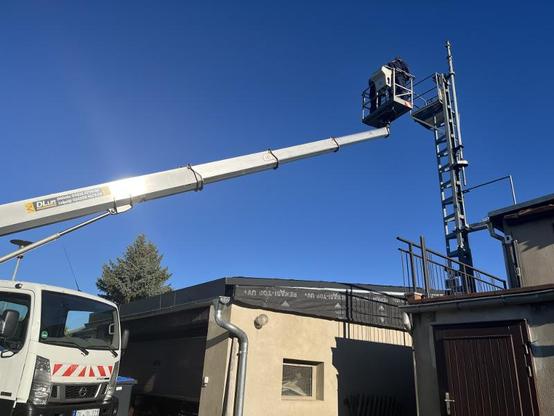
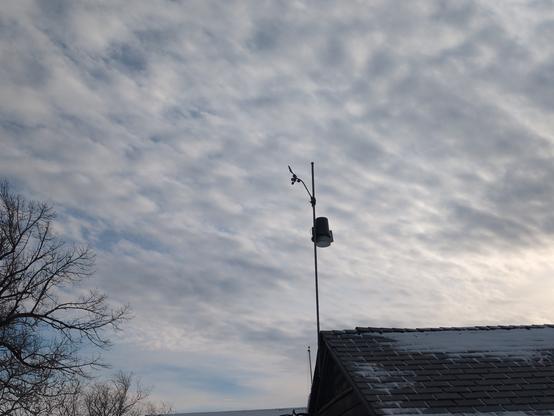
Heute haben wir endlich das defekte #Anemometer (Windmesser) austauschen lassen können. Es lieferte die #Windrichtung nur noch sporadisch. Die Gelegenheit wurde genutzt, die Leitungen in Schutzrohre zu legen, falls der Ausfall doch etwas mit dem Schnabel der Krähe in Zusammenhang stehen sollte.
https://www.woellsdorf-wetter.de
#Wetterstation #Döbeln-#Wöllsdorf #Wind #Wetterfahne
Very cool approach for a DIY solid-state wind gauge / anemomter: using strain gauges to measure wind load
Weather Station Predicts Air Quality
Measuring air quality at any particular location isn't too complicated. Just a sensor or two and a small microcontroller is generally all that's needed. Predicting the upcoming air quality is a little more complicated, though, since so many factors determine how safe it will be to breathe the air outside. Luckily, though, we don't need to know all of these factors and their complex interactions in order to predict air quality. We can train a computer to do that for us as [kutluhan_aktar] demonstrates with a machine learning-capable air quality meter.
The build is based around an Arduino Nano 33 BLE which is connected to a small weather station outside. It specifically monitors ozone concentration as a benchmark for overall air quality but also uses an anemometer and a BMP180 precision pressure and temperature sensor to assist in training the algorithm. The weather data is sent over Bluetooth to a Raspberry Pi which is running TensorFlow. Once the neural network was trained, the model was sent back to the Arduino which is now capable of using it to make much more accurate predictions of future air quality.
The build goes into quite a bit of detail on setting up the models, training them, and then using them on the Arduino. It's an impressive build capped off with a fun 3D-printed case that resembles an old windmill. Using machine learning to help predict the weather is starting to become more commonplace as well, as we have seen before with this weather station that can predict rainfall intensity.
#machinelearning #airquality #algorithm #anemometer #arduino #ozone #raspberrypi #sensor #tensorflow
DIY Anemometer For Projects Big and Small
When [Fab] needed an anemometer for his latest project, he was stymied by the limited range and relatively high prices of commercial options. Undeterred, his solution was an impressive DIY anemometer that rivals the off-the-shelf alternatives.
AnemoSens was designed from the ground up as a component for the ambitious WinDIY_2 Horizontal Axis Wind Turbine, however it's just as suitable as part of your standard home weather station. The microcontroller unit uses RS485/Modbus connectivity, ensuring that data from the wind sensor is accessible across a variety of platforms. Serial-stream via USB and an SD cart slot are also available for recording data, the latter being particularly useful for long-term unsupervised monitoring. [Fab] also integrated an ESP32 for recording data over the air.
The MCU also features a location for the venerable BME280, which is a relatively accurate temperature, pressure and humidity sensor often deployed in DIY weather stations. This feels like a nice touch, as it means the anemometer package alone could feasibly serve as a rudimentary weather sensing station, or as a backup for more elaborate environmental monitoring.
The prototype currently uses a Hall effect sensor for measuring the wind speed, while a AS5048B magnetic rotary encoder does a decent job of measuring rotation (wind direction). Some calibration is likely necessary to improve the accuracy of this setup, but it's a promising start.
[Fab] has already identified some shortcomings with the bearing, but has a plan for future iterations. He might want to check out this spare-parts anemometer that uses a bearing from an old hard drive.
Open Source Ultrasonic Anemometer
Weather stations are a popular project for experimenting with various environmental sensors, and for wind speed and direction the choice is usually a simple cup anemometer and wind vane. For [Jianjia Ma]'s QingStation, he decided to build another type of wind sensor: An ultrasonic anemometer.
Ultrasonic anemometers have no moving parts but come at the cost of significantly more electronic complexity. They work by measuring the time it takes for an ultrasonic audio pulse to be reflected the receiver across a known distance. Wind direction can be calculated by taking velocity readings from two ultrasonic sensor pairs perpendicular to each other and using a bit of simple trigonometry. For an ultrasonic anemometer to work properly, it requires a carefully designed analog amplifier on the receive side and a lot of signal processing to extract the correct signal from all the noise caused by secondary echoes, multi-pathing, and the environment. The design and experimentation process is well-documented. Since [Jianjia] does not have access to a wind tunnel for testing and calibration, he improvised by mounting the anemometer on his car's roof and going for a drive. This yielded readings that were proportional to the car's GPS speed, but a bit higher. This might due to a calculation error, or external factors like wind, or disturbed airflow from the test car or other traffic.
Other sensors include an optical rain sensor, light sensor, lighting sensor, and a BME280 for air pressure, humidity, and temperature. [Jianjia] plans to use the QingStation on an autonomous boat, so he also included an IMU, compass, GPS, and a microphone for environmental sounds. The fact that none of the sensors have moving parts is a major advantage for this use case, and we look forward to seeing the boat project. All the hardware and software are open-source and available on GitHub.
We covered another ultrasonic anemometer a few years ago, but it had a different sensor arrangement. IF you prefer simplicity, the more common cup anemometers can be built from a range of scrap materials, including old hard drive parts and plastic Easter eggs.
#techhacks #anemometer #ultrasonicsensor #weatherstation #windsensor