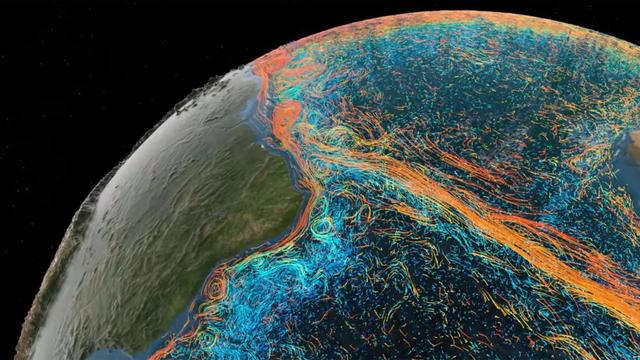
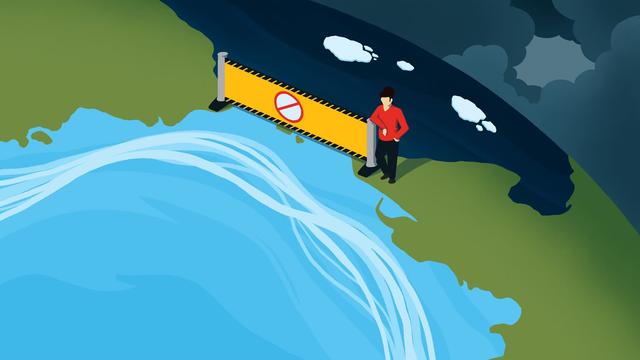
#4

I began with this project in November and the last day was in mid January. Not the longest data dig for me, but one of the longer ones. And I abandoned it unfinished.

I like it a lot.
Mostly because I like the paper by Smoulder, vanWesten et al a lot.
https://agupubs.onlinelibrary.wiley.com/doi/full/10.1029/2025GL116242

Important to know where we might see Early Warning signals EWS for an imminent #AMOCcollapse. That way we can monitor the oh-shit-location more closely – and look for past behaviour in proxies.

Just recently, vanWesten's team in Utrecht published a new study that looks at an oh-shit-location in the Gulfstream.
https://www.nature.com/articles/s43247-026-03309-1
"Abrupt Gulf Stream path changes are a precursor to a collapse". You probably read about it: 2 years before convection tips into then-inevitable death in the Subpolar Gyre, the Gulfstream jumps 200km north.

Smoulder identified that wider location as well as one of her EWS zones. In my project it's called "gstream" (top right corner in each chart, in the subtitles says which zone and which season the matching pixels are for). It's a zone with far fewer matching pixels than most others. Only the zone in the North Sea has even fewer.

When I say, I abandoned the project, I mean that I did not begin to match the identified pixels with actual proxies from #paleoclimate – which is the ultimate goal of the project.
So it made me laugh when I saw the Tasmanian coral getting tied to #AMOC in the new paper in #1 and finding Tasmania in my old, dusty project. 💃🏽 🖖🏽

🌊 Abrupte Veränderungen des Golfstroms könnten laut Studie schon in den kommenden Jahrzehnten auftreten. Ein plötzliches „Nordspringen“ wäre dabei ein ernstes Warnsignal: Der finale Kipppunkt könnte dann nur noch rund 25 Jahre entfernt sein.

#Golfstrom #AMOC #Klimawandel #Kipppunkt #Klimaforschung #Ozeanströmung #KlimaKrise #Erderwärmung #Wissenschaft #Klimadynamik 🌍🌡️

https://www.derstandard.at/story/3000000311931/veraenderung-des-golfstroms-kuendigt-kollaps-einer-grossen-meeresstroemung-an

Veränderung des Golfstroms kündigt Kollaps einer großen Meeresströmung an

Neue Simulationen zeigen, dass der Golfstrom Jahrzehnte vor dem Versiegen der Fernwärme im Atlantik seinen Pfad schlagartig ändert – ein Prozess, der bereits begonnen hat

DER STANDARD

Hahaha, how cool! 💃🏽

These researchers took a 1300 years long temperature-related time series from corals South of Tasmania and compared them to @rahmstorf 's reconstruction of the Northern Atlantic AMOC to show how the teleconnection indicates that the NA AMOC gets its rhythm from the Southern Ocean, albeit 46 years earlier
https://www.nature.com/articles/s41561-026-01959-6
"Millennial-scale Atlantic overturning circulation led by the Southern Ocean"

Cool is that I can confirm that their odd Tasmanian coral location is indeed connected to the #AMOC, and to this day. Not only their by-46-years-removed connection, but actually tied to the same seasons.

How do I know? I took the year-on-year difference in seasonal sea surface temperature from zones with Early Warning Signals (Smoulders, vanWesten 2025 https://onlinelibrary.wiley.com/doi/abs/10.1029/2025GL116242, supplement figure S4)

and compared the differences to those of every pixel on land in #Berkeley Earth's data series. ^^
If a Berkeley pixel meets certain "bingo" criteria (eg., how often per decade in how many decades) they are plotted on the map.

Tasmania pops up as seasonal teleconnection to the Early Warning zones in the North Sea (!) , to near Southern and West Africa, and to South Brazil.

See #2 and #3 for more info and more pixels! 🍿

#ClimateChange #ocean #OceanCurrent

Whee!

Nature:
Published: 27 March 2026

Collapse of the Atlantic meridional overturning circulation would lead to substantial oceanic carbon release and additional global warming

https://www.nature.com/articles/s43247-026-03427-w

#amoc #climateemergency

Collapse of the Atlantic meridional overturning circulation would lead to substantial oceanic carbon release and additional global warming - Communications Earth & Environment

The collapse of Atlantic Meridional Overturning Circulation would result in increase of 47-83 ppm of global mean atmospheric carbon dioxide and 0. 2 °C of additional global warming at higher carbon dioxide background levels, according to simulations using an Earth system model.

Nature
@Snoro not to mention that the greatest overall risk to the Scottish people would be the collapse of #AMOC which would make Scotland pretty well completely uninhabitable. Long term but catastophic!
#AMOC Dijkstra et al. 30 March 2026, Wiley Interdis Rev: Climate Change17(2): e70049 Multi-Stability of the Present-Day Atlantic Meridional Overturning Circulation "AMOC is in a multi-stable regime" "could transition into a substantially weaker or fully collapsed state." doi.org/10.1002/wcc....

Multi‐Stability of the Present...

#AMOC

Open access

Dijkstra et al. 30 March 2026, Wiley Interdis Rev Climate Change17(2): e70049

Multi-Stability of the Present-Day Atlantic Meridional Overturning Circulation

"present-day AMOC is in a multi-stable regime" "and could transition into a substantially weaker or fully collapsed state"

https://doi.org/10.1002/wcc.70049

#climate #ClimateScience #climatechange #ClimateEmergency #ClimateCrisis #ClimateBreakdown #ClimateDisruption #globalWarming #globalHeating #ExtremeWeather #polycrisis

@rahmstorf An important scientific review by H. A. Dijkstra et al. (2026) analyzes the potential impacts of further #weakening of the Atlantic Meridional Overturning Circulation (#AMOC), which, according to historical reconstructions, has weakened by approximately 15% since the mid-20th century. The authors suggest that the highly sensitive AMOC is at risk of #collapsing entirely in the #future, strongly influencing the global climate. Authors conclude that the AMOC is in a #multistableregime.