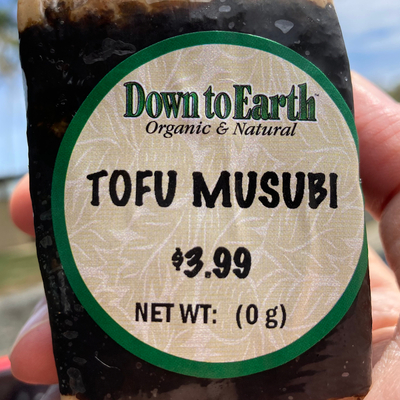
 Tofu Musubi
I used to live on Kina'u ('kee-nah-ooo") Street in #Honolulu, #Hawaii, which runs parallel to the H-1 highway seen here. When the traffic report shows this camera I always sigh and reminisce. I know it doesn't look like much - paradise shouldn't have this much concrete, eh? - but this was a great place to live. I worked near the airport, so it was an easy walk or bus ride. The people, the food, the music, I carry it all in my heart. #AlohaAina

 Jeff Reinebold 🤖
BACK ON HAWAIIAN SOIL! THERE REALLY IS NO PLACE QUITE LIKE HAWAI'I!
#AlohaAina
#DefendHawaii
#BRADDAHHOOD
#AlohaAina
#DefendHawaii
#BRADDAHHOOD

WHEN YOU ARE FORTUNATE ENOUGH TO LIVE IN THE MOST BEAUTIFUL PLACE ON EARTH YOU NEED TO RESPECT THAT BEAUTY AND PERPETUATE IT FOR THOSE WHO WILL LIVE HERE AFTER US! HAPPY EARTH DAY HAWAI'I ! #alohaaina #malamakekai
#braddahhood https://x.com/warrioraccess/…
#braddahhood https://x.com/warrioraccess/…


 SaltPhoenix


 ReimanSaara
FYI: Scientific research conducted at #MaunaKea and #MaunaLoa is NOT conflict free. At this time, it is unethical and as such, unsustainable, no matter how amazing the results. Those results are obtained by colonialist exploitation, against will of Hawaiian people.
I love astronomy. I used to research philosophy of space exploration. But what is being done in Hawaii in name of science is just wrong. Scientific community's failure to respect Hawaiians and their ancestral land is shameful.
Both of these volcanos are sacred to native Hawaiians. They have protested peacefully against colonialist exploitation conducted in name of science for a long time -and been consistently ignored.
The way Mauna Loa and Mauna Kea are being exploited in name of science *is* deeply hurtful to people who have already suffered much in hands of American colonialism.
It is not enough to do tokenistic nods to Hawaiian culture when it is convenient while at the same time blatantly ignoring what Hawaiian people would truly want.
Dismissing indigenous faiths as "backwards and primitive"- as etymology of the word "heathen" suggests- is an old colonialist tactic. It is not based on objective thinking but on Western sense of supremacy and belief that Europeans know what is best for everyone. One can not form an objective opinion about something they can not begin to understand...and sense of supremacy and self-absorbedness are destructive to people's ability to understand anything.
Personally speaking: as much as I love astronomy and science, I think that it would be best if scientists packed their bags and left sacred lands to be until Hawaiians tell otherwise.
What scientific community could learn about humility, decency and basic respect for those unlike them, would be more valuable to our species than the most amazing discoveries.
 ghost in a meat robot 2.0
For deeply personal reasons, the people and culture of Hawaiʻi have a special place in my heart 
The kānaka maoli and ʻāina are in my thoughts today and always 🫶🏽
This one's for you, fam ✊🏽
#YouTube #Music #HipHop #Rap #IndigenousResistance #Indigenous #AlohaAina #KeepHawaiiHawaiian
The kānaka maoli and ʻāina are in my thoughts today and always 🫶🏽
This one's for you, fam ✊🏽
#YouTube #Music #HipHop #Rap #IndigenousResistance #Indigenous #AlohaAina #KeepHawaiiHawaiian

Keep Hawai'i Hawaiian Music Video
 MamaKeiki™-RFG
 Stone Bear
Stumbled into this on YouTube... forest management.... with goats! Us West Coast Yanks think we have fires bad; the Aussies have it worse... but the goats seem to work much more efficiently than stinky machines or even worse pesticides or burning... Maybe we can do that here? @seattle #TikkunOlam #AlohaAina

How Goats are Regenerating a Forest and Protecting this Town from Bushfire
 Melissa Chimera
New episode on “Land & People”: Penny Rawlins Martin from Molokai on the stewardship lessons that voyaging on the 1976 Hōkūle‘a sailing canoe can teach us as one of the first two Hawaiian women to make the 2500 mile journey from Hawai’i to Tahiti. Available now everywhere you listen to podcasts❤️🌸🤙

EP 8 Penny Rawlins Martin on the stewardship lessons that voyaging on the 1976 Hōkūle‘a sailing canoe can teach us
Penny Rawlins Martin is one of the first two kānaka maoli (Native Hawaiian) women to sail as a crew member on the first 1976 voyage of the Hōkūle‘a Hawaiian sailing canoe between Tahiti and Hawai‘i, a 2,500 mile journey of her ancestors. She takes us back to the energy of the 1970s during the Hawaiian renaissance where the language, music, dance, voyages and land-back initiatives were being fought for, revived and uplifted. Penny shares with us her many lessons aboard the canoe, namely care for one another through love of the land and concern for its limited resources--now commonly referred to as aloha ‘āina. She brings these historical, social and environmental perspectives to Moloka‘i students through her work with Papahana Kuaola, a non-profit education organization aiming to connect students to culture, place and history with an eye towards a sustainable future.