I’ve always been interested in monitoring indoor Air Quality. I think the itch to monitor indoor Air Quality grew over the years as the wild fires started getting worse, here in California. I even have a dedicated Watch (Apple) face that includes the Air Quality Index (AQI) complication.
Indoor Air Quality
Monitoring air quality typically includes monitoring Carbon dioxide (CO2), Particulate Matter (PM2.5 – represents particles that <= 2.5 microns in diameter), Temperature, Humidity, and Total Volatile Organic Compounds (TVOC). Some monitors include a few other stats, but these are more common.
There are many monitors available online that monitor these. Most of them are either bulky, wired, fugly, or just inaccurate.
After some research, earlier this year, I found 2 very good indoor air quality monitors.
One is from Awair, called the Element. It monitors all of the above, but it’s wired. Even though it looks cool, it’s slightly bigger than what I wanted. So, I went with the other one that I liked, the SAF Aranet4 Home.
This one is wireless, replaceable battery operated (2 AAs), has a cool E Ink display but it doesn’t include PM2.5/TVOC monitoring. It’s apparently quite accurate and the best part is that it’s tiny.
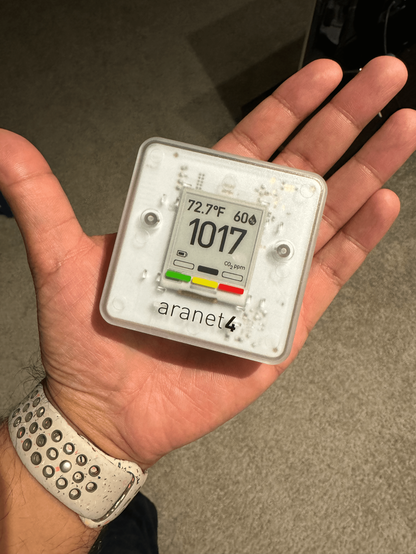
My palm for reference.
The moment I switched it ON, I was shocked at the initial reading!
The first reading at my place.
To give you context on why this value is shocking, here’s list of the expected CO2 levels –
420 ppm – fresh outdoor air
< 1000 ppm – indoors
1000 ppm to 1400 ppm – brain cognitive function decreases by 15%
> 1400 ppm – brain cognitive function decreases by 50%
CO2 levels are expressed in ppm – parts per million
So yeah, I was shocked to know we were living in conditions where we had 50% less brain cognitive function. Maybe this explains all the dumb shit I do ☺️
One way I could think of lowering this number was by improving ventilation and that’s by opening up the windows and doors. This improved the CO2 level very quickly. After monitoring it for a couple of days, I’ve gathered the CO2 data and how proper ventilation affects the value.
Green to Red
Closed the windows @ 22:30Peak CO2
The above is data from my bedroom, with two people sleeping (no, I don’t go to bed at 22:30, I just closed the bedroom windows at that time).
Red to Orange and then to Green
Opened the windows at 11:00The moment CO2 dropped to < 1000Green readings while the windows were open
This morning, I opened the bedroom windows at 11:00. As you can see from the above graphs, it took about 55 mins for the CO2 levels to drop from 1670 ppm to 999 ppm.
The green region shows an uptick and that’s because I moved the monitor into the hall. Opening bedroom windows seemed to lower the overall indoor CO2.
Possible ways to improve indoor CO2/Air Quality
There are a number of solutions to fix different aspects of indoor air quality.
Improving ventilation – Simplest way is to open the windows and balcony/patio doors to let the air circulate around. I’ve been using this technique and it has been working wonders.Air Purifier – These are not cheap, at least the good ones. These are great when the outside air quality is poor or during winters, when you can’t really open your windows while it’s cold outside.Indoor Plants – Plants need CO2 to function. Naturally, these are great to help improve indoor CO2 levels.Replace AC’s Air filters – Replace air filters to improve your indoor air quality.I suspect my home AC’s air filters. They might need to be replaced. I will monitor the data from my sensor for another week and see if it indeed does require a replacement. I will report back my findings soon.
In the past, I tried using a PM2.5 monitor with my Raspberry Pi. It worked wonders but having the Pi run all the time seemed like a hassle for this use case.
https://iam.mt/emphasizing-indoor-air-quality/
#airQualityMonitor #aqi #aranet #awair #co2 #indoorAirQuality
 Shaula Evans
 Labmate Scientific LLC
 13
13
 Mohnish Thallavajhula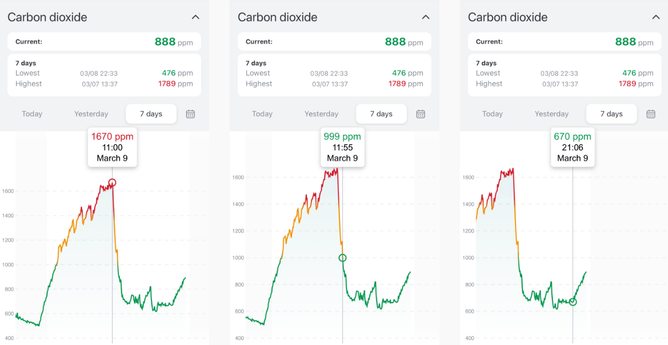
 Andre Courchesne (VisiblAir)