I try to keep things even-steven in terms of at least 3x reviews for every paper my group submits. With a slew of recent submissions 🎉, I'm in debt. Editors: know I'm excited to review papers in #affectivescience *especially* when they lean quantitative (behavioral & neural models, ML, etc).
#toReadList ; Just finished reading this beautiful interdisciplinary paper about relevance in #pragmatics and #affectivescience: "Relevance and emotion" by Wharton et al., 2021.
https://doi.org/10.1016/j.pragma.2021.06.001

🌟 This week, we're spotlighting our incredible SAS 2025 speakers lineup! Check back each day to learn more!🌟

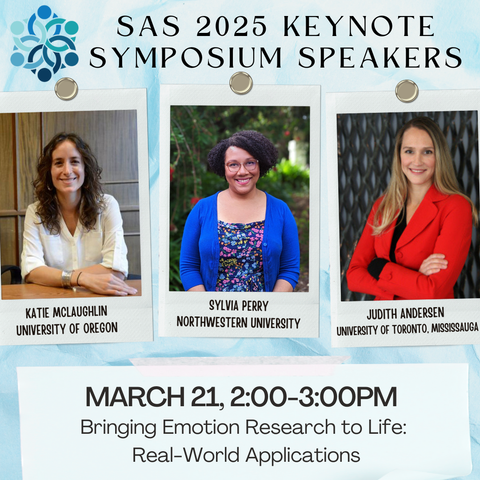
Kicking things off: The Keynote Symposium which will be held Friday, 3/21, 2:00pm - 3:00pm in Portland. Join us to explore how to bring emotion research to the real world with Katie McLaughlin, Sylvia Perry, and Judith Andersen!

📅 Register now—early bird ends Jan 31!
👉

society-for-affective-science.org

#SAS2025 #EmotionResearch #AffectiveScience

🌟 New Issue Alert! 🌟
Discover how social media shapes emotions across ages, cultures, and contexts! Dive into 18 groundbreaking articles on everything from adolescent self-evaluations to #MeToo moral discourse. 🧠📱✨

📰 Read it now at Affective Science!

https://link.springer.com/journal/42761/volumes-and-issues/5-4

#AffectiveScience #SocialMedia #EmotionResearch #Psychology #InterdisciplinaryScience

Affective Science | Volume 5, issue 4

Volume 5, issue 4 articles listing for Affective Science

SpringerLink

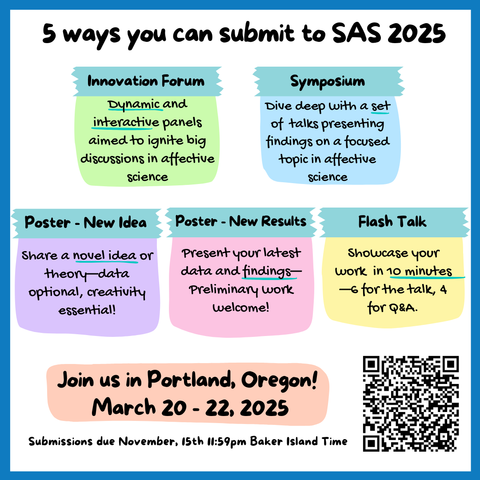
Submit your research to #SAS2025! Whether you've got fresh data, a bold new idea, or a knack for sparking discussion, there’s a spot for you!

🕛 Submissions close Friday, Nov. 8 at 11:59 p.m. Baker Island Time. Don't miss out!
#AffectiveScience #LastCall #SubmitNow

https://society-for-affective-science.org/2025-sas-annual-conference/abstracts/

Abstracts – The Society for Affective Science

The Society for Affective Science

Pleased to announce that our #SocialMedia side project "News source bias and sentiment on social media" just appeared in #PLoS_One ! ( #affectivescience , #psychology , #media , #news 1/3) :

https://journals.plos.org/plosone/article/metrics?id=10.1371/journal.pone.0305148

News source bias and sentiment on social media

As social media becomes a key channel for news consumption and sharing, proliferating partisan and mainstream news sources must increasingly compete for users’ attention. While affective qualities of news content may promote engagement, it is not clear whether news source bias influences affective content production or virality, or whether any differences have changed over time. We analyzed the sentiment of ~30 million posts (on twitter.com) from 182 U.S. news sources that ranged from extreme left to right bias over the course of a decade (2011–2020). Biased news sources (on both left and right) produced more high arousal negative affective content than balanced sources. High arousal negative content also increased reposting for biased versus balanced sources. The combination of increased prevalence and virality for high arousal negative affective content was not evident for other types of affective content. Over a decade, the virality of high arousal negative affective content also increased, particularly in balanced news sources, and in posts about politics. Together, these findings reveal that high arousal negative affective content may promote the spread of news from biased sources, and conversely imply that sentiment analysis tools might help social media users to counteract these trends.

An implication for users:
#misinformation can be boosted not only by #sources (e.g., bad actors) and #semantics (e.g., topics related to outgroups), but also by #sentiment (e.g., negative arousal). By identifying and quantifying these elements, we might develop better filters and other tools for mitigating misinformation (stay tuned for future work 3/3). ( #affectivescience , #psychology , #media , #news )

Delighted to see our #socialmedia side project published in #PLoS_One:
"News source bias and sentiment on social media"
( #affectivescience , #psychology , #media , #news 1/3):

https://journals.plos.org/plosone/article?id=10.1371/journal.pone.0305148

News source bias and sentiment on social media

As social media becomes a key channel for news consumption and sharing, proliferating partisan and mainstream news sources must increasingly compete for users’ attention. While affective qualities of news content may promote engagement, it is not clear whether news source bias influences affective content production or virality, or whether any differences have changed over time. We analyzed the sentiment of ~30 million posts (on twitter.com) from 182 U.S. news sources that ranged from extreme left to right bias over the course of a decade (2011–2020). Biased news sources (on both left and right) produced more high arousal negative affective content than balanced sources. High arousal negative content also increased reposting for biased versus balanced sources. The combination of increased prevalence and virality for high arousal negative affective content was not evident for other types of affective content. Over a decade, the virality of high arousal negative affective content also increased, particularly in balanced news sources, and in posts about politics. Together, these findings reveal that high arousal negative affective content may promote the spread of news from biased sources, and conversely imply that sentiment analysis tools might help social media users to counteract these trends.

Excited to learn that our side project "News source bias and sentiment on social media" has been accepted for publication in #PLoS_One !
Here's a link to a preprint version -- key points follow in the next post ( #affectivescience , #psychology , #media , #news 1/3) :

https://osf.io/preprints/psyarxiv/jxu95

OSF