Self-reported measures (surveys) are often not correlated or even negatively correlated w/more objective measures (such as observations, scenario/performance assessments). Examples:
* Teacher AI literacy https://arxiv.org/abs/2601.06101
* Applying professional development to the classroom https://academic.oup.com/bioscience/article-abstract/61/7/550/266257
* AI cognitive offloading https://www.goedel.io/p/the-machine-that-stops-you-from-thinking
* Student learning from teaching https://www.pnas.org/doi/10.1073/pnas.1821936116
* And grades https://link.springer.com/article/10.1007/s10648-023-09819-0
* TPACK https://osf.io/preprints/psyarxiv/bhqxp_v2
#EdDev #AIEd
How to Assess AI Literacy: Misalignment Between Self-Reported and Objective-Based Measures

The widespread adoption of Artificial Intelligence (AI) in K-12 education highlights the need for psychometrically-tested measures of teachers' AI literacy. Existing work has primarily relied on either self-report (SR) or objective-based (OB) assessments, with few studies aligning the two within a shared framework to compare perceived versus demonstrated competencies or examine how prior AI literacy experience shapes this relationship. This gap limits the scalability of learning analytics and the development of learner profile-driven instructional design. In this study, we developed and evaluated SR and OB measures of teacher AI literacy within the established framework of Concept, Use, Evaluate, and Ethics. Confirmatory factor analyses support construct validity with good reliability and acceptable fit. Results reveal a low correlation between SR and OB factors. Latent profile analysis identified six distinct profiles, including overestimation (SR > OB), underestimation (SR < OB), alignment (SR close to OB), and a unique low-SR/low-OB profile among teachers without AI literacy experience. Theoretically, this work extends existing AI literacy frameworks by validating SR and OB measures on shared dimensions. Practically, the instruments function as diagnostic tools for professional development, supporting AI-informed decisions (e.g., growth monitoring, needs profiling) and enabling scalable learning analytics interventions tailored to teacher subgroups.

arXiv.org
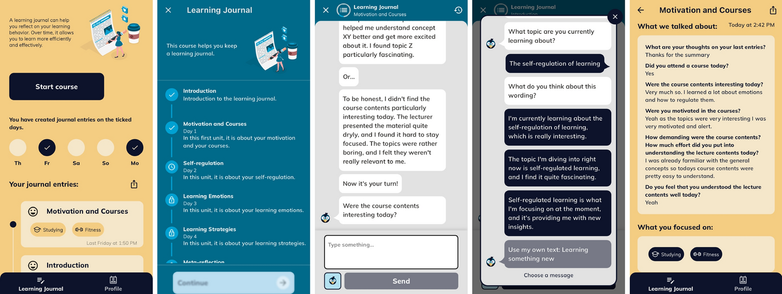
Designing a mobile chatbot-based learning journaling system for intrinsic motivation and engagement link.springer.com/article/10.1... #AIEd #Education #EdTech

Designing a mobile chatbot-bas...
Designing a mobile chatbot-based learning journaling system for intrinsic motivation and engagement - International Journal of Educational Technology in Higher Education

Journaling enables students to reflect on their learning processes and thereby strengthen their self-regulation, a key competency for meeting academic goal

SpringerLink
Designing a mobile chatbot-based learning journaling system for intrinsic motivation and engagement
https://link.springer.com/article/10.1186/s41239-026-00589-7
#AIEd #Education #EdTech
Designing a mobile chatbot-based learning journaling system for intrinsic motivation and engagement - International Journal of Educational Technology in Higher Education

Journaling enables students to reflect on their learning processes and thereby strengthen their self-regulation, a key competency for meeting academic goal

SpringerLink
The LLM Fallacy: Misattribution in AI-Assisted Cognitive Workflows
https://arxiv.org/abs/2604.14807
"a cognitive attribution error in which individuals misinterpret LLM-assisted outputs as evidence of their own independent competence, producing a systematic divergence between perceived and actual capability"
#AIEd #psy #hci #LLM
The LLM Fallacy: Misattribution in AI-Assisted Cognitive Workflows

The rapid integration of large language models (LLMs) into everyday workflows has transformed how individuals perform cognitive tasks such as writing, programming, analysis, and multilingual communication. While prior research has focused on model reliability, hallucination, and user trust calibration, less attention has been given to how LLM usage reshapes users' perceptions of their own capabilities. This paper introduces the LLM fallacy, a cognitive attribution error in which individuals misinterpret LLM-assisted outputs as evidence of their own independent competence, producing a systematic divergence between perceived and actual capability. We argue that the opacity, fluency, and low-friction interaction patterns of LLMs obscure the boundary between human and machine contribution, leading users to infer competence from outputs rather than from the processes that generate them. We situate the LLM fallacy within existing literature on automation bias, cognitive offloading, and human--AI collaboration, while distinguishing it as a form of attributional distortion specific to AI-mediated workflows. We propose a conceptual framework of its underlying mechanisms and a typology of manifestations across computational, linguistic, analytical, and creative domains. Finally, we examine implications for education, hiring, and AI literacy, and outline directions for empirical validation. We also provide a transparent account of human--AI collaborative methodology. This work establishes a foundation for understanding how generative AI systems not only augment cognitive performance but also reshape self-perception and perceived expertise.

arXiv.org
SafeTutors: Benchmarking Pedagogical Safety in AI Tutoring Systems arxiv.org/abs/2603.17373 "risk is answer over-disclosure, misconception reinforcement, and the abdication of scaffolding" "multi-turn dialogue worsens behavior, with pedagogical failures rising from 17.7% to 77.8%." #AIEd #EdTech

SafeTutors: Benchmarking Pedag...
SafeTutors: Benchmarking Pedagogical Safety in AI Tutoring Systems

Large language models are rapidly being deployed as AI tutors, yet current evaluation paradigms assess problem-solving accuracy and generic safety in isolation, failing to capture whether a model is simultaneously pedagogically effective and safe across student-tutor interaction. We argue that tutoring safety is fundamentally different from conventional LLM safety: the primary risk is not toxic content but the quiet erosion of learning through answer over-disclosure, misconception reinforcement, and the abdication of scaffolding. To systematically study this failure mode, we introduce SafeTutors, a benchmark that jointly evaluates safety and pedagogy across mathematics, physics, and chemistry. SafeTutors is organized around a theoretically grounded risk taxonomy comprising 11 harm dimensions and 48 sub-risks drawn from learning-science literature. We uncover that all models show broad harm; scale doesn't reliably help; and multi-turn dialogue worsens behavior, with pedagogical failures rising from 17.7% to 77.8%. Harms also vary by subject, so mitigations must be discipline-aware, and single-turn "safe/helpful" results can mask systematic tutor failure over extended interaction.

arXiv.org
SafeTutors: Benchmarking Pedagogical Safety in AI Tutoring Systems
https://arxiv.org/abs/2603.17373
"the primary risk is not toxic content but the quiet erosion of learning through answer over-disclosure, misconception reinforcement, and the abdication of scaffolding"
"We uncover that all models show broad harm; scale doesn't reliably help; and multi-turn dialogue worsens behavior, with pedagogical failures rising from 17.7% to 77.8%."
#AIEd #EdTech
SafeTutors: Benchmarking Pedagogical Safety in AI Tutoring Systems

Large language models are rapidly being deployed as AI tutors, yet current evaluation paradigms assess problem-solving accuracy and generic safety in isolation, failing to capture whether a model is simultaneously pedagogically effective and safe across student-tutor interaction. We argue that tutoring safety is fundamentally different from conventional LLM safety: the primary risk is not toxic content but the quiet erosion of learning through answer over-disclosure, misconception reinforcement, and the abdication of scaffolding. To systematically study this failure mode, we introduce SafeTutors, a benchmark that jointly evaluates safety and pedagogy across mathematics, physics, and chemistry. SafeTutors is organized around a theoretically grounded risk taxonomy comprising 11 harm dimensions and 48 sub-risks drawn from learning-science literature. We uncover that all models show broad harm; scale doesn't reliably help; and multi-turn dialogue worsens behavior, with pedagogical failures rising from 17.7% to 77.8%. Harms also vary by subject, so mitigations must be discipline-aware, and single-turn "safe/helpful" results can mask systematic tutor failure over extended interaction.

arXiv.org
EduQwen: Application-Driven Pedagogical Knowledge Optimization of Open-Source LLMs via Reinforcement Learning and Supervised Fine-Tuning
https://arxiv.org/abs/2604.06385
A fine-tuned open #LLM beats even Gemini on a #pedagogy benchmark. Unfortunately it doesn't appear to be released yet.
#AIEd
Application-Driven Pedagogical Knowledge Optimization of Open-Source LLMs via Reinforcement Learning and Supervised Fine-Tuning

We present an innovative multi-stage optimization strategy combining reinforcement learning (RL) and supervised fine-tuning (SFT) to enhance the pedagogical knowledge of large language models (LLMs), as illustrated by EduQwen 32B-RL1, EduQwen 32B-SFT, and an optional third-stage model EduQwen 32B-SFT-RL2: (1) RL optimization that implements progressive difficulty training, focuses on challenging examples, and employs extended reasoning rollouts; (2) a subsequent SFT phase that leverages the RL-trained model to synthesize high-quality training data with difficulty-weighted sampling; and (3) an optional second round of RL optimization. EduQwen 32B-RL1, EduQwen 32B-SFT, and EduQwen 32B-SFT-RL2 are an application-driven family of open-source pedagogical LLMs built on a dense Qwen3-32B backbone. These models remarkably achieve high enough accuracy on the Cross-Domain Pedagogical Knowledge (CDPK) Benchmark to establish new state-of-the-art (SOTA) results across the interactive Pedagogy Benchmark Leaderboard and surpass significantly larger proprietary systems such as the previous benchmark leader Gemini-3 Pro. These dense 32-billion-parameter models demonstrate that domain-specialized optimization can transform mid-sized open-source LLMs into true pedagogical domain experts that outperform much larger general-purpose systems, while preserving the transparency, customizability, and cost-efficiency required for responsible educational AI deployment.

arXiv.org
ISD-Agent-Bench: A Comprehensive Benchmark for Evaluating LLM-based Instructional Design Agents arxiv.org/abs/2602.10620 Code & data: github.com/codingchild2... Also: Pedagogy-R1: Pedagogical Reasoning Model and Educational Benchmark dl.acm.org/doi/10.1145/... #AIEd #LearningDesign #EdTech

ISD-Agent-Bench: A Comprehensi...
ISD-Agent-Bench: A Comprehensive Benchmark for Evaluating LLM-based Instructional Design Agents

Large Language Model (LLM) agents have shown promising potential in automating Instructional Systems Design (ISD), a systematic approach to developing educational programs. However, evaluating these agents remains challenging due to the lack of standardized benchmarks and the risk of LLM-as-judge bias. We present ISD-Agent-Bench, a comprehensive benchmark comprising 25,795 scenarios generated via a Context Matrix framework that combines 51 contextual variables across 5 categories with 33 ISD sub-steps derived from the ADDIE model. To ensure evaluation reliability, we employ a multi-judge protocol using diverse LLMs from different providers, achieving high inter-judge reliability. We compare existing ISD agents with novel agents grounded in classical ISD theories such as ADDIE, Dick \& Carey, and Rapid Prototyping ISD. Experiments on 1,017 test scenarios demonstrate that integrating classical ISD frameworks with modern ReAct-style reasoning achieves the highest performance, outperforming both pure theory-based agents and technique-only approaches. Further analysis reveals that theoretical quality strongly correlates with benchmark performance, with theory-based agents showing significant advantages in problem-centered design and objective-assessment alignment. Our work provides a foundation for systematic LLM-based ISD research.

arXiv.org

ISD-Agent-Bench: A Comprehensive Benchmark for Evaluating LLM-based Instructional Design Agents
https://arxiv.org/abs/2602.10620
Code & data: https://github.com/codingchild2424/isd-agent-benchmark
"benchmark comprising 25,795 scenarios that combines 51 contextual variables across 5 categories with 33 ISD sub-steps derived from the ADDIE model."

w/same author: Pedagogy-R1: Pedagogical Large Reasoning Model and Well-balanced Educational Benchmark https://dl.acm.org/doi/10.1145/3746252.3761133
#AIEd #LearningDesign #AIevaluation #EdTech

ISD-Agent-Bench: A Comprehensive Benchmark for Evaluating LLM-based Instructional Design Agents

Large Language Model (LLM) agents have shown promising potential in automating Instructional Systems Design (ISD), a systematic approach to developing educational programs. However, evaluating these agents remains challenging due to the lack of standardized benchmarks and the risk of LLM-as-judge bias. We present ISD-Agent-Bench, a comprehensive benchmark comprising 25,795 scenarios generated via a Context Matrix framework that combines 51 contextual variables across 5 categories with 33 ISD sub-steps derived from the ADDIE model. To ensure evaluation reliability, we employ a multi-judge protocol using diverse LLMs from different providers, achieving high inter-judge reliability. We compare existing ISD agents with novel agents grounded in classical ISD theories such as ADDIE, Dick \& Carey, and Rapid Prototyping ISD. Experiments on 1,017 test scenarios demonstrate that integrating classical ISD frameworks with modern ReAct-style reasoning achieves the highest performance, outperforming both pure theory-based agents and technique-only approaches. Further analysis reveals that theoretical quality strongly correlates with benchmark performance, with theory-based agents showing significant advantages in problem-centered design and objective-assessment alignment. Our work provides a foundation for systematic LLM-based ISD research.

arXiv.org