Foma:52 – Fifty-Two Weeks, Fifty-Two Images

Well, we've come to the end of another fifty-two roll project, and in proper form, I'm going to present my favourites from each week. Unlike previous projects, I started to build a final photo book of all my favourite images. And that I why I started working on this post at the beginning of February 2021, and each month I collected my favourites and posted them here and wrote out their pieces for the month. So that even with such a vast catalogue of images, I could quickly get the book to print. So without further delay, I give you my choices for the best of the year.

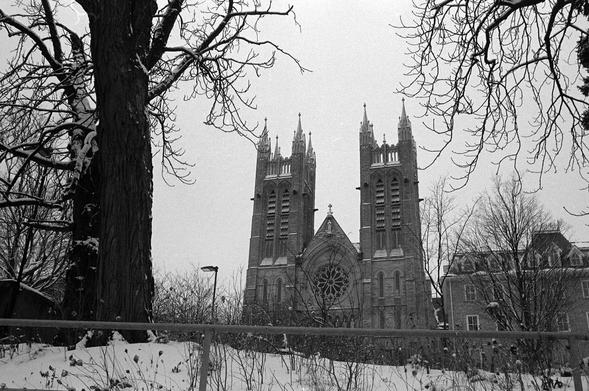
Week 01 - Royal City - The inclusion of the Basilica of Our Lady Immaculate is three fold. First, it is the recognisable building in downtown Guelph, second, its towers that drew me towards the downtown during my stay. And thirdly a small tribute to my Opa who was a Roman Catholic in life, but from a different parish.
Nikon FM - AI-S Nikkor 35mm 1:2.8 - Fomapan 400 @ ASA-200 - Rollei Low Speed (1+4) 10:45 @ 24CWeek 02 - Ghosts - While Streetsville offered up a lot of excellent historical buildings, the Barber House has of all of them the best story. Which is more on the history of the property and the death of Elizabeth Comfort at the hands of Tory Thugs during the 1837 Rebellion and the ghosts that still haunt the site today.
Nikon FM - AI-S Nikkor 35mm 1:2.8 (Yellow-12) - Fomapan 400 @ ASA-200 - Adox Atomol 49 (Stock) 9:00 @ 20CWeek 03 - Daily Gind - My choice for this image became clear because the idea I had was to convey the loneliness of a campus that should have been bustling with activity for start-of-term.
Nikon FM - AI-S Nikkor 50mm 1:1.4 - Fomapan 400 @ ASA-400 - Acufine (Stock) 6:00 @ 20CWeek 04 - Hometown Blues - Again the choice of the image comes down to story and with Milton, there are a lot of buildings that I have connections with, but the old Court House has the best story as it secured Milton as the seat of Halton and helped catalyse the preservation of other historic buildings in town.
Nikon FM - AI Nikkor 28mm 1:3.5 - Fompan 400 @ ASA-400 - Adox Atomal 49 (Stock) 10:00 @ 20CWeek 05 - The Falls - There's something about a hike in the Winter with snow and trees and your wife to add to the same shot you get while hiking through the woods in the winter.
Nikon FM - AI Nikkor 28mm 1:3.5 - Fomapan 400 @ ASA-200 - Kodak D-76 (1+1) 9:00 @ 20CWeek 06 - Erchless - The title of week six ended up being the deciding factor of which image would be chosen. In this case the Erchless manor, showing all three sections of growth between 1835-1858 and remains the ancestral home of the Oakville Chisholms.
Nikon FM - AI Nikkor 28mm 1:3.5 (Yellow-12) - Fomapan 400 @ ASA-200 - FPP D96 (Stock) 7:30 @ 20CWeek 07 - The Neighborhood - Picking an image for week 7 was hard, I'd walked this route many times over the past couple of years. But the pedestrian bridge over the railroad made sense as it closed the loop on the walking route.
Nikon FM - AI-S Nikkor 35mm 1:2.8 - Fomapan 400 @ ASA-320 - Ilford Ilfotec HC (1+63) 12:00 @ 20CWeek 08 - Still As The Grave - Despite being knee-deep in snow, I managed to visit a pair of historic cemeteries. But this photo, while far from perfect stood out, with the bare branches serving as light beams coming from the head of the statue of Jesus.
Nikon FM - Lomography Daguerreotype Achromat 2.9/64mm - Fomapan 400 @ ASA-200 - FA-1027 (1+14) 8:00 @ 20CWeek 09 - By the Bay - Not often do you have a reminder of the original founding of the community, but in Burlington they have that reminder. The Joseph Brant House today is a 1937 replica of the original 18th Century home of noted Mohawk leader, Thayendanegea.
Nikon FM - AI-S Nikkor 50mm 1:1.4 - Fomapan 200 @ ASA-200 - Ilford Perceptol (Stock) 6:00 @ 20CWeek 10 - Sixteen - Knox Sixteen, originally founded in 1844 as a wooden meeting house for Presbyterians in the region, it was clad in brick in 1899 and is the only surviving building from the settlement of Sixteen Hollow and remains an active congregation today.
Nikon FM - AI Nikkor 28mm 1:3.5 (Yellow-12) - Fompan 200 @ ASA-200 - FA-1027 (1+19) 10:30 @ 20CWeek 11 - Galt - The Russian Gun, captured by the British at Sevastapol in 1855, granted to Galt in 1863. It was fired in May 1866, after three successful rounds, the fourth round went off early killing two and injuring three. It's not safe and deactivated in Queen's Square.
Nikon FM - AI-S Nikkor 105mm 1:2.5 - Fomapan 200 @ ASA-200 - Ilford Ilfotec HC (1+63) 9:00 @ 20CWeek 12 - Distant Voices - Two of the three reconstucted Wendat Longhouses at Crawford Lake, built with the aid of indigenous people to showcase life in the area in the 15th Century.
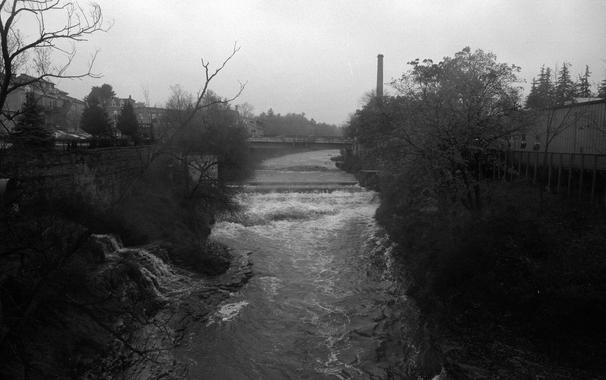
Nikon FM - AI Nikkor 28mm 1:3.5 (Yellow-12) - Fomapan 200 @ ASA-200 - Kodak D-76 (1+1) 9:00 @ 20CWeek 13 - By George - The Former Barber Mill that operated from 1854-1991 and was the first industrial uses of hydro electricity in 1880.
Nikon FM - AI Nikkor 28mm 1:3.5 - Fomapan 200 @ ASA-200 - Adox Atomal 49 (Stock) 10:00 @ 20C

For this 52-Roll project, I decided to play a little bit with the available data that I have access to, thanks to tracking the entire project in an Excel spreadsheet and tailoring the spreadsheet to make it easy to analyse and turn the data into information. Some of my job tasks often involve analysing data for future decision-making, and I think this project might help determine future project targets, locations, and even film development. With everything that took place throughout 2021, I'm not surprised that most of the week's of the projects were located in my hometown of Milton. A total of eleven weeks were spent in Milton, the second-highest location count being Oakville and Toronto, also no surprise at those two numbers. Three weeks were spent in Hamilton, and an additional three weeks were shot at multiple locations. With the remaining places being 1-2 weeks. With an entire range of Nikkor manual focus lenses available, there were two top lenses from the project; at the number one spot with fourteen weeks being used is the Nikkor 35mm f/2.8 and in second place with twelve weeks the Nikkor 28mm f/3.5. This year, I allowed myself to have weeks where I brought multiple lenses; this accounted for ten weeks of the project. I used my Lomography Achromat 64mm f/2.9 lens twice this year. The lenses with the lowest counts were the 50mm f/1.8 and 200mm f/4; no surprise on the 200mm as it came into my kit late in the year and is highly specialised. Some films are easier to nail down a developer than others when it comes to Foma films. Over the year, I used seventeen different developers. The one that I used the most shouldn't come as a surprise, Ilford Ilfotec HC, at a total of eleven times. Tied in second place are Adox Rodinal (a surprise) and Adox Atomal 49, another fantastic developer who did a fine job with Fomapan 400 and Fomapan 200. Then if you break it down by film stock and developer used. The most used Developer with Fomapan 100 was a tie between Ilfotec HC and Adox Rodinal, both at five times each. Fomapan 200, a tough stock to nail down a good developer, was Ilfotec HC four times, followed by Kodak D-23. This older developer is one of the best developers for the stock. Then with Fomapan 400, the number one developer is Adox Atomal 49 at four times, and provided the best results at both the box speed of ASA-400 and at one-stop over (ASA-200) and pulled in development.

Week 14 - Upon Avon - Originally built in 1910 as the Imperial Ratten Co and one of the big five furniture factories in Stratford. Imperial became a major player in modern design through the 1950s. It closed in 2006 as Krug Furniture.
Nikon FM - AI Nikkor 28mm 1:3.5 (Yellow-12) - Fomapan 200 @ ASA-200 - Adox Atomal 49 (Stock) 10:00 @ 20CWeek 15 - In Memorial - It's always fun to explore a new park that you pass every day. But also to find it has a far richer history than you first expected.
Nikon FM - AI-S Nikkor 105mm 1:2.5 - Fomapan 200 @ ASA-160- Adox Rodinal (1+50) 8:00 @ 20CWeek 16 - The Summit - It's never fun to have movements restricted, but it does help to take on a new hiking trail at the Summit entrance for Kelso Conservation Area!
Nikon FM - AI Nikkor 28mm 1:3.5 - Fomapan 200 @ ASA-200 - FPP D96 (Stock) 9:00 @ 20CWeek 17 - Boston - Boston Presbyterian Church is the area's oldest congregation having been founded in 1820.
Nikon FM - AI Nikkor 28mm 1:3.5 - Fomapan 200 @ ASA-100 - Adox FX-39 II (1+9) 10:00 @ 20CWeek 18 - End of Line - A rather unassuming house operated as a vaccine farm from 1885-1916.
Nikon FM - AI-S Nikkor 35mm 1:2.8 - Fomapan 100 @ ASA-100 - Rollei Supergrain (1+15) 7:30 @ 20CWeek 20 - Sharpe's Tragedy - A Memorial to Colonel S. Sharpe - committed suicide on 25 May 1918 brought on by Post-Traumatic Stress. Least We Forget.
Nikon FM - AI-S Nikkor 35mm 1:2.8 (Yellow-12) - Fomapan 100 @ ASA-100 - Adox FX-39 II (1+9) 7:00 @ 20CWeek 21 - Yorklands - The Main Administration building of the former Guelph Reformatory.
Nikon FM - AI Nikkor 28mm 1:3.5 - Fomapan 100 @ ASA-100 - FA-1027 (1+14) 9:00 @ 20CWeek 22 - Bought the Farm - The overgrown rear yard for the Historic Cattle barn at Scotsdale Farm, the barn probably dates to the 1870s.
Nikon FM - AI-S Nikkor 35mm 1:2.8 (Yellow-12) - Fomapan 100 @ ASA-100 - Ilford Ilfotec HC (1+63) 10:00 @ 20CWeek 23 - Parkway - Looking out over Navy Island which was a shipyard, the Republic of Canada, Resort Island, and potential site for the United Nations Headquarters.
Nikon FM - AI-S Nikkor 35mm 1:2.8 (Yellow-12) - Fomapan 100 @ ASA-100 - Adox Rodinal (1+50) 9:00 @ 20CWeek 24 - Westfield - The 1814 Log Church that once served the Six Nations Reserve.
Nikon FM - AI-S Nikkor 35mm 1:2.8 (Yellow-12) - Fomapan 100 @ ASA-100 - Rollei Supergrain (1+15) 7:30 @ 20CWeek 25 - Embrace the Grain - Big B is a very special stuffed panda that has helped both Heather and I.
Nikon FM - AI-S Nikkor 50mm 1:1.8 - Fomapan 100 @ ASA-100 - Ilford Ilfotec HC (1+79) 12:00 @ 20CWeek 26 - The Gorge - The Elora Inn & Spa is built from the original 1832 Saw, Grist, and Distillery and Elora's oldest building.
Nikon FM - AI-S Nikkor 50mm 1:1.4 - Fomapan 100 @ ASA-100 - Ilford Ilfotec HC (1+79) 12:00 @ 20CWeek 27 - Steel City Blues - The Lister Block, my personal choice to symbolise the height, the fall, and rebirth of Hamilton's downtown core.
Nikon FM - AI Nikkor 28mm 1:3.5 (Yellow-12) - Fomapan 100 @ ASA-100 - Adox Rodinal (1+50) 60:00 @ 20C

There is a certain joy to completing this project during the ongoing global pandemic. I realised several months in that I could not always rely on the subject matter that drove previous projects. With events being cancelled and travel restricted, not to mention plenty of ongoing changes in public health guidelines, I knew that I would have to get creative in some cases. But that is what these projects are about, being creative. That meant that the entirety of this project got created right here in Ontario. And mostly local also, the furthest spot, being Petrolia, Ontario only two and a half hours away. As for reenactments and photo walks, these were mostly cancelled. And while I didn't get out to any War of 1812 related events, I did experience some World War 1 events thanks to the fine folk in the 11th Swiss Rifles. And both these events expanded my understanding of the conflict, not just in Canada's role but also the role of the Swiss, which is often missed in Canadian history textbooks. Equipment-wise, I suffered no catastrophic failures, sure a couple of glitches, but these were easily fixed at home. I also added two new lenses to my kit, the 24mm f/2.8 and 200mm f/2.8; as for lenses, I did manage to use almost every manual focus Nikon lens in my kit, save for one, the PC Nikkor 35mm f/2.8. I did consider the PC-Nikkor for one of the weeks but decided against it because lugging a tripod does make life harder. For film stocks, I'm happy with my choice of going with the three main Fomapan films and learning a bit more about their nature. The biggest is that Fomapan 400, while it still works best when shot at ASA-200, can be shot at the box speed of ASA-400, providing you develop it in the proper chemistry. I still had a hard time with Fomapan 200 but am a little closer to cracking the code on that stock; it does perform the best in classic developers like Pyro based and D-76/D-23. And, of course, Fomapan 100 remains a solid favourite. And it felt good to revitalise the project idea in my mind and certainly provided plenty of inspiration. I even think that I may return to a sheet based project in a couple of years.

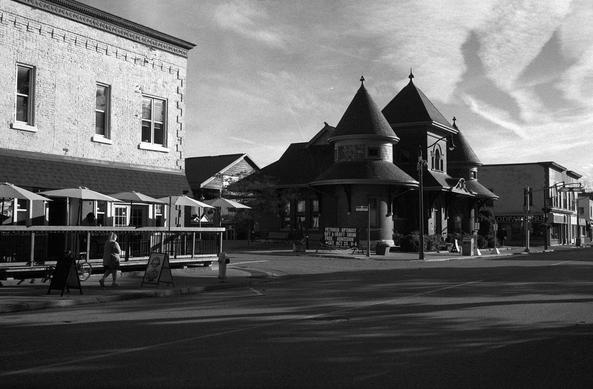
Week 28 - Stone Town - St. Marys 1907 GTR station, today operated by VIA is the third and final train station completed for the town. The first station still stands a kilometer outside the community at St. Marys Junction.
Nikon FM - AI Nikkor 28mm 1:3.5 (Yellow-12) - Fomapan 100 @ ASA-32 - Ilford Ilfotec HC (1+63) 8:30 @ 20CWeek 29 - Muddy York - The Gooderham Building, an icon of Old Toronto, despite dating to 1892, it has survived against much of the urban renewal of the 1970s.
Nikon FM - AI-S Nikkor 35mm 1:2.8 (Yellow-12) - Fomapan 100 @ ASA-100 - Adox Rodinal (1+50) 9:00 @ 20CWeek 30 - The Last Bastion - A visit to Lindsay, Ontario and finding the Victoria Park Armoury that looks totally different from all the other armouries from the era across Ontario.
Nikon FM - AI-S Nikkor 35mm 1:2.8 - Fomapan 100 @ ASA-100 - Ilford Microphen (1+1) 9:00 @ 20CWeek 31 - The Swiss Connection - Members of the 11th Swiss Rifles, a Reenactment Unit portraying a Swiss rifle unit during World War 1 and their replica Maschinengewehr Modell 1900.
Nikon FM - AI-S Nikkor 105mm 1:2.5 - Fomapan 100 @ ASA-100 - Ilford Microphen (1+1) 9:00 @ 20CWeek 32 - Syndenham - The Boyhood home of World War 1 Flying Ace Billy Bishop (bet you thought I was going to say Snoopy).
Nikon FM - AI Nikkor 28mm 1:3.5 (Yellow-12) - Fomapan 100 @ ASA-100 - Adox Rodinal (1+50) 9:00 @ 20CWeek 33 - Connect - Saying goodbye to a wonderful social group, group founder Susan taking in a thank you video the participants put together.
Nikon FM - AI-S Nikkor 105mm 1:2.5 - Fomapan 100 @ ASA-100 - Ilford Ilfotec HC (1+63) 10:00 @ 20CWeek 34 - Brant's Ford - A sad memorial to the thousands of children who never left the Residential School Systems on the steps of the oldest such places in Canada.
Nikon FM - AI-S Nikkor 105mm 1:2.5 - Fomapan 100 @ ASA-100 - Adox FX-39 II (1+9) 7:00 @ 20CWeek 35 - Smokey Hollow - The beautiful Grindstone Creek valley while it was not the shot I planned but I'm far more happy with this one.
Nikon FM - AI Nikkor 28mm 1:3.5 - Fomapan 100 @ ASA-100 - Adox Rodinal (1+50) 9:00 @ 20CWeek 36 - The Quarry - Getting back to the unstated goal of trying to fit in all the Conservation Halton Parks into the project!
Nikon FM - AI Nikkor 24mm 1:2.8 (Yellow-12) - Fomapan 200 @ ASA-200 - Adox FX-39 II (1+9) 10:00 @ 20CWeek 37 - Break On Through (To the Other Side) - While a rather commercial looking door for a week about doors, Sunshine Donuts is an amazing local store that delivers amazing treats. It's been a constant for Heather and I through this year and the one before.
Nikon FM - AI-S Nikkor 50mm 1:1.4 - Fomapan 200 @ ASA-200 - Ilford Ilfotec HC (1+63) 9:00 @ 20CWeek 38 - Cobblestones - The Paris Wincy Mills, a former industrial mill from 1889 that survived well into the 20th Century now is a local hub for food and vendors. Also an excellent craft brewery.
Nikon FM - AI Nikkor 24mm 1:2.8 - Fomapan 200 @ ASA-200 - Ilford Ilfotec HC (1+63) 9:00 @ 20CWeek 39 - Entrenched - Lance Corporal Julius is the unit Mascot for the No. 3 Casulty Clearing Station - Canadian Army Medical Corps.
Nikon FM - Lomography Daguerreotype Achromat 1:2.9/64mm - Fomapan 200 @ ASA-50 - Kodak D-23 (Stock) 5:45 @ 20CWeek 40 - Stone City - Shoal Tower, one of four Martello towers that form the defence of Kingston. And one of only a handful of surviving towers in Canada.
Nikon FM - AI-S Nikkor 200mm 1:4 - Fomapan 200 @ ASA-200 - Kodak D-23 (Stock) 7:00 @ 20C

This year has only been the second time I put together a final book on the project. The book wasn't entirely required by my original criteria, but it gives the project that last project. The saying "it's not complete until it's printed", which I don't always agree with, but makes sense in this case. While the blog posts allowed for that 'big-picture' view for each week with either an overarching theme or local history, I rarely translated that directly to the book copy. The book gave me a chance to target a specific image, picking the shot that I liked the most from the week or had an interesting story attached. Some weeks, I had to seriously trim down the entry to fit and still have the text big enough for people to read. I could explore many different parts of history that I enjoy studying, including military, railway, architecture, natural, and local histories. I covered a lot of early colonial history in Ontario and some of the darker aspects of that story. I touched on a lot of World War One history through local men who served and learned a great deal about the Swiss during the Great War. Surprisingly, despite visiting a few locations related to the War of 1812, none of those made it into the book this time around. But the biggest help to get the book moving from the start, allowing things to clip along at a good pace, so I only had a handful of things to take care of to complete the project.

Week 41 - If I Left the Zoo - Tiger Cub Milia is the most recent arrival to the Zoo and the Amur Tiger species.
Nikon FM - AI-S Nikkor 105mm 1:2.5 - Fomapan 200 @ ASA-200 - Ilford Ilfotec HC (1+63) 9:00 @ 20CWeek 42 - All In the Details - The Steeple of Knox Presbyterian Church in Downtown Milton, Ontario. Depsite appearances, it never had bells.
Nikon FM - AI-S Nikkor 200mm 1:4 - Fomapan 200 @ ASA-200 - Kodak D-23 (Stock) 7:00 @ 20CWeek 43 - Black Gold - While a shot of the original oil fields would have been more appropriate, Sunnyside Mansion, built for John Henry Fairbanks, Ontario's biggest oil baron's 1891 Victorian Mansion is a rather creepy but photogenic building in downtown Petrolia, Ontario.
Nikon FM - AI-S Nikkor 35mm 1:2.8 (Yellow-12) - Fomapan 200 @ ASA-100 - Pyrocat-HD (1+1+100) 7:30 @ 20CWeek 44 - Highlands - The Wellington County Poorhouse, the oldest surviving such structures in Canada used to house men and women poor and destitute to 'fix' their moral failing through hard work. Today it is the local history museum and archives.
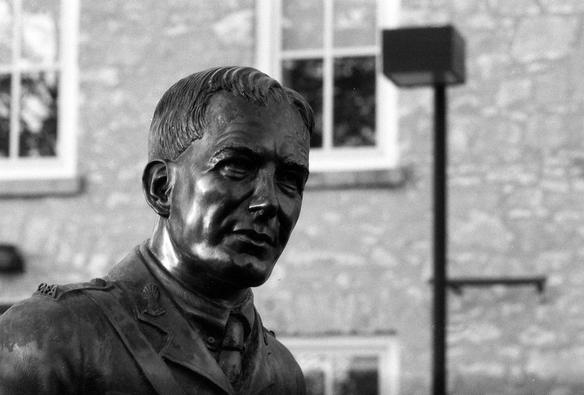
Nikon FM - AI Nikkor 28mm 1:3.5 - Fomapan 200 @ ASA-200 - Adox XT-3 (Stock) 6:00 @ 20CWeek 45 - For the Fallen - A beautiful memorial to Lieutenant-Colonel John McCrea, the author of one of Canada's most notable poems of Rememberance "In Flander's Fields" installed near the Guelph Civic Museum.
Nikon FM - AI-S Nikkor 105mm 1:2.5 - New Classics EZ400 @ ASA-250 - Kodak D-23 (Stock) 7:30 @ 20CWeek 49 - Houses of Holy - St. Jude's Anglican church, a congregation that traces itself back to 1839, their current home from 1889 is one of the more difficult churches to photograph especially around the noon hour.
Nikon FM - AI Nikkor 28mm 1:3.5 - New Classic EZ400 @ ASA-400 - Adox Atomal 49 (Stock) 10:00 @ 20CWeek 47 - Worth The Drive - Acton's history has always been tied to the leather industry, and today that is only continued through the Old Hide House.
Nikon FM - AI-S Nikkor 35mm 1:2.8 (Yellow-12) - New Classic EZ400 @ ASA-200 - Adox Atomal 49 (Stock) 9:00 @ 20CWeek 48 - Danforth to Downtown - A long walk from Greektown to the downtown put me past the site of Toronto's earliest 'lost' buildings, the Simcoe's cottage grandly named "Castle Frank" now only a small historical marker.
Nikon FM - AI Nikkor 24mm 1:2.8 - New Classic EZ400 @ ASA-200 - Pyrocat-HD (1+1+100) 12:30 @ 20CWeek 49 - First Capital - A memorial to the Simcoes, while most memorials feature only John Graves (Upper Canada's first Lieutenant-Governors), this one also features Elizabeth, who's watercolours and diaries are key to our understanding of early life in Upper Canada.
Nikon FM - AI-S Nikkor 35mm 1:2.8 (Yellow-12) - Fomapan 400 @ ASA-400 - Flic Film Black/White & Green (1+49) 13:30 @ 20CWeek 50 - Little Saxony - The stunning Puddicombe House in the New Hamburg Heritage District, originally built 1868 this Italinate Mansion is a boutique hotel, resteraunt, spa and event space since 2006.
Nikon FM - AI Nikkor 24mm 1:2.8 (Yellow-12) - Fomapan 40 @ ASA-200 - Ilford Ilfotec HC (1+63) 11:45 @ 20CWeek 51 - Rattler - A beautiful afternoon hike after a snowfall at Rattlesnake Point. And while we didn't make it too far, I'm happy with the results I did get.
Nikon FM - AI Nikkor 24mm 1:2.8 (Yellow-12) - Fomapan 400 @ ASA-200 - Adox Rodinal (1+50) 11:00 @ 20CNikon FM - AI Nikkor 28mm 1:3.5 - Fomapan 400 @ ASA-200 - Flic Film Black/White & Green (1+49) 12:00 @ 20C

And so dear readers, we've reached the end of another project. It was fun to dust off this project form again, and it made me glad I still had the chops to complete the task at hand. And despite everything that happened this year, I still managed to complete the project with no significant failures. If you like what you see and want a copy, you will be able to pick up this project in book form, and all the images featured here on this post are the ones that I chose for the book itself. It will be available at the end of February 2022 through Blurb. Maybe next year, I was revisiting a sheet-based project, but we'll see how the whole parenting thing goes first.

#foma52 #52roll #52rollproject #accufine #adoxatomal49 #adoxfx39ii #adoxrodinal #fomapan100 #fomapan200 #fomapan400 #fppd96 #ilfordilfotechc #ilfordperceptol #kodakd76 #nikkor #nikonfm #rolleirls
Foma:52 - Fifty-Two Weeks, Fifty-Two Images

Well, I made it through another 52-Roll project, and in true form, I'm sharing my favourite images from the year; all of these are featured in the final book!

Alex Luyckx | Blog

Foma:52 – Week 52 – Christmastime

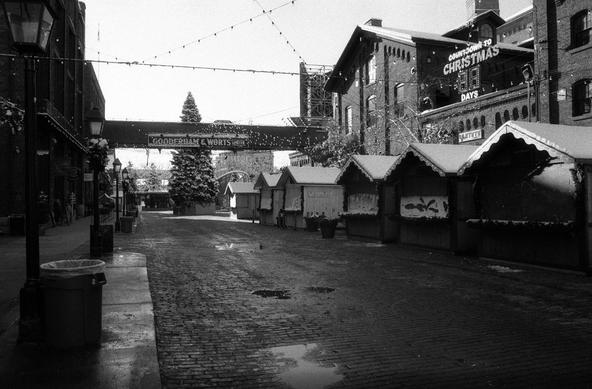
There's something special about arriving before the crowds do. When it comes to Toronto Distillery District Christmas Market, that is key to capturing both the space and the decorations. So for the final week, I ducked into Toronto in the early morning and wandered around the area before heading home and to the family times of the Christmas Season, and it seemed to be the appropriate way to end the project.

Nikon FM - AI Nikkor 28mm 1:3.5 - Fomapan 400 @ ASA-200 - Flic Film Black/White & Green (1+49) 12:00 @ 20C

If you've spent any time in Toronto or are in some way involved with the arts scene, there is a good chance the Distillery District is a familiar sight. In 1831, James Wort, a miller, emigrated from Diss, England, to York in Upper Canada (Toronto, Ontario). His brother-in-law, William Gooderham, joined him there a year later. The two men established a mill at the mouth of the Don River. Their windmill became a landmark of the city's skyline of the era; taking advantage of its access waterfront and the vast agricultural industry, the two men met with great success. Grain would come in from the surrounding farms, milled and then sent out steamships into the Great Lakes. In 1834, two week's after his wife's death during childbirth, James threw himself down the mill's well, committing suicide by drowning. William would continue to operate the mill as a sole operator, but faced with a grain surplus, William began to produce spirits in 1837. In the same year, both wind and water power were replaced by steam to drive the milling and distilling processes. Gooderham's whiskey became the mill's primary source of income and tapped into a lucrative market. By 1845, William invited James' eldest son, James Gooderham-Worts, to be a co-manager and, in 1856, his son, George Gooderham, into the business. The three men saw the future in distilling and hired noted Toronto architect David Roberts Jr to design a massive distillery complex. Construction of the complex began in 1859 and was completed in 1861; the old windmill came down during the construction. After one full year of production, the Gooderham & Worts Distillery produced seven million imperial gallons of spirits, approximately 3.2 million litres. It represented 25% of all the spirits produced in the Province of Canada. To help bring in more raw materials and ship out the finished product, the company invested in three railroads in the 1860s and 1870s, Toronto, Grey & Bruce, Credit Valley Railway, and Toronto & Nippissing. Using that influence, the distillery was well served by rail and ship, despite the slow movement of the Toronto shoreline. When George Gooderham took over from his father, production increased to almost 2 million imperial gallons of spirits per year or 50% of all spirits produced in Canada. By 1890 the complex had again increased in size to allow various spirits, including Rum and Industrial alcohols, to be made. During World War One, the distillery operating under the parent company British Acetones began producing chemical components to produce smokeless powder to support the war effort. After the war's end, the rise of temperance movements and the growing popularity of beer forced the distillery's sale to Harry C. Hatch, who in turn sold the company to Hiram Walker Distillery in 1927. Under Walker's management, two additional buildings were added as Prohibition began to lift across Ontario, but they banked on the American market as Prohibition continued south of the border until 1933. After 1930 the distillery lost all access to the lake and could only rely on the railroad (now all former railways they invested in were part of Canadian National) and the growing automotive transport. The distillery again ramped up industrial production during World War Two, focusing on antifreeze. Whiskey production ceased in 1957, with rum and industrial alcohols continuing production until 1990. During the 1970s and the increased urban renewal and deindustrialization sweeping across Toronto, the Ontario Heritage Foundation designated the distillery to prevent any demolition; it received Federal Heritage designation in 1988. The distillery again changed hands in 1987 to the British firm, Allied Lyons. After closure, the site fell into disrepair, becoming a popular spot for the growing Urban Exploration Community and the film and television production industry. Some 800 productions were filmed at the Distillery District. Seeing the potential for a tourist spot, Cityscape purchased the shuttered distillery in 2001. Restoration began in 2002 and took a year, with a grand reopening in 2003. Today, the Distillery District is a pedestrian-friendly space and art enclave. Space is dedicated to local artists who run studios, galleries and independent shops; there is also two theatres and several coffee spots. And the brewing industry is also not lost, with Mill Street Brewery, Spirit of York Distillery and IZUMI Brewery (Ontario Spring Water Sake Company). They have also hosted a Christmas Market since 2010 and remain a popular tourist attraction in the city.

Nikon FM - AI Nikkor 28mm 1:3.5 - Fomapan 400 @ ASA-200 - Flic Film Black/White & Green (1+49) 12:00 @ 20CNikon FM - AI Nikkor 28mm 1:3.5 - Fomapan 400 @ ASA-200 - Flic Film Black/White & Green (1+49) 12:00 @ 20C

The trouble with spaces that I like is that it's hard to pick your favourites, and I did walk away with several excellent images. However, the feature image came clear to my mind from the start. I had to try several different angles to balance the rising sun and composition. Still, I'm happy with showing off the Christmas Tree, the countdown clock and the iconic Gooderham & Worts signage that survives from the original purpose of the location. In the end, I went with my gut when choosing the rest of the images and focusing on the architecture of the space. That meant that I went with wide shots that the Distillery District indeed allows. And even in the narrow sections, there's plenty to see.

Nikon FM - AI Nikkor 28mm 1:3.5 - Fomapan 400 @ ASA-200 - Flic Film Black/White & Green (1+49) 12:00 @ 20CNikon FM - AI Nikkor 28mm 1:3.5 - Fomapan 400 @ ASA-200 - Flic Film Black/White & Green (1+49) 12:00 @ 20C

Right from the start, I knew I wanted a wide-angle lens to capture the architecture at the distillery, but with the sun starting to shine and still getting some nice low angle light, I didn't want anything too wide. That left the 24mm sitting at home, and while being slightly slower, the 28mm f/3.5 seemed the perfect fit. Although I would have liked to have a lens hood to help with any off-axis light as the sun crept up over the expressway. The lovely morning light helped and let me shoot the roll one last time at ASA-200. I also wanted to see how Flic Film Black/White & Green handled pulling the film in development. And it did an okay job, still plenty of contrast, sharpness and a bit of grain in the negative spaces. I had planned to bring a yellow filter along, but I'm glad I didn't, as, in several areas, I was shooting wide open to get decent shutter speeds.

Nikon FM - AI Nikkor 28mm 1:3.5 - Fomapan 400 @ ASA-200 - Flic Film Black/White & Green (1+49) 12:00 @ 20CNikon FM - AI Nikkor 28mm 1:3.5 - Fomapan 400 @ ASA-200 - Flic Film Black/White & Green (1+49) 12:00 @ 20C

Well, folks, we're here at the end of the project, so the next time you'll see the project will be in the new year as I run down my favourite fifty-two images of the year.

#foma52 #52roll #52rollproject #canada #flicfilmblackwhitegreen #fomapan400 #gooderhamworts #nikonfm #ontario #thedistillerydistrict #toronto

Foma:52 - Week 52 - Christmastime

We are ending the year on a high note and an early morning visit to Toronto's distillery district.

Alex Luyckx | Blog

Foma:52 – Week 51 – Rattler

While I did it, I managed to include almost all the parks in my region and operated by Conservation Halton. At least the parks are more aimed towards hiking, and today we're at what is considered the most beautiful of all the parks. Rattlesnake Point may not have any incredible history connected to the property it does have some of the oldest surviving trees in the region. The park is an untouched space that if you're there on a quiet day, you can get a real sense of place and how things used to be long before we arrived.

Nikon FM - AI Nikkor 24mm 1:2.8 (Yellow-12) - Fomapan 400 @ ASA-200 - Adox Rodinal (1+50) 11:00 @ 20C

Unlike many other parks in the Halton Parks system, there is no natural history connected to Rattlesnake Point. The area never held farms, old mills, or quarries. But that doesn't mean it is not enjoyable by any means. While I often look for human history, it is all about natural history. The one thing that everyone in my part of Ontario knows about the Niagara Escarpment, if you've turned around and looking for something to navigate towards, the bluff will always lead you where you want to go—created during the last great ice age during a glacial retreat. The same retreat also formed the earliest forms of the Great Lakes. The result of unequal erosion and made up of dolomitic limestone. Starting at Rochester, New York, it goes along to the Niagara River, forming the mighty Niagara Falls and the bloody battlefield of Queenston Heights. It runs up to the Bruce Penisula and then through the Upper Penisula of Michigan and into Wisconsin! Rich forests followed, forming some of the world's oldest standing woods; animals found a home as did humans, including the Neutral peoples. And Halton Conservation sought to protect that beauty when Rattlesnake Point was established in 1961. Although the chosen name remains a mystery to the source, it could come from when the Mississauga Rattler thrived in the region or the snake-like cuts running through the cliffs. While Rattlesnake Point lacks any human history, it makes up for it in natural beauty as you can wander ancient paths and see trees that have stood for over a thousand years. From several lookouts, you can see out as far as the eye can see and even wander down into a local canyon.

Nikon FM - AI Nikkor 24mm 1:2.8 (Yellow-12) - Fomapan 400 @ ASA-200 - Adox Rodinal (1+50) 11:00 @ 20CNikon FM - AI Nikkor 24mm 1:2.8 (Yellow-12) - Fomapan 400 @ ASA-200 - Adox Rodinal (1+50) 11:00 @ 20C

While the snow and blue sky certainly made for a fantastic day to make images, it also turned the trails into a bit of a mess. The original plan for Heather and me was to walk to the lower path, which is both wide and flat. Which makes it easy to navigate; there are some side trails out to lookout points. The trouble is that the access road down and up were blocked off, probably because it's difficult to clear in the winter. And probably would have given me a run for my money to get back up to the main road in the Kia, so we stuck to the upper trail, which isn't as easy, especially in the winter. So we didn't make it too far along; rather than only shoot a small part of the roll and say 'enough' at 25, I started to bracket my shots and still shot the whole roll, not in the true sense of the word, but after a fashion. I would shoot one frame slightly over-exposed and another somewhat under-exposed with the brilliant conditions. Or one in landscape and one in portrait orientation. Because of that, I only ended up with about fifteen keepers, which made it easier to pick the images I included.

Nikon FM - AI Nikkor 24mm 1:2.8 (Yellow-12) - Fomapan 400 @ ASA-200 - Adox Rodinal (1+50) 11:00 @ 20CNikon FM - AI Nikkor 24mm 1:2.8 (Yellow-12) - Fomapan 400 @ ASA-200 - Adox Rodinal (1+50) 11:00 @ 20C

It was a day for landscapes, so the only lens I could think of to capture the true grandeur of the park was my trusty 24mm f/2.8, and thanks to the recent snowfall and the brilliant blue skies, I put on the pale-yellow filter to help cut down on those blues. I also decided to over-expose the film by a stop and shoot at ASA-200 as I find that produces the best overall image quality out of Fomapan 400. This week I did something crazy and developed with Adox Rodinal and not even stand-developing the film. Instead, I went with a 1+50 dilution and a long time for development. And from what I've seen throughout the year, the longer the development time, the better Fomapan 400 performs with standard developers. And right from the tank, the negatives looked terrific, but the real proof would come from the scans. Is there grain? Yes, but the images are also sharp and have a lot of detail pulled out, although I think the new scanner software helped out a bit? It turns out, Epson Scan doesn't like Windows 11, so I switched up to Silverfast.

Nikon FM - AI Nikkor 24mm 1:2.8 (Yellow-12) - Fomapan 400 @ ASA-200 - Adox Rodinal (1+50) 11:00 @ 20CNikon FM - AI Nikkor 24mm 1:2.8 (Yellow-12) - Fomapan 400 @ ASA-200 - Adox Rodinal (1+50) 11:00 @ 20C

I cannot believe it, we're onto the last week, and you won't have to wait until next week to see it; Christmastime is here again! I'm in Toronto for an early morning visit to the Distillery District.

#foma52 #52roll #52rollproject #adoxrodinal #brucetrail #canada #fomapan400 #milton #nikonfm #ontario #rattlesnakepoint

Foma:52 - Week 51 - Rattler

Hitting up the final major hiking park for the Halton Conservation Authority. Rattlesnake Point is rich in natural history with ancient cliffs and thousand-year-old trees.

Alex Luyckx | Blog

Foma:52 – Week 50 – Little Saxony

There's a good chance that if I'm heading along Highway 7/8, a sign for New Hamburg is something that I will generally ignore. If I'm in that part of Ontario, I'm on my way to points further west, good chance, Stratford. But I'm also a sucker for a new town, so I made the point to head into New Hamburg during a day out shooting for reviews last year. Like other communities in Southern Ontario, the town has been expanded outwards in urban sprawl with several new subdivisions. Still, it has also maintained a cosy historic downtown, which is where we're exploring today.

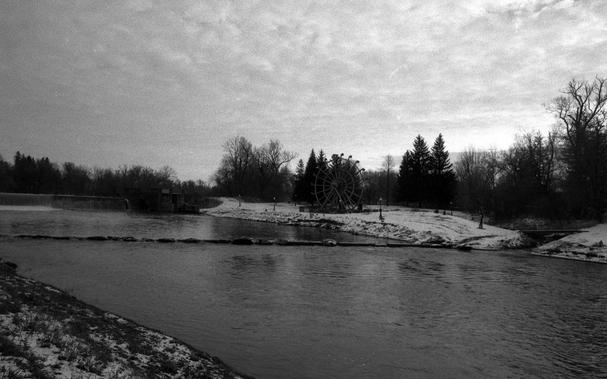
Built in 1990, this 65 foot water wheel commemorates the early waterpowered industry that formed the core of New Hamburg's foundations.
Nikon FM - AI Nikkor 24mm 1:2.8 (Yellow-12) - Fomapan 40 @ ASA-200 - Ilford Ilfotec HC (1+63) 11:45 @ 20C

There is fertile soil and running water you will find a human settlement. While the original name for the land and the river remains lost in time. The area where New Hamburg stands today has passed through several different hands; the first was the Neutrals, the Attiwonderonk. They were pushed out and destroyed by the Haudenosaunee, and over time, they were pushed out by the Anishinabewaki or Mississaugas. After the formation of Upper Canada, British Colonial Authorities secured title to the land under Treaty 3 of 1792, designating the rich area as Crown Reserve. Essentially land in the ownership of the Monarchy is to be given as a reward for services rendered. Although some former slaves escaped and settled here, it remained uninhabited primarily and unsettled, carving a life out of the dense bush. The Post-War period brought a great deal of colonial expansion, including the sale of Crown Land to development companies, the largest being the Canada Company. Surveys in 1824 divided the land into townships, with Wilmot being accessed through the newly created Huron Road in 1828. The area's rich soil and agriculture attracted many German immigrants, primarily those who followed the Amish and Mennonite beliefs. The first signs of a town came in 1832 when Josiah Cushman established a sawmill on Smith Creek, soon others joined, and additional mills took advantage of the water power afforded by the creek, the name Cassel became attached to the settlement and then Hamburg. The small settlement nearly vanished after a Cholera epidemic ripped through the area in 1834; despite everything, the colony survived. Although among the dead was Cushman, in 1838, the Cushman interests were purchased by a Scottish Lord, William Scott or Lord Campfield, who continued to expand the small community. Scott immediately put his mark, renaming Scott Creek the Nith River, building a new dam and establishing several new mills. The name of New Hamburg came in 1840 with the opening of the first post office; soon, more businesses arrived in the growing settlement. Although it was the arrival of the Grand Trunk Railway in 1856, things started to expand, and incorporation as a village came a year later. The industrial base only increased through the 1860s. More mills and factories opened along the Nith River, supported by other hotels, foundries, carriage works, taverns, three churches, and even a school. Agriculture remained the primary industry outside of New Hamburg, and the village continued to support that base in the rural sections. Scott's sawmill continued to operate until 1902 when a fire destroyed the original structure, and it was replaced by flour and later feed mill in 1905 and still stands today. The New Hamburg Felt Boot Co also dates to 1898 and still operates, although the building is far older. While the village thrived through the early 20th century and even achieved incorporation as a town in 1966. The boom would not last long; de-industrialisation and the closure of many family farms proved too much. In changes, government structure resulted in dis-incorporation in 1973 and absorbed into Wilmot Township with several other rural villages. Thankfully the strong heritage movement in the community resulted in the designation of the central core as a Heritage District in 1992. Today New Hamburg is a small sleepy rural community with the historic centre maintained with an increasing urban sprawl on the periphery.

Built in 1905 to replace Scott's lumber mill, the Stuart Flour Mill a brick Ontario Vernacular building today serves as a B-W Feed Store.
Nikon FM - AI Nikkor 24mm 1:2.8 (Yellow-12) - Fomapan 40 @ ASA-200 - Ilford Ilfotec HC (1+63) 11:45 @ 20CThe Hartman Bridge, a steel Pratt Truss bridge completed in 1936, this is the fourth bridge to cross the river, the first being built 1845.
Nikon FM - AI Nikkor 24mm 1:2.8 (Yellow-12) - Fomapan 40 @ ASA-200 - Ilford Ilfotec HC (1+63) 11:45 @ 20C

This week proved challenging to choose which images to include in the post as there are so many buildings in New Hamburg with excellent stories attached to them. So I went with a bit of help and found an only walking tour of the New Hamburg Heritage district and began to look at items that followed my own written history of the community and then found matching photos. The William Scott House and Puddicombe house. Some of the more interesting buildings, like the Standard Reliance & Mortgage Co building, are easy to miss because it's tiny yet has a grand architecture usually reserved for large installations. The Imperial Hotel, while not the most imposing commercial block is where I got lunch the day I was visiting New Hamburg; they do an excellent Mac & Cheese. And while I would have liked to include more, the town's short history meant that adding in a couple of bonus images may have thrown off the flow of the text block.

The Puddicombe House, originally completed in 1868 by Samuel Merner, but sold to the Puddicombe family in 1888 and stayed in that family until 1969. It's been a boutique hotel, spa, and event space since 2006.
Nikon FM - AI Nikkor 24mm 1:2.8 (Yellow-12) - Fomapan 40 @ ASA-200 - Ilford Ilfotec HC (1+63) 11:45 @ 20CThe 1846 William Scott House, it has also been the home of Samuel Merner when he was appointed a Senator and today is the Waterlot Restaurant.
Nikon FM - AI Nikkor 24mm 1:2.8 (Yellow-12) - Fomapan 40 @ ASA-200 - Ilford Ilfotec HC (1+63) 11:45 @ 20C

Through this project, I have learned that knowledge of a place is key to selecting the kit for photographing the location. In this case, knowing that the downtown is compact and has narrow streets, I went with the Nikkor 24mm f/2.8 and added a pale yellow filter to the lens. I could have gotten away with the 28mm lens, but the 24mm suited the space better. The addition of the 105mm probably wouldn't have gone amiss, but I was also working with limited bag space on the trip. And working with bright light, I went with a one-stop over-exposure, shooting the film at ASA-200 and then pulling in development. For development, I went back to an old favourite, Ilford Ilfotec HC, running with a 1+63 dilution to help with compensating the over-exposure.

Originally opening as the Domnion Hotel in 1872, it is better known as the Imperial Hotel. It also served as the first Library (Mechanic's Institute 1881) and a third storey added in 1902.
Nikon FM - AI Nikkor 24mm 1:2.8 (Yellow-12) - Fomapan 40 @ ASA-200 - Ilford Ilfotec HC (1+63) 11:45 @ 20CThe 1914 Standard Reliance & Mortgage Co is a tiny Beaux Arts/Classical Revival that if you blink you will miss it, it also was a jewellery business in 1919, today it's a small pizza place.
Nikon FM - AI Nikkor 24mm 1:2.8 (Yellow-12) - Fomapan 40 @ ASA-200 - Ilford Ilfotec HC (1+63) 11:45 @ 20C

Next week I'm finally going to visit all the major parks under Conservation Halton with a visit to Rattlesnake Point!

#foma52 #52roll #52rollproject #architecture #canada #canadianhistory #downtown #fomapan400 #heritagedistrict #ilfordilfotechc #newhamburg #nikonfm #ontario #town #urban #wilmottownship

Foma:52 - Week 50 - Little Saxony

While visiting New Hamburg hasn't always been my first choice, a chance visit last year found me loving this cute little downtown and Heritage district.

Alex Luyckx | Blog

Foma:52 – Week 49 – First Capital

Across Ontario, there are many surviving enclaves of the 19th century. In the middle of that century, much of the Province saw a massive upswing in population growth. But none can compare to one of the oldest urban centres in Ontario, that of Niagara-On-The-Lake. And Heather and I took a short getaway here last week after discovering the lovely Pillar & Post Inn the previous year.

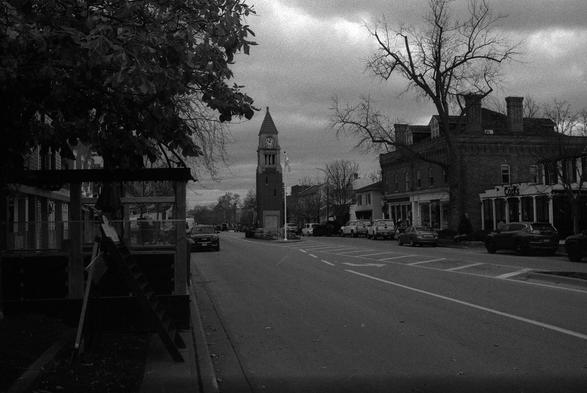
Looking along the Main Street, the Memorial Clocktower is a unique cenotaph in Ontario for those who died during World War One. The Tower is designed by noted Toronto Architect Charles M. Wilmott.
Nikon FM - AI-S Nikkor 35mm 1:2.8 (Yellow-12) - Fomapan 400 @ ASA-400 - Flic Film Black/White & Green (1+49) 13:30 @ 20C

The small peninsula that sits at the mouth of the Niagara River first saw human settlement back in 100 CE by an off-shoot of a people known as the Mound Builders. Little is known of these people in Canada; the first noted Indigenous peoples were those of the Neutral Nation who settled off Mississauga Point in 1400 CE. These made contact with French fur traders in 1615 when the French established their presence across the Niagara River at what is today Fort Niagara. The Neutrals were decimated by sickness and war when the Seneca and Iroquois swept north during the Beaver Wars, while the Seneca stayed to the south of the River, the Iroquois settled to the north. These were forced off the land, and in the 1700s, the Mississaugas arrived. The area became the first major land purchase by the British Crown from the Mississaugas in 1781. Known as Treaty 381 or the Niagara Purchase, the goal was to secure land for an overflow of United Empire Loyalists fleeing to Loyalist strongholds during the American Revolutionary War. Fort Niagara became one of these enclaves, and needing more space, Colonel John Butler led a group north of the Fort and surveyed a small military settlement.

The 1765 Navy Barracks, known today as Navy Hall is attached to Fort George and is now a rentable venue and fully restored.
Nikon FM - AI-S Nikkor 35mm 1:2.8 (Yellow-12) - Fomapan 400 @ ASA-400 - Flic Film Black/White & Green (1+49) 13:30 @ 20C

The Royal Navy's Barracks had been located here since 1765 and remained separate from the small settlement known as Butlersburg. Although that name quickly fell out of favour for West Niagara. Being one of the only built-up centres, in 1792, Lieutenant-Governor John Graves Simcoe renamed the town Newark and established the capital of Upper Canada, holding the first Parliament under an oak tree according to local legend. The community quickly grew, and grand manor homes were constructed by the members of Parliament. It also became a port of entry for many American slaves who sought out Upper Canada after the Bill to Reduce Slavery passed through the Provincial Parliament.

A memorial to John and Elizabeth Simcoe, two important people in the early days of Upper Canada.
Nikon FM - AI-S Nikkor 35mm 1:2.8 (Yellow-12) - Fomapan 400 @ ASA-400 - Flic Film Black/White & Green (1+49) 13:30 @ 20C

In 1796, Simcoe moved the seat of Government to York, as the Jay Treaty saw the threat of renewed violence between England and the United States. The British garrison was also forced to relocate from Fort Niagara to Fort George. Despite the loss of status, the town became a bustling port of commerce, and in 1804 the first lighthouse on the Great Lakes sent out a beacon from Mississauga Point. But when the Anglo-American War of 1812 opened, it turned into a battlefield. American troops landed at the end of May 1813 and after an intense battle, the British garrison at Fort George abandoned the region, leaving it under American occupation for the balance of the year. In December, Joseph Wilcocks, who led a group of turncoat Canadians known as the Canadian Volunteers, presented the idea to the garrison commander to destroy the community in the face of a British army marching on the tiny enclave. The American commander reluctantly allowed the action, and the Canadian Volunteers and a handful of American militia troops set fire to most of the town's buildings. Undaunted the community rebuilt after the war, many buildings took shape from the rubble of the destroyed ones.

Fort Mississauga as seen from across the Golf Course it sits on, I couldn't get closer because of a coyote wandering the grounds.
Nikon FM - AI-S Nikkor 35mm 1:2.8 (Yellow-12) - Fomapan 400 @ ASA-400 - Flic Film Black/White & Green (1+49) 13:30 @ 20C

By the 1820s, the community had almost completely rebuilt, returning as a commercial hub. Focused mainly around agriculture (mostly fruit), shipping, and shipbuilding. Sadly much of the shipping industry would leave after the opening of the Welland Canal. Thankfully the agriculture business continued to boom through the region thanks to the mild climate and excellent soil. The opening of the Welland Canal and its proximity allowed the product to move quickly to a broader market. The railroad's arrival in the 1850s helped bring more people to the region; access to the lake, those mild temperatures, beautiful farms, and public golf courses helped drive people out from the city to take vacation time. It also helped people make their home in the region; the first public school opened in 1859 and a high school in 1875. To help differentiate themselves from Niagara Falls, Niagara-On-The-Lake was adopted in 1880. At the same time, the community rode high through the remainder of the 19th and into the 20th centuries, after the First World War. The Great Depression hit the community hard in both the Agriculture and Tourism sectors, further harm when passenger rail service was cut to the community. Some assistance came in 1930 when the reconstruction of Fort George and Fort Mississauga and further recognition of the battlefields of the Anglo-American War of 1812 along the Niagara River. But the fortunes were even more devastated after the Second World War, and the military pulled out of the community. However, the poor economic fortunes allowed the community to maintain some of its historic buildings and homes as they could not afford the urban renewal sweeping across Ontario in the mid-century. While we can look back now and see this as a good thing, at the time, I'm sure many were not too happy with the state of things. This all changed in 1962 with the opening of the Shaw Festival, celebrating the works of George Bernard Shaw. The old 1847 courthouse became the first playhouse, and soon money and income returned. Gentrification swept the community by finding an enclave of nearly new post-1812 architecture and a new form of renewal as wealth poured in, a return to agriculture with the opening of the Niagara Wine Region with the Inniskillin Winery which opened in 1970. Today, Niagara-On-The-Lake is a bustling tourist town with high-end shops, bed-and-breakfasts, and many boutique hotels. Making it a great spot for a day trip or a weekend away.

The 1859 School House, Niagara-On-The-Lake's first public school and was used until 1948 when Parliament Oak opened. Today it's a bed-and-breakfast.
Nikon FM - AI-S Nikkor 35mm 1:2.8 (Yellow-12) - Fomapan 400 @ ASA-400 - Flic Film Black/White & Green (1+49) 13:30 @ 20CMemorial Hall, originally part of the 1875 High School as an expansion in 1907. Today it forms a section of the Niagara Historical Museum.
Nikon FM - AI-S Nikkor 35mm 1:2.8 (Yellow-12) - Fomapan 400 @ ASA-400 - Flic Film Black/White & Green (1+49) 13:30 @ 20C

Okay, so I love to cheat when it comes to image selection, especially when you have so many unique subjects to choose from. Instead of my usual seven, I included ten photos this week. Like any post about an urban location, the featured image is of the main street but looking from a different direction than what I usually photograph, featuring the unique World War One memorial, which I've only found in Niagara-On-The-Lake and equally iconic. From there, I went with buildings and items that had interesting stories and were unique to the community. While it would be easy to include everything from the War of 1812, that was not the week's theme. Through the history section, I had some of the bonus images, including Navy Hall, a memorial to the Simcoes and Fort Mississauga. I went with a few new locations, at least for me, including the 1859 School House and the 1875 High School Memorial Hall. From there, we went into the downtown and the iconic Niagara Apothecary and the 1847 Court House; the overcast morning light and lack of people landed me a good shot of the building finally. Another problematic shot was St. Mark's Anglican; I finally got a shot I liked of the Province's oldest Anglican parish. And for the final shot, that of George Bernard Shaw (at least a statue of him) as recognition of Shaw's festival role in the revival of Niagara-On-The-Lake.

The Niagara Apothecary is a far older building, originally serving as an office for a County Court Judge in 1830. By 1866 it had been turned into an Apothecary and was last known as Field's Drug Store until 1965, today it is fully restored and has many original items on display inside.
Nikon FM - AI-S Nikkor 35mm 1:2.8 (Yellow-12) - Fomapan 400 @ ASA-400 - Flic Film Black/White & Green (1+49) 13:30 @ 20CThe 1847 County Courthouse and served in that capacity until 1863 when the county seat moved to St. Catharines. It has since served as a townhall, jail, and orphanage until 1962 when it became the first play house for the Shaw Festival.
Nikon FM - AI-S Nikkor 35mm 1:2.8 (Yellow-12) - Fomapan 400 @ ASA-400 - Flic Film Black/White & Green (1+49) 13:30 @ 20C

This week I went back to an old favourite lens, the Nikkor 35mm f/2.8. Niagara-On-The-Lake has plenty of space and wide streets that any short of wide-angle lens would prove problematic if I'm trying to focus on a specific building. The 35mm offered a happy medium that a 28mm or a 50mm on either side would be too wide or narrow. I also added a yellow filter to the lens; although I probably could have gone without, I wanted to get a touch more contrast. I shot the Fomapan 400 at the box speed of ASA-400 this week, the reason I tried out a new developer. And I mean, new developer, Flic Film's Black/White & Green, is a new developer on the market from Canada. Designed as a liquid version of Kodak Xtol, with a viscosity of old school Kodak HC-110 and the same keeping power, the developer did an excellent job with Fomapan 400. While it certainly did an okay job at keeping the less ideal aspects of the film at bay while making the stuff look good.

St. Mark's Anglican Church is one of the oldest Anglican parishes in Ontario. Originally founded in 1792, the current structure dates to 1828.
Nikon FM - AI-S Nikkor 35mm 1:2.8 (Yellow-12) - Fomapan 400 @ ASA-400 - Flic Film Black/White & Green (1+49) 13:30 @ 20CA rather festive memorial to George Bernard Shaw, the Shaw Festival is what helped Niagara-On-The-Lake pull itself out of a deep slide and return the community to its former glory.
Nikon FM - AI-S Nikkor 35mm 1:2.8 (Yellow-12) - Fomapan 400 @ ASA-400 - Flic Film Black/White & Green (1+49) 13:30 @ 20C

Next week I'm heading back to the Waterloo region to visit another small town that I had a chance to explore last year, the community of New Hamburg!

#foma52 #52rollproject #canada #canadianhistory #flickfilmblackwhitegreen #fomapan400 #niagaraonthelake #nikonfm #ontario #shawfestival #simcoe #unitedempireloyalists #uppercanada #warof1812

Foma:52 - Week 49 - First Capital

While Niagara-On-The-Lake is no stranger to this year's project, it has an entry all to itself this week. Because Heather and I enjoyed our stay here last year, we decided on a repeat!

Alex Luyckx | Blog

Foma:52 – Week 48 – Danforth To Downtown

It's funny that for this year's 52-roll project, the city of Toronto that has in the past featured prominently has taken more of a minor role this time around. With all the restrictions placed on us this year, I have found myself purposefully avoiding the city. But when my friend John Meadows asked me to be a part of his project, I jumped on a visit to Toronto. After spending time at The Only, I decided to take the hour and a half walk from Greektown on the Danforth to downtown Toronto to stock up on supplies at Downtown Camera.

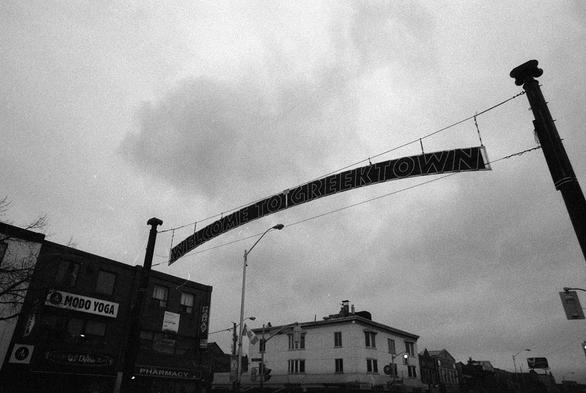
My starting point, The Danforth or Greektown, a part of the city I often don't visit or explore.
Nikon FM - AI Nikkor 24mm 1:2.8 - New Classic EZ400 @ ASA-200 - Pyrocat-HD (1+1+100) 12:30 @ 20C

Having already told the grand history of the City of Toronto, I will be avoiding that subject this time around. Instead, I'll be speaking to the story of my walk and the smaller stories of the areas of Toronto I passed through. My walk started up on the Danforth, a rather famous stretch of road and The Only Cafe. At The Only, I visited with my good friend John Meadows and participated in the portrait project he's been working on, and I can see why he speaks highly of the place. Sadly I did not get a photo of the joint before walking west through Greektown. Officially located along The Danforth between Chester and Dewhurst, the area first formed through the second decade of the 20th century, although the city's ethnic Greek population lived in a different part of the city at this point, an anti-greek riot in 1918 dispersed the population. It wasn't until the military coup in Greece that led to Junta rule from 1967-74 that the area became a focal point of many Greek Immigrants, many of whom fled from the Military government. The area quickly became North America's largest Greektown through the 1970s and 1980s and officially took Greektown on The Danforth in 1993. It's appeared in the movie My Big Fat Greek Wedding and the novel The History of John. It also became a focal point in a deadly shooting in July 2018 that left two dead and thirteen injured. I crossed the Don Valley by the Prince Edward Viaduct, a massive truss arch bridge that carries Bloor Street over the river valley. The Edmund Burke designed bridge carries both vehicles, pedestrian and subway traffic and opened in 1918. And given the name for Prince Edward, then Prince of Wales and the future King Edward VIII (who later abdicated the throne in December 1936). While heavily reinforced for streetcar traffic on the top deck, the controversial lower deck for rail traffic proved to future proof the bridge when the TTC ran their subway line across in 1966. The high bridge proved deadly and became a spot where many took their own life on purpose or by accident, giving it the deadly title of the fatal standing structure in Canada by 2003, second in all of North America. The Luminous Veil, installed in 2003, helped reduce the number of falls from the bridge, although signs with support lines still stand at either end. After crossing the bridge, I turned south, passing by St. James Cemetery, Toronto's oldest cemetery that remains in use today. First opened in 1844, it became the final resting place of the city's Anglican population and is known for The Chapel of James-The-Less, a beautiful Victorian Gothic structure. Over time, the cemetery became non-denomination and holds Canada's first casualties of War, the Ridgeway 13, a group of soldiers from The Queen's Own Rifles who died at the Battle of Ridgeway. After passing through St. Jamestown, I found myself in Cabbagetown, once home to several Irish immigrants; the area is known for its beautiful Victorian and Second Empire homes. Cabbagetown came in the late 19th century when many poor immigrants dug up the front lawns to plant cabbage for food. Despite the grand architecture, many of the houses were rented by the working class, and through the 20th century, the income bracket continued to decline. The area became one of Toronto's largest slums. Although much of the original housing was lost during redevelopment in the 1940s. Thankfully the 1970s saw new bylaws prevent the loss of many historic buildings, although today, many people who call the area home are being priced out due to gentrification. After travelling south on Parliament, I turned west again on Carlton, where many historic homes reside, then crossed southwest through Allan Gardens. The gardens are the brainchild of George William Allan, who donated the land to the Toronto Horticultural Society in 1858, who established gardens in 1860. The area came under the control of the city's government, which allowed the society to continue their garden but allowed the public access to the space. The central structure known as the Palm House is the third such structure, completed in 1910 and replaced an earlier structure burned down. Then back across Gerrard and down Church skirting the edges of the Ryerson University/University X, established in 1948 and named for Egerton Ryerson, and recently faced a great deal of backlash due to the ongoing struggles with Colonial and Indigenous relations. Then down Bond Street, because I wanted to walk past the last home of Toronto's first mayor, the infamous William Lyon MacKenzie and more importantly took a look at the older sections of St. Michael's Hospital. The hospital had its beginnings in 1892, opened by the Sisters of St. Joseph to care for the poorer population in Toronto's southern areas. It also became one of Toronto's first teaching hospitals with a formal agreement with the University of Toronto. And then my final stop, Downtown Camera, my favourite camera shop, which carries a wide range of film and chemistry and is always a stop.

Looking down over the Don Valley from the Prince Edward Viaduct.
Nikon FM - AI Nikkor 24mm 1:2.8 - New Classic EZ400 @ ASA-200 - Pyrocat-HD (1+1+100) 12:30 @ 20CThe simple beauty of a Victorian Gothic chapel in St. James Cemetery.
Nikon FM - AI Nikkor 24mm 1:2.8 - New Classic EZ400 @ ASA-200 - Pyrocat-HD (1+1+100) 12:30 @ 20C

I will admit, it was a tough week for choosing which images to include in the post. And I am glad that I wrote the narrative of my journey from The Only to Downtown Camera as it certainly helped shape which images to include. Instead of stressing over which photos to form, I went chronologically based on my journey. Starting with the Welcome to Greektown sign, while not my favourite, I should have overexposed it a bit to pull out the shadow detail, and this was the third such sign and the best composition of the three. It also took a bit of patience walking over the viaduct to shoot through the veil. I passed into St. James Cemetery; again, I should have opened up the aperture to fill in the shadows, I was hoping to get a bit more compensation out of the Pyrocat-HD, but sadly, I did not. Another hard choice was which image to include from Cabbagetown, there is so much to shoot, so I went with some of the fine residential architecture on Carlton Street. I had to, of course, include a shot of the Palm House circa 1910 in Allan Gardens. I did avoid capturing the camps for those living rough in the park; it seemed a touch tasteless, in my opinion. Being a history buff, I did have to include the MacKenzie house, which, if you're in Toronto and can, is well worth a visit to enjoy a bit of Toronto history. MacKenzie is certainly tied directly into both Canadian and Toronto History. And of course, I included the last shot from the roll and my journey, Downtown Camera.

Carleton offers up excellent examples of High Victorian and Second Empire houses. Many are in excellent conditions today.
Nikon FM - AI Nikkor 24mm 1:2.8 - New Classic EZ400 @ ASA-200 - Pyrocat-HD (1+1+100) 12:30 @ 20CThe Palm House at Allan Gardens is the current conservatory structure and the centre piece of a large horticultural complex.
Nikon FM - AI Nikkor 24mm 1:2.8 - New Classic EZ400 @ ASA-200 - Pyrocat-HD (1+1+100) 12:30 @ 20C

While my initial place was to bring a standard three lens kit along for the walk, carrying some extra items into Toronto using a backpack rather than my usual messenger bag kept me using a single lens this time around, I went with my trusty Nikkor 24mm f/2.8, given I would be walking through spaces that a wide-angle lens would work with narrow streets and a bit of urban landscape work. Although I probably could have gotten away with either the 28mm f/3.5 or the 35mm f/2.8. Despite being overcast, the day remained bright, allowing me to over-expose the film by a stop and shoot at ASA-200, but I did not use a yellow filter as I did not get any blue skies. For the developer, I went with an old favourite and magic bullet, Pyrocat-HD, as I had enough left for one more roll. The only published time was for Fomapan 400 shot at full box speed, but by reducing the time by 10%, I landed on a better time, and the results are right in line with what I would expect from Fomapan 400. And that did surprise me for the first time, as Pyrocat-HD did a superb job with Fomapan 200. Yet with Fomapan 400, even with the one-stop over-exposure, it's nothing too special.

The MacKenzie House, reportedly haunted by its most famous occupant, rebel, mayor and rabblerouser William Lyon MacKenzie.
Nikon FM - AI Nikkor 24mm 1:2.8 - New Classic EZ400 @ ASA-200 - Pyrocat-HD (1+1+100) 12:30 @ 20CMy final destination, Downtown Camera, always a welcome spot with some awesome employees who love photography!
Nikon FM - AI Nikkor 24mm 1:2.8 - New Classic EZ400 @ ASA-200 - Pyrocat-HD (1+1+100) 12:30 @ 20C

Next week, Heather and I take a well-deserved break from work and head out to Niagara-On-The-Lake for a two-day vacation in Upper Canada's first capital.

#foma52 #52roll #52rollproject #canada #city #neighborhood #newclassicez400 #nikonfm #ontario #photowalk #pyrocathd #toronto #urban

Foma:52 - Week 48 - Danforth To Downtown

And we're walking! Yes, I'm back in Toronto this week and travelling from Greektown into the Old City and enjoying every step!

Alex Luyckx | Blog

Foma:52 – Week 46 – Houses of Holy

This week is a bit of a throwback, not to this project, but my first photography project! In my last year in High School, I took a Media English course that included a photography element. We learned how to process and print black & white film during the period, and the final project from that section had a photo project. I chose to work with documenting the churches in Milton. So this week, we're visiting churches in both Oakville and Milton, not only the ones in the community centres but also a couple of rural churches.

My home church of Knox Presbyterian Church in downtown Milton - The Congregation dates back to 1855, the current building to 1891.
Nikon FM - AI Nikkor 28mm 1:3.5 - New Classic EZ400 @ ASA-400 - Adox Atomal 49 (Stock) 10:00 @ 20C

Human spirituality has been around for as long as humans have been around. There's evidence of worship reaching far back into the dark days of pre-history. Here in North America, the first civilizations to take root and build a life carried a deep sense of spirituality. Weaving tales of the Earth Diver or a massive Turtle to speak of the creation of the Earth. The Spirit and Natural worlds intertwined, told through story and dance around a sacred fire passed these tales and traditions down through generations. They found the divine in nature, places, and animals. The arrival of European Explorers brought Christianity across from Europe, John Cabot planting an English flag along with the banners of the Pope and Vatican claiming what is today Newfoundland in the name of King Henry VI and the Roman Church. And where Europeans went, the Roman Catholic Church followed, settlers and missionaries alike spread Catholicism among the Indigenous People. One of the most prolific Roman Catholic missionaries was those of the Society of Jesus or Jesuits. While much can be said for their actions, and I certainly condemn the forced conversion and violence taken against the Indigenous Peoples, some came and preached the gospel who genuinely wanted to see them receive the Salvation offered by Christ. The one who stands out the most here in North America is Jean de Brébeuf. Brébeuf is mainly noted for his work with the Wendat people, establishing a mission in Wendake, Sainte-Marie-au-pays-des-Hurons. Out of this mission, Brébeuf began intertwining Christian spirituality with those of the Wendat, penning one of my favourite Christmas Carols, the Huron Carol. These early churches met in the homes of those who formed the church. Eventually, log and frame buildings began to spring up. By the time Europeans began settling in Halton County, the denomination of church was determined by the makeup of those settlers. Anglican churches and Presbyterian Churches became the most common where English and Scottish settlements formed, Roman Catholic parishes also followed. Saddlebag preachers from the Methodist churches often rode through rural settlements teaching and leading worship in homes or out in nature. As settlements grew and populations expanded, these frame buildings were replaced by those of brick. The 1880 and 1890s brought grand brick or stone buildings, often following the popular Gothic Revival style. Milton and Oakville were still rural backwaters, so the churches here are mainly in that style with no Cathedrals or grand churches. Even today, these congregations can trace their histories back to the 1830s and are fiercely protective of their buildings. But even today, church buildings are changing with the time, using modern architectural styles and multi-use rooms to continue to serve within their communities.

Grace Anglican Church - One of Milton's first congregations, the beautiful Norman styled building is their second home, their first frame Church now serves as the parish hall.
Nikon FM - AI Nikkor 28mm 1:3.5 - New Classic EZ400 @ ASA-400 - Adox Atomal 49 (Stock) 10:00 @ 20CSouthside is a church my family attended several years ago and I've remained connected to the church still today.
Nikon FM - AI Nikkor 28mm 1:3.5 - New Classic EZ400 @ ASA-400 - Adox Atomal 49 (Stock) 10:00 @ 20C

I'll get this right out in the open first; yes, all these images are of Christian Churches; I wish I could have included a far more diverse selection of sacred spaces for the project. But despite all the expansion and changes in the makeup of the populations of Milton and Oakville, Christian churches of various denominations make up these Houses of Holy. That's not to say there aren't spaces for other beliefs in my area; my travels were not near those spaces this week. While this week presents a narrow view, I recognize more than a Judeo-Christian within Canada, Ontario, and Halton Region today. The featured image should come as no surprise as I have the most connection to Knox Church in Milton, having been born and raised in the congregation and continuing to worship here and help serve the congregation. From there, I went with two more downtown Churches in Milton, Grace Anglican, because the current sanctuary is excellent, and Southside Community Church, a congregation that, thanks to their Bible Studies and other programs, I met Heather through. I included two formerly rural churches, Munn's United and Omagh Presbyterian, that today face being surrounded by the slowly spreading urban sprawl but continue to serve. Then into downtown Oakville, with the beautiful but challenging to photograph St. Jude's Anglican church and Knox Presbyterian, a church that I've worshipped with on a few occasions now.

Munn's United Church, formed in 1832 as a Methodist Congregation, their current building dates to 1898 and once served the small village that occupied this part of Oakville.
Nikon FM - AI Nikkor 28mm 1:3.5 - New Classic EZ400 @ ASA-400 - Adox Atomal 49 (Stock) 10:00 @ 20COmagh Presbyterian Church is a small rural congregation now facing the rapid expansion of Milton, but they continue to thrive.
Nikon FM - AI Nikkor 28mm 1:3.5 - New Classic EZ400 @ ASA-400 - Adox Atomal 49 (Stock) 10:00 @ 20C

For this week, we're continuing to work with New Classic EZ400, and unlike past times with this film, I'm shooting it at the full box speed of ASA-400. Not a common way I shoot this film stock, but I needed a bit of an extra boost in speed shooting over three days. For the developer, I had initially wanted to go with Ilford Microphen, great for compensating any over/under exposure and then push/pull processing. I thought I had a box sitting waiting to be mixed up, but instead of Microphen, I had Perceptol. But I did have a pouch of Adox Atomal 49 waiting, so I went with that instead. Result Comments Here. As I was shooting mainly architectural work, I went with the old favourite, Nikkor 28mm f/3.5 lens. While the 24mm may have been slightly better, I didn't want the results to be too wide, although that 24mm might have worked in a couple of cases. But overall, the 28mm gave me enough room to play.

Knox Presbyterian in downtown Oakville is an 1833 congregation the building dates to 1888, I have good memories of this church having helped run an awesome PYPS weekend here!
Nikon FM - AI Nikkor 28mm 1:3.5 - New Classic EZ400 @ ASA-400 - Adox Atomal 49 (Stock) 10:00 @ 20CSet back from the downtown, St. Jude Anglican is a difficult church to photograph especially around the noon hour, the congregation traces to 1839 and the building to 1889.
Nikon FM - AI Nikkor 28mm 1:3.5 - New Classic EZ400 @ ASA-400 - Adox Atomal 49 (Stock) 10:00 @ 20C

Next week we're visiting Milton's biggest rival, at least it was when I was in school! We're heading back into Halton Hills to answer the age-old question. Is it worth the drive to Acton?

#foma52 #52rollproject #adoxatomal49 #anglican #architecture #canada #church #milton #missionaryalliance #munn #newclassicez400 #nikonfm #oakville #omagh #ontario #presbyterian #united #worship

Foma:52 - Week 46 - Houses of Holy

With all apologies to Led Zepplin, we're checking out some of the Churches in Milton & Oakville and points in between this week. Many can trace themselves back to the 1830s.

Alex Luyckx | Blog

Foma:52 – Week 45 – For the Fallen

Throughout most of my 52-Roll projects, I made a point that at Week 45 or thereabout, to remember those who gave the ultimate sacrifice in the service of their country, here in Canada that is called Remembrance Day and falls on the 11th of November to mark the armistice that ended the fighting on the western front. While I had initially planned to photograph the Milton Remembrance Day Parade the Sunday before the 11th, I quickly shifted to feature cenotaphs and war graves in Oakville, Milton, and Guelph due to other plans.

A memorial to Lieutenant-Colonel John McCrea, author of the poem "In Flanders Fields" where many Canadians get the image of the poppy from as a sign of Remembrance Day.
Nikon FM - AI-S Nikkor 105mm 1:2.5 - New Classics EZ400 @ ASA-250 - Kodak D-23 (Stock) 7:30 @ 20C

This week there are a few items to unpack historically, but let's start with the first one, Remembrance Day. If you're tapped into history, you'll realise that Remembrance Day is the second day in Canada that would serve as a solemn day to remember Canada's War Dead. On the 2nd of June 1866, a force of Canadian Militia consisting of the XIIIth Batallion Volunteer Militia of Canada, 2nd Battalion Queen's Rifles, and various other small militia formations arrived at the Grand Trunk Station in Ridgeway and marched north. What they did not expect to encounter was a force of Fenians, Irish-Americans bent on holding the Province of Canada Hostage to force the British Parliament to grant independence to Ireland. The engagement, known as the Battle of Limestone Ridge or Ridgeway saw the Canadians soundly defeated through mismanagement, miscommunications, and faced with a larger, better armed and trained fighting force. The Fenians would eventually retreat from Canadian shores but many saw this as the first engagement of the Canadian Army (at least in prototypical form). Canadian Militia troops would fight in a series of other conflicts, our wars of colonisation, but in many cases, especially Ridgeway, these were quietly swept under the rug. In 1890 the veterans from those conflicts visited the small memorials and graves of those fallen, decorating them in remembrance. This was a form of protest, and the following year nearly 30,000 showed up on the 2nd of June 1891 decorating the Lime Ridge Monument in Toronto and lobbying the Provincial and Federal Government for some form of recognition. Decoration Day became Canada's first day of remembrance for our war dead. Eventually, a Canadian General Service Medal was authorised in 1899 and veterans from the 2nd Boer War, and the Great War were added to Decoration Day. The day is usually marked with Canadians cleaning up the graves of the fallen, decorating them with flowers and any war memorials. While Decoration Day continued to be celebrated in Canada, in England on the 11th of November 1919, the first anniversary of the Armistice, King George V marked the day with a solemn ceremony of remembrance of the dead from the Great War. One of the biggest symbols of this day of remembrance was the Poppy. A blood-red flower that occupied the battlefields of Europe as far back as the Napoleonic Wars. The heavy artillery bombardment of modern war churned up the chalk rich soil turning it into lime, a nutrient that the popaver rhoeas flourished quickly as soon as the fighting died down. This flower was noticed by a Canadian Medical Officer, Lieutenant-Colonel John McCrea, who, in his grief of having lost his close friend Lieutenant Alexis Helmer, the day prior in 1915, wrote the poem "In Flanders Feilds", a poem that stuck into the Canadian mythos of the war. The poppies were also noticed by a French woman, Madame Anna Guérin. They made fabric poppies and sold them with the money used towards reconstruction efforts in France during the post-war period. The symbol was adopted by the Royal Canadian Legion in July 1921. The Canadian Government also adopted Armistice Day that same year, with the day being marked on the Monday of the same week of the 11th of November. For about a decade, both Armistice Day and Decoration Day were marked by many Canadians. It wasn't until 1931 that the name of Armistice Day was renamed Remembrance Day and set directly on the 11th of November. After 1931 Decoration Day fell out of the public eye, and those who fought in the conflicts remembered by Decoration Day are not publicly recognised by Remembrance Day (Boer War, Fenian Raids, Red River Rebellion, and North-West Rebellion). Recently, however, those who died during the Anglo-American War of 1812 have received some recognition. Remembrance Day has also expanded to Canadian War Dead from World War Two, Korea, Peacekeeping Missions, Gulf War and the War on Terror. Decoration Day is still celebrated but is a regional event and is focused mainly on. HisNiagara Region.

Guelph's main Cenotaph located in Trafalgar Square, it features many figures including this one holding two wreathed swords.
Nikon FM - AI-S Nikkor 105mm 1:2.5 - New Classics EZ400 @ ASA-250 - Kodak D-23 (Stock) 7:30 @ 20CA second cenotaph near Guelph's armoury, with the phrase "Our Glorious Dead" a common phrase found, along with the Latin phrase "Te Deum Laudamus" meaning God, We Praise You.
Nikon FM - AI-S Nikkor 105mm 1:2.5 - New Classics EZ400 @ ASA-250 - Kodak D-23 (Stock) 7:30 @ 20C

My travels took me through Guelph, Milton, and Oakville to explore the memorials to the fallen, so I made a point to include a little something from each of those places. For the featured image. The monument to Lieutenant-Colonel John McCrea, the author of the poem "In Flanders Fields," has become synonymous with Remembrance Day within the Commonwealth sphere, especially here in Canada. Also, from Guelph, the main cenotaph is set outside the downtown and a smaller one standing near the Central Train Station near the city's Armoury. This second cenotaph features "Our Glorious Dead" and "God, We Praise You" in Latin, a common phrase found on many memorials. From Milton, there are two memorials; the first is our main cenotaph. Located in Victoria Park near Town Hall standing atop, that is a typical image that many monuments across Canada and the US feature a soldier standing next to a cross. The second is located in Evergreen Cemetery, the memorial for our local branch of the Royal Canadian Legion and the Remembrance Day ceremony. The final two are from Oakville, the Cenotaph in George Square, a simple affair surrounded by the names and locations of the veterans of Oakville. And a second memorial to the service of the local reserve regiment, the Lorne Scots that traces itself back to 1866 and continues the tradition of earlier Militia units.

The Cenotaph for the Milton branch of the Royal Canadian Legion, enscribed with Milton's war dead, located at Evergreen Cemetary.
Nikon FM - AI-S Nikkor 105mm 1:2.5 - New Classics EZ400 @ ASA-250 - Kodak D-23 (Stock) 7:30 @ 20CMilton's Victoria Park Cenotaph, surmounted with a typical statue and the phrase "In Flanders Fields" on a cross similar to the ones haistly made to mark the graves of the fallen.
Nikon FM - AI-S Nikkor 105mm 1:2.5 - New Classics EZ400 @ ASA-250 - Kodak D-23 (Stock) 7:30 @ 20C

And we're back into the final nine rolls of film for the year, so we're back working with Fomapan 400. But this week, instead of using the branded Fomapan 400, we're working with a rebrand film, New Classic EZ400. A rebrand brought to market by a YouTube film photographer, Ribsy. Having a bottle of Kodak D-23 around and liking the results from that film/developer combination, I went with that as my developer and shot the film at ASA-250 to get the best results. I also used the AuRA Rotary Assist Film Developing Machine to run the processing, as I'm working on a review on the accessory for next year. It made sense to capture these memorials using a combination that produced classic results and looks in the final images. The easy choice in capturing these memorials would be a normal or wide-angle lens. And I did consider my 28mm, 35mm, or 50mm; in the end, I settled on my classic 105mm f/2.5. The reason was that I wanted to capture details, names, services and dates. Also, the spectacular cenotaphs in the towns I visited were varied.

Poppies decorate the Oakville Cenotaph in Georges Square.
Nikon FM - AI-S Nikkor 105mm 1:2.5 - New Classics EZ400 @ ASA-250 - Kodak D-23 (Stock) 7:30 @ 20CA memorial in Georges Square to the Lorne Scots, the local regiment of the Canadian Army (Reserves) marking their battle honours from The Anglo-American War of 1812 to modern conflicts.
Nikon FM - AI-S Nikkor 105mm 1:2.5 - New Classics EZ400 @ ASA-250 - Kodak D-23 (Stock) 7:30 @ 20C

Next week we're exploring the churches in and around Milton & Oakville.

#foma52 #52roll #52rollproject #actofremembrance #canada #canadianhistory #fomapan400 #guelph #kodakd23 #milton #newclassicsez400 #nikonfm #oakville #ontario #remembranceday

Foma:52 - Week 45 - For the Fallen

They shall grow not old, as we that are left grow old: Age shall not weary them, nor the years condemn. At the going down of the sun and in the morning We will remember them.

Alex Luyckx | Blog

Foma:52 – Week 44 – Highlands

I have seen Fergus in the past, but it's only been for a short visit. Whenever I'm in this area, I tend to gravitate more towards Elora, Ontario, because it is a community that I enjoy exploring and can always find something new. But having already visited Elora this year and in this project, I needed someplace new. With the exact concentration of stone buildings from the 19th century and a walking route in mind, it was time to head into a bit of a pocket of the highlands in Ontario.

Looking along the Grand River, the heavy rains that day made the river a rough waterway. And shows why Fergus became a centre for industry.
Nikon FM - AI Nikkor 28mm 1:3.5 - Fomapan 200 @ ASA-200 - Adox XT-3 (Stock) 6:00 @ 20C

For thousands of years before the arrival of the earliest European settlers, the Grand River has been home to a vast and diverse group of Indigenous people. Archaeological research shows the presence of human settlement by the Petun, Attiwonderonk, Anishinabewaki, Haudenosaunee and the Mississauga's of the Credit. The area ceded under Treaty 4 would be marked for settlement by veterans of the War of 1812 in the 1820s as the Garafraxa Township. Richard Pierpoint of Senegal arrived in the United States as a slave and chose to fight for the British during the American Revolution to gain a release from slavery and later volunteered as part of the Coloured Corps during the Anglo-American War of 1812. After the war, Pierpoint began to petition for his promised land grant and, specifically, passage back to Senegal. However, the British authorities denied his requests instead of granting him and many other former soldiers of colour land in the Garafraxa Township. Pierpoint, having little choice, settled on Lot 6, Concession 1, near where Scotland Street is today. About a half-dozen former soldiers also settled in the region in 1822. These land grants carried several rules; the settlers were required to clear five acres of land, build a house and a road. If they did so within two years, the full title would be granted. The small group of farms became known as the Pierpoint Settlement. The Scottish would not arrive until a decade later, Adam Fergusson, a Scottish Lawyer and James Webster purchased a plot of 28 square kilometres. Fergusson, taken by the area and the available water power, began to survey a village site. Fergusson and Webster controlled those who could purchase the lots, with only those from Scotland or of Scottish descent being allowed. By 1835 a small settlement known as Little Falls had grown, with a sawmill, grist mill, several houses, a school and a church. Also, present a curling club (which still operates today). The establishment of a post office gave the name Fergus to the settlement after Adam Fergusson. By the middle of the century, the small settlement housed 184 with 21 businesses, and much of the black settlers were becoming the minority in the region as Fergus became mainly Scottish. The arrival of James Webster in 1855 brought a massive industrial base with an oatmeal mill, flour mill, and woollens mill, allowing incorporation as a village by 1858 and a population of 1000. The railroad, the Wellington, Grey & Bruce passed through in the 1870s bringing even more industry, notably the Beatty Brothers opening their foundry to build agricultural equipment. The Wellington County Poorhouse opened outside of the village in 1877, providing a place where those who were destitute, disabled or old could overcome their moral failing (pauperism was viewed in this manner) through hard work at the industrial farm to help support themselves and the staff. Credit Valley also ran through the village in the 1880s as part of their Elora branch. Fergus grew as a major manufacturing centre in the region. Still, it also became known for advanced medical technology, Dr Abraham Groves, noted for sterilisation of his surgical gear, performed the first appendectomy in 1883 and pushed for the installation of an electric generator in 1890. Dr Groves would help build a hospital in Fergus in 1902, today known as the Groves Memorial Hospital. The county poorhouse transformed itself into a nursing home in 1947 after many poor laws in Canada were abolished. While the community enjoyed a great deal of success and affluence through the mid-20th century, the industrial base would be unable to keep up with the times, and by the 1960s, many factories and mills were closing. In 1999 the community lost its autonomy and was absorbed into Centre Wellington along with the village of Elora. Today the historic town enjoys a lot of historical buildings from the 1800s, with even the old mills being adapted to modern uses.

The Wellington County Poorhouse, the oldest surviving such structures in Canada used to house men and women poor and destitute to 'fix' their moral failing through hard work. Today it is the local history museum and archives.
Nikon FM - AI Nikkor 28mm 1:3.5 - Fomapan 200 @ ASA-200 - Adox XT-3 (Stock) 6:00 @ 20CThe former Beatty Foundry that grew into a major manufacturer of agricultural equipment. Today it is a local market.
Nikon FM - AI Nikkor 28mm 1:3.5 - Fomapan 200 @ ASA-200 - Adox XT-3 (Stock) 6:00 @ 20C

Despite being surrounded by many impressive buildings, I found it easy to select the images for this week as I went for ideas that had some interesting stories behind them. As the Grand River remained the core of Fergus' history, that shot turned into the featured image. From there, I went for buildings that showed some unique and historical aspects or stories. And the best part is that many still are in use, with only the Carnegie Library being in its original use. The old Beatty Foundry is now a marketplace, the original hydroelectric plant a pub & brewhouse. The Brew House on the Grand is where Heather and I had lunch while waiting for the rain to slacken. And finally, I had to include the beautiful Templin Gardens with Heather overlooking the raging river below. I wish I could have captured something related to the original settlers in the area, but nothing of the Pierpoint settlement remains memorialised.

The Former Fergus Swimming Pool with a unique gambral & hip roof operated from 1930-60 and is today a commercial property.
Nikon FM - AI Nikkor 28mm 1:3.5 - Fomapan 200 @ ASA-200 - Adox XT-3 (Stock) 6:00 @ 20COriginally a Tannery in 1851 and a failed Flour Mill, Dr Abraham Groves installed a pair of electrical generators in 1890 to provide electricity to the town.
Nikon FM - AI Nikkor 28mm 1:3.5 - Fomapan 200 @ ASA-200 - Adox XT-3 (Stock) 6:00 @ 20C

Having a second camera (the Maxxum 9) with me, I wanted to keep things simple. Knowing I was dealing with a narrow street, I went with my old favourite, Nikkor 28mm f/3.5; we had some decent light, so I was getting apertures between f/4 and f/11 and shutter speeds of 1/125″. However, I shot the roll of film at the box speed of ASA-200 to give that extra boost of speed. For the developer, I went with something new: that new developer, Adox XT-3, which is based on the 2019 formula of Kodak Xtol. In contrast, I have used Xtol with Fomapan 200 in the past and was not too happy with the results. However, I think that had to do with an old and nearly expired batch of Xtol. This time around, the results impressed me! Excellent control of the grain, good sharpness and a bit of a bump in contrast, despite being in a foggy and low-contrast day.

The 1911 Carnagie Libary which still operates as a library today although greatly expanded to serve the modern needs of the community.
Nikon FM - AI Nikkor 28mm 1:3.5 - Fomapan 200 @ ASA-200 - Adox XT-3 (Stock) 6:00 @ 20CHeather enjoying the Templin Gardens, the gardens were constructed by John C. Templin in stages from 1920 to 1934 and gardened by John Johnson Senior from 1930 to 1941.
Nikon FM - AI Nikkor 28mm 1:3.5 - Fomapan 200 @ ASA-200 - Adox XT-3 (Stock) 6:00 @ 20C

Next week in Canada, we noted Remembrance Day, a solemn day to remember those who paid the ultimate sacrifice. I'll be sharing some of the area's cenotaphs and war graves for the fallen.

#foma52 #52roll #52rollproject #adoxxt3 #architecture #canada #centrewellington #fergus #nikonfm #ontario

Foma:52 - Week 44 - Highlands

Despite the dull and wet fall day, Heather and I took the road to return to Centre Wellington and the historical town of Fergus, Ontario.

Alex Luyckx | Blog

Foma:52 – Week 43 – Black Gold

If you haven't heard of the small community of Petrolia, that makes perfect sense, it seems a bit out of place here in Ontario. But this is the area credited with kicking off an early oil boom in Ontario and within the British Empire. While a shadow of its former glory, the name and legacy live on as part of Canada's role as a major exporter of raw resources.

Petrolia's former Grand Trunk Railway station, operated from 1903 to 1927, today it is the town library and beautifully restored.
Nikon FM - AI-S Nikkor 35mm 1:2.8 (Yellow-12) - Fomapan 200 @ ASA-100 - Pyrocat-HD (1+1+100) 7:30 @ 20C

Back thousands of years, the Attiwonderonk, Anishiabewaki, and Mississaugas made use of the sticky tar-like substance through the region to help with waterproofing their canoes. The area remained the territory of the Mississaugas until the Canada Company came calling in 1827, acquiring the land under Treaty 29 in 1827. The area became part of Lambton County and the Enniskillen Township. Settlers to the region worked the land as farmers until industrialist Charles Nelson Tripp began purchasing large areas of the township to exploit the bitumen in creating asphalt. Tripp petitioned successfully for the creation of the International Mining Manufacturing Company in 1854. And Tripp's products earned world renown when they went on display at the 1855 University Exhibition in Paris. Tripp promptly made the contract to produce enough asphalt to pave the city of Paris. Sadly, while Tripp rode high on the initial success by 1857, he had been forced to sell off a majority of his holdings to pay off creditors. Among those creditors, James Miller Wilson, who sought the same bitumen but to create lamp oil, but when Wilson began digging a water well, it wasn't water he found but oil. Oil Springs formed quickly and attracted many prospectors and surveyors to the region, one being John Henry Fairbanks. Fairbanks struck it rich with his Jerker Line system, steam-driven oil pumps and formed Fairbanks Oil in 1861. Further north, more oil patches were discovered, resulting in a second boom by the middle of the decade. The settlement of Petrolia grew overnight and was incorporated as a town in 1866. Fairbanks even led the charge to build a privately funded railway branch line to the Great Western line in Wyoming, which Great Western took over that same year. Soon thousands of barrels of oil were pouring out of the ground, but these early methods created large amounts of wasted resources. A second boom came in 1898 and a third in 1938, only lasting a few weeks. Hard Oilers, those who were born, raised and worked the oil fields, became world-renowned, and some eighty countries owe their oil industries to the workers of Petrolia. During the second world war, with the oil boom over, the town switched to industrial manufacturing; the presence of two rail lines certainly helped move products and materials out into broader markets. While today the community rests on the laurels of the past, oil and manufacturing remain a primary economic driver along with the history and the beginning of the oil industry in Canada. And thankfully, the community has done a great deal to ensure the preservation of the past.

The Sunnyside Mansion, former house of Oil Baron John H. Fairbanks.
Nikon FM - AI-S Nikkor 35mm 1:2.8 (Yellow-12) - Fomapan 200 @ ASA-100 - Pyrocat-HD (1+1+100) 7:30 @ 20CThe historic post office.
Nikon FM - AI-S Nikkor 35mm 1:2.8 (Yellow-12) - Fomapan 200 @ ASA-100 - Pyrocat-HD (1+1+100) 7:30 @ 20C

I'll admit, this week was another hard one to figure out which images to include because I ended up with a large number of keepers. There were so many notable buildings downtown and even more that I realized that I missed because they were off on side streets. I should have done some more preparation as the local historical society does have a walking tour. But even sticking to the main road netted several impressive buildings from the stunning 1903 train station and the spooky Fairbank's house or Sunnyside Mansion. An old hardware store and commercial blocks in various states of repair all show that the town once sat on a pile of wealth. Sadly I did not see the original oil fields (the gate was closed) or any of the original businesses, so I could not include anything like that. Like any of these trips, I certainly have Petrolia on my list of places to revisit in the future.

Boges Bros. Hardware store, one of the former businesses along the downtown, while the store is closed the old sign has been wonderfully maintained.
Nikon FM - AI-S Nikkor 35mm 1:2.8 (Yellow-12) - Fomapan 200 @ ASA-100 - Pyrocat-HD (1+1+100) 7:30 @ 20CThe McKay Block housed several commercial ventures including a sign and carriage painting business, pharmacy and a furniture store.
Nikon FM - AI-S Nikkor 35mm 1:2.8 (Yellow-12) - Fomapan 200 @ ASA-100 - Pyrocat-HD (1+1+100) 7:30 @ 20C

I had to keep it simple as I was working with a large camera loadout when visiting Petrolia. This week, I decided to stick to an old favourite, the Nikkor 35mm f/28 with a yellow filter. While the lens worked, I probably could have gotten away better with either the 28mm or 24mm in some cases. Although these couldn't work for all the images, the compositions would have been too broad in some cases. I probably could have gotten away with having that second lens in the bag, but I honestly didn't want to be swapping around lenses when I tried to keep walking through town. And I was then giving the film a one-stop over-exposure shooting it at ASA-100 rather than ASA-200. This allowed me to shoot with good shutter speed and aperture to keep the lens in that sweet spot of f/8. For development, I had enough Pyrocat-HD left over from the railroad project to run the film through that a developer. I also went for the first time with a two bath fix, the first being TD-4 designed for use with Pyro developers and won't affect the stain. Then I ran the film through my regular Kodafix, thanks to Mat Marrash for helping me out with how long to do both fixing stages And the results they speak for themselves, this is precisely how I wanted the images to turn out, and the light and weather that morning were perfect for what I wanted. The images were sharp, gritty with a tonal separation to die for, an ideal match for an old oil town.

A small commercial block that is looking for fresh tenants.
Nikon FM - AI-S Nikkor 35mm 1:2.8 (Yellow-12) - Fomapan 200 @ ASA-100 - Pyrocat-HD (1+1+100) 7:30 @ 20CA far better preserved commercial block.
Nikon FM - AI-S Nikkor 35mm 1:2.8 (Yellow-12) - Fomapan 200 @ ASA-100 - Pyrocat-HD (1+1+100) 7:30 @ 20C

Next week Heather and I took a trip back out to Centre Wellington and the historic village of Fergus, so coming along with us!

#foma52 #52roll #52rollproject #blackgold #canada #canadianhistory #fomapan200 #nikonfm #oil #ontario #petrolia #pyrocathd

Foma:52 - Week 43 - Black Gold

We're out in western Ontario and the centre of Ontario's Oil Boom in the second half of the 19th Century.

Alex Luyckx | Blog