Inject a less viscous fluid into a gap filled with a more viscous fluid, and you’ll get finger-like patterns spreading radially. Here, researchers put a twist on this viscous fingering by taking turns injecting different liquids. Each injection cycle disrupts what came before, layering fingering patterns on fingering patterns. The results resemble fireworks. Happy 4th of July! (Image credit: C. Chou et al.)

https://fyfluiddynamics.com/2024/07/viscous-fireworks/

#2023gofm #flowVisualization #fluidDynamics #fluidsAsArt #instability #physics #SaffmanTaylorInstability #science #viscousFingering

Gallery of Fluid Motion

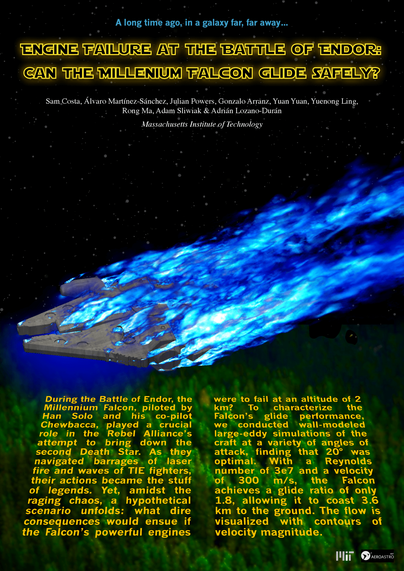
In what seems to be a tradition now, a group at MIT imagined how the Millennium Falcon would perform if it lost its engines during atmospheric flight. Their hypothetical scenario took place in the Battle of Endor, with the Falcon flying at an altitude of 2 kilometers.* Could Han Solo and Chewbecca safely glide the craft down?

Using computational fluid dynamics, the group found the Millennium Falcon has a glide ratio of only 1.8, meaning it travels forward 1.8 kilometers in the time it takes to lose one kilometer of altitude. Its namesake bird, on the other hand, has a glide ratio of 10. The Corellian freighter might not be the best glider out there, but the team estimated that it could safely manage its 3.6 kilometer glide down. (Image credit: S. Costa et al.; see also X-Wing Re-entry and AT-AT Flow)

*I’m definitely overthinking this, but now I’m really wondering what atmospheric characteristics they used for Endor. And what’s Endor’s gravity like?

https://fyfluiddynamics.com/2024/05/millennium-falcons-glide/

#2023gofm #flowVisualization #fluidDynamics #gliding #physics #science #starWars

Aerodynamics of Gliding Flight in A Falcon and Other Birds

ABSTRACT. A live laggar falcon (Falco jugger) glided in a wind tunnel at speeds between 6·6 and 15·9 m./sec. The bird had a maximum lift to drag ratio (L/D) of 10 at a speed of 12·5 m./sec. As the falcon increased its air speed at a given glide angle, it reduced its wing span, wing area and lift coefficient.A model aircraft with about the same wingspan as the falcon had a maximum L/D value of 10.Published measurements of the aerodynamic characteristics of gliding birds are summarized by presenting them in a diagram showing air speed, sinking speed and L/D values. Data for a high-performance sailplane are included. The soaring birds had maximum L/D values near 10, or about one quarter that of the sailplane. The birds glided more slowly than the sailplane and had about the same sinking speed.The ‘equivalent parasite area’ method used by aircraft designers to estimate parasite drag was modified for use with gliding birds, and empirical data are presented to provide a means of predicting the gliding performance of a bird in the absence of wind-tunnel tests.The birds in this study had conventional values for parasite drag. Technical errors seem responsible for published claims of unusually low parasite drag values in a vulture.The falcon adjusted its wing span in flight to achieve nearly the maximum possible L/D value over its range of gliding speeds.The maximum terminal speed of the falcon in a vertical dive is estimated to be 100 m./sec.

The Company of Biologists