#ESO:
"
Könnte Hayabusa2 auf 1998 KY26 aufsetzen?
"
"Neue Studie zeigt, dass der Zielasteroid der Weltraummission kleiner und schneller ist als gedacht"

https://www.eso.org/public/germany/news/eso2515/

18.9.2025

#Astronomie #Asteroid #1998KY26 #Hayabusa2 #Japan #JAXA #Raumfahrt #Raumsonde #SpaceFlight #VLT

Könnte Hayabusa2 auf 1998 KY26 aufsetzen? - Neue Studie zeigt, dass der Zielasteroid der Weltraummission kleiner und schneller ist als gedacht

Astronominnen und Astronomen haben weltweit Observatorien genutzt, darunter das Very Large Telescope (VLT) der Europäischen Südsternwarte (ESO), um den Asteroiden 1998 KY26 zu untersuchen. Dabei haben sie festgestellt, dass er fast dreimal kleiner ist und sich viel schneller dreht als bisher angenommen. Der Asteroid ist das Ziel der verlängerten Mission der japanischen Raumsonde Hayabusa2 im Jahr 2031. Die neuen Beobachtungen liefern wichtige Informationen für die Mission, die nur noch sechs Jahre bis zur Begegnung der Raumsonde mit 1998 KY26 entfernt ist.

www.eso.org
Kan Hayabusa2 in 2031 wel landen op asteroïde 1998 KY26?
Nieuwe waarnemingen laten zien dat asteroïde 1998 KY26 veel Kleiner is en veel sneller ronddraait dan aanvankelijk werd gedacht.
#1998Ky26 #asteroïde #hayabusa2 #japan #jaxa #ryugu #zonnestelsel
https://www.kuuke.nl/kan-hayabusa2-in-2031-wel-landen-op-asteroide-1998-ky26/

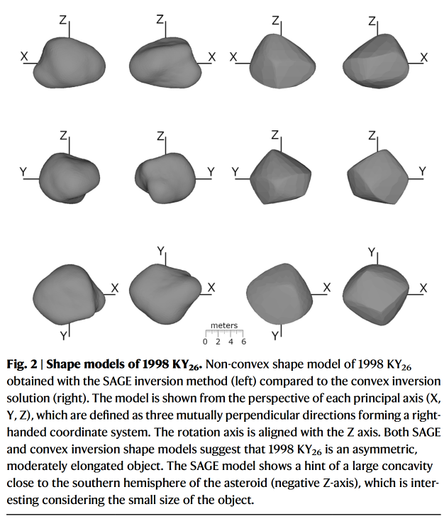
I have a 3D print of the old #TeamRadar #1998KY26 shape model, which was always suspiciously symmetric - because it turned out to be aliased.

Maybe I should order a new one.

QT Agata Rożek @agastro.bsky.social‬
2025 September 18

Check out our tiny rock featured by @esoastronomy !

Now available in Nature Comms: https://www.nature.com/articles/s41467-025-63697-4

We measured the size using the new lightcurve shape models and old radar data #TeamRadar

https://bsky.app/profile/agastro.bsky.social/post/3lz44rubvus26

Hayabusa2 extended mission target asteroid 1998 KY26 is smaller and rotating faster than previously known - Nature Communications

Asteroid 1998 KY26 is the target of Hayabusa2 extended space mission. Here, authors show that it is smaller and rotates faster than known.

Nature

the paper

Santana-Ros et al: "#Hayabusa2 extended mission target asteroid #1998KY26 is smaller and rotating faster than
previously known."

https://www.eso.org/public/archives/releases/sciencepapers/eso2515/eso2515a.pdf

RE: https://mastodon.social/@esoastronomy/115224504925649507

TIL a touchdown was in the "menu". Rotating at that speed and still holding up, shouldn't it be rather compact?

#1998KY26

Additional background information on dark comets:

#TeamRadar observed the dark comet #1998KY26 in 1998: https://echo.jpl.nasa.gov/asteroids/ostro+1999_ky26_science.pdf . It is a lumpy ball ~30 m across.

The #Hayabusa2 spacecraft is now on its way there, with arrival in 2031 July.

Discussed at #ACM2023 today.

QT Michael Busch 2022 Dec 19 @michael_w_busch

Today on the arXiv:

Seligman et al. 2023, "Dark Comets? Unexpectedly Large Nongravitational Accelerations on a Sample of Small Asteroids" - arxiv.org/pdf/2212.08115…

Suggests outgassing from asteroid #1998KY26, to be visited by Hayabusa 2, at a level #TeamRadar could not detect.

Addendum:

Seligman et al. 2023 discuss at length other things that can push small asteroids around: thermal fracturing throwing dust out, asymmetric meteoroid bombardment, etc.

Resolving this will probably have to wait for @[email protected]/@haya2e_jaxa
to get to #1998KY26.

Addendum:

Seligman et al. 2023 discuss at length other things that can push small asteroids around: thermal fracturing throwing dust out, asymmetric meteoroid bombardment, etc.

Resolving this will probably have to wait for @[email protected] / @[email protected] to get to #1998KY26.

@astrokiwi For the NEAs in this sample; there are options on thermal fracturing, asymmetric meteoroid bombardment, etc. that would push the rock piles around a little bit without outgassing - Seligman et al. rightly discussed the possibilities at length (comparing to Bennu).

Some may not work - e.g. #1998KY26 spins fast, so thermal swings are low.

But that seems qualitatively different than #ʻOumuamua?