 bit101
 oschene
Found the original radio shows of Hitchhiker's Guide to the Galaxy. Hope all you froods know where your towel is.
##hhgg

Here's a link to the store page:
https://bit101.gumroad.com/l/coding_curves
And to celebrate, here's a code that will get you 100% off, i.e. the book is free - for the first 10 people to use the code.
SY9KO80

Coding Curves is all about writing code to draw various interesting and often beautiful 2D curves. Included topics are trigonometric curves, arc, circles, ellipses, Lissajous curves, harmonographs and pintographs, parabolas, Bezier curves, roulette curves, spirals, roses, guilloche patterns, superellipses and superformulas and others. The concepts of each type of curves are discussed and then code is presented, usually built up a bit at a time. Then variations are shown and more ideas are suggested for self-study. Each curve and variation is also graphically demonstrated in the book, which contains 278 illustrations.Another benefit of the book is getting insight and practice in how to take a formula you find in a book or on the web somewhere and translate that into executable code - in a useful and reusable function that draws a particular shape, how to decide what parameters to provide for that function to fine tune its properties, and sometimes how to compose lower level functions to create more complex shapes.The code shown is a generalized pseudocode, which avoids the idiosyncrasies of any concrete language, and allows for clear illustration of the techniques and easy porting to the language of your choice, so you can take advantage of the tools your favorite language offers.To see a sampling of the illustrations in the book, go to https://bit-101.com/codingcurvesThe download contains four versions of the book, EPUB, PDF, KEPUB (Kobo), AZW3 (Kindle). All files are DRM free so you can read them on virtually any device.
Found the original radio shows of Hitchhiker's Guide to the Galaxy. Hope all you froods know where your towel is.
##hhgg
Stumbled across this reference of 74-series logic chips and it's very handy, it certainly beats my collection of random PDF datasheets. They're missing a few like the 373 but this is definitely going to stay bookmarked.
https://www.build-electronic-circuits.com/7400-series-integrated-circuits/

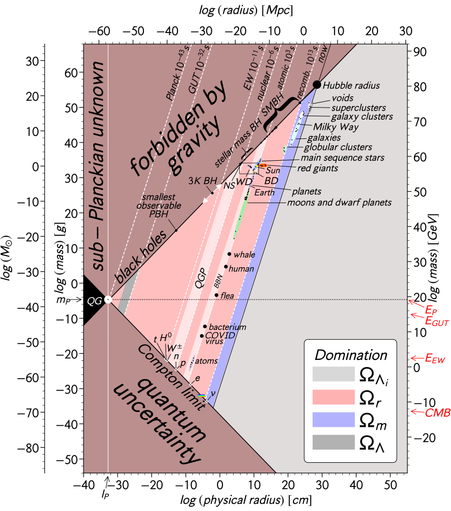
This chart shows all objects in the Universe, arranged by mass (vertical) and radius (horizontal).
The edge of the upper left corner is the "Schwarzschild radius" - anything along this edge becomes a black hole, so we don't expect stuff above and to the left of that.
The edge of the lower left corner is the "Compton wavelength" - anything here has a size so small that measuring its position that accurately would require enough energy to create a new one.
These two corners intersect in a white dot. This would be a black hole so small that it's heavily affected by quantum mechanics. By definition its mass would be the Planck mass, and its radius the Planck length. Nobody has seen such a thing.
The black region to the left of that dot, labeled "QG", contains imaginary objects that are more compressed than black holes, yet also ruled out by the uncertainty principle. So they're doubly impossible - unless Quantum Gravity, which we don't understand, changes the rules.
The pink strips of slope 3 are lines of constant density. For example "QGP" is the density of quark-gluon plasma, "BBN" is the density of the universe when Big Bang nucleosynthesis was going on, and so on.
The Earth is only slightly more dense than a flea.
The black dot labeled "Hubble radius" is the whole observable universe.
I like this chart a lot. It's from here:
C. H. Lineweaver and V. M. Patel, “All objects and some questions”, American Journal of Physics 91 (2023), 819-825. Free at https://pubs.aip.org/aapt/ajp/article-pdf/91/10/819/20107261/819_1_5.0150209.pdf
A higher-resolution version is on Wikicommons:
https://commons.wikimedia.org/wiki/File:Masses_and_sizes_of_objects_in_our_Universe.png
See the alt text for more!
I'd always wondered when it was sensible to treat a derivative dy/dx as a ratio. I mean, it's really an operator, so why does the hand-wavy "let's treat it like a ratio" process work?
I've now stumbled across an answer:
"...when we split up dy/dx into separate terms [..] what we're doing is integrating both sides of the equation with respect to the same variable, and then applying the chain rule to remove the differential term from the integrand."
https://kevinboone.me/separation_variables.html
Nice to know!
'Separation of variables' is one of the first methods usually taught to math and engineering students for solving differential equations, and yet the method as taught is mathematically very sloppy. That's not to say it doesn't work, but rather that it isn't made clear why it works, and whether similar methods will work elsewhere. This article attempts to treat the subject with a bit of mathematical rigour. We end up exactly where we started but, perhaps, with a bit more insight.
Wat fantastisch: een nieuwe Nederlandse vertaling van de Beowulf.
 mxk
mxk gloriouscow
 Sylvia Wenmackers 🦉🍀
 ~n
~n
 Cees Bassa
 John Carlos Baez
 Paul Cochrane 🇪🇺
 Jona lendering