Charlie Loyd

1,047 Followers
358 Following
1.3K Posts
You know him on the internet. Eucalypt-adjacent; very occasional writer. Consulting and passively looking for work in geospatial, image processing, and related fields.
e-mail[email protected]
workgeographical pixels
whereXučyun/Oakland, Ohlone land, western Laurentian accretions
whohim

I'm nearing the end of a two-month residency at MakerLabs, a community fabrication space here in East Vancouver. I'll write and share more about it online soon, but if you're in the Lower Mainland, please come out this Wednesday, February 25th from 7-8:30pm to see what I've been up to, along with the rest of the cohort!

Link + RSVP: https://www.eventbrite.ca/e/tools-for-change-showcase-meetup-tickets-1974947151093
Tools for Change Showcase & Meetup

Come see what our residents have been up to and learn about the Tools for Change residency program.

Eventbrite
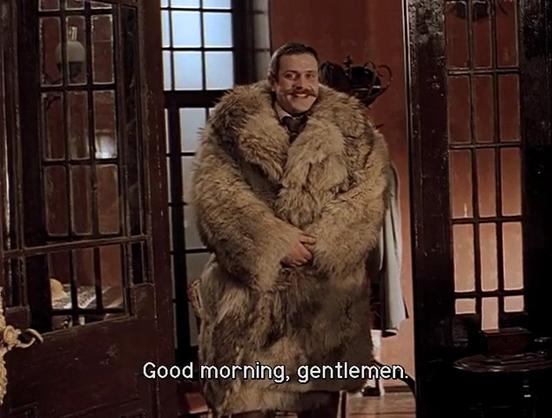
Allow me to recommend the Soviet production of Sherlock Holmes on YouTube. As an index of its vibe, this is how it depicts a man who has just arrived from Canada.

I am still a novice at Rust but it’s hard to emphasize enough how non-annoying it is in general.

I’m not a big PL nerd, but rarely do I think “oh, the people who put this together actually thought carefully about it” – Scheme, Postscript, HyperCard, Haskell maybe (I don’t know it well enough), and precious few others.

Rust feels like a low-level language designed by people who understand and sincerely appreciate current-millennium high-level languages instead of feeling insecure about them.

The documentation for this image processing library by @vruba is one of the most interesting things I've read in weeks:

https://github.com/celoyd/potato/blob/main/docs/personal.md
https://github.com/celoyd/potato/blob/main/README.md
https://github.com/celoyd/potato/blob/main/docs/concepts.md

Philosophical discussion of the nature of seeing and what am image is vs a map, fascinating technical details about how satellite imaging works and why it looks as bad as it often does, a lot of really thoughtful conversation about engineering and aesthetic process, and even an amusing unit of measurement — grams per terrapixel.

potato/docs/personal.md at main · celoyd/potato

A small pansharpening model. Contribute to celoyd/potato development by creating an account on GitHub.

GitHub
You know when someone says something like “My therapist let me know a really interesting trick:” and then they say something that’s an obvious solution to a problem you cannot imagine having? You’ve seen a little too deeply into their worldview? This is how a lot of year-end lists come across.

Happy holidays, fediverse!

I got you a megathrust earthquake, soil liquefaction, spine-tingling papers about the way our networks confound knowledge, and a PDF in a pear tree. It's my wrap on a year of trying to make sense of how we make sense of what's happening to us.

https://www.wrecka.ge/landslide-a-ghost-story/

Landslide; a ghost story

On March 27, 1964, a converted liberty ship named the SS Chena brought a shipment of supplies to the port of Valdez, Alaska. Valdez, which I need you to know is pronounced “valDEEZ,” sits at the end of a fjord—a narrow inlet carved by a glacier.

wreckage/salvage

The most important part of Potato for me is its colors. For more than a decade, in several workplaces, I’ve griped about how standard pansharpening renders colors. It’s been gratifying to show what I think is a better way.

So if you work with satellite imagery, I hope Potato makes good holiday reading. If you don’t, I hope it gets you interested. And if you’re hiring for skills shown in it (chewy, cross-disciplinary spatial/visual/etc. work), drop me a line.

There’s a lot in the repo, but I’m happy to say the core code is small and efficient. You can pansharpen several megapixels/second on an ordinary CPU, and somewhere > 10 Mpx/s on a gaming rig.

It's all licensed CC BY-NC, like its training data: Maxar/Vantor’s Open Data Program (h/t @marcpfister). This is imagery for disaster response, and a goal of Potato is to publicize that data, and similar data, and to encourage work that makes it easier to use.

It’s got a lot of moving parts and I wanted to make it intelligible to several audiences, so the documentation is a bit much at times.