 Kagi HQ
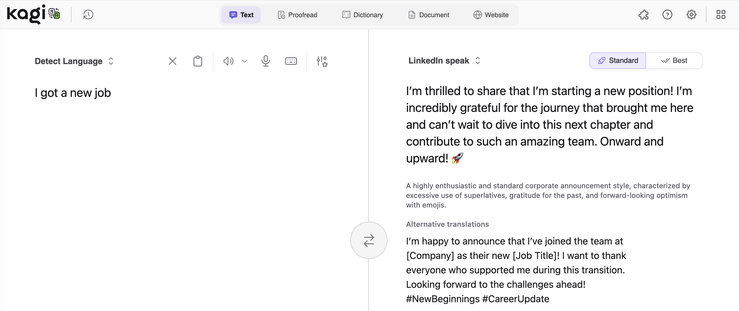
Not sure how we went from plain, straightforward words to LinkedIn speak but now you can use Kagi Translate to fit right into that crowd:

Not sure how we went from plain, straightforward words to LinkedIn speak but now you can use Kagi Translate to fit right into that crowd:
Interview über Steuerhinterziehung mit Juristin Brorhilker: Dem Staat entgehen jährlich rund 100 Milliarden Euro https://share.deutschlandradio.de/dlf-audiothek-audio-teilen.html?audio_id=dira_3A747504247F11F17DA6B883034C2FA0
Wer mehr als 27 Minuten für das Thema Zeit hat, dem lege ich das Interview mit ihr bei der Lage der Nation nahe:
https://lagedernation.org/podcast/ldn428-cumex-co-wie-der-staat-durch-steuerbetrug-milliarden-verliert-und-warum-er-sich-das-gefallen-laesst-interview-anne-brorhilker-buergerbewegung-finanzwende/
Was mich interessieren würde: das ist jetzt alles seit mindestens einem Jahr allgemein bekannt. Welche Politiker und Parteien haben seit dem Initiativen gestartet, etwas zu verbessern?
It seems clear that every single company that makes money off of software is or will soon be in a race to the bottom on software quality
A lot of younger people who are being conditioned to accept this stuff just weren’t around to experience how unstable and unreliable the vast majority of PC software was in the 1990s, and a lot of more senior-level people must have willfully forgotten. I’ve been thinking about this more and more lately. The difference was that in the 90s, the major PC companies could port their enterprise-grade OSes with proper memory protection down to the consumer level, as hardware advanced and running a more complex OS kernel was no longer a big demand. Even then, it was an uphill battle, especially once you threw widespread networking and dubious internet-sourced malware into the equation.
End-user software has already seen a decline in quality and increase in user frustration during the cloud era, as many apps have become siloed blobs of JavaScript running on top of an extra copy of your web browser engine. I’m concerned that we’re headed firmly back to the bad old days now, without the release valve of better underlying software stacks on the horizon. The main solution will likely be to rip a lot of this crap out and start over (which is already a pretty widespread approach anyway, my credit union is going on their 3rd online banking “upgrade” in 5 years). But that completely zeroes out the “productivity” gains, not that anyone touting such things will ever measure it that way. I suppose the cost of re-stabilizing the software industrial base will be counted as GDP gains instead.

 Ingo Wichmann
 Anon Opin
 Danielle Foré
 Matt Blaze
 Fesshole 🧻
 istewart
 Daniel
 Steve Mitchell