Still here, navigating social media usage and phone usage just like everyone. Peacefulness is my preference 🙂

Charlie Finlayson
@unreachablecode
- 6 Followers
- 48 Following
- 35 Posts
Yo @azcoigreach thought you might like this https://www.nybooks.com/online/2024/11/09/all-bets-are-off-joseph-oneill/

 Dan Fixes Coin-Ops
My idea: CLOTHES SHOP FOR DADS
You roll up at the facility, drive over to the JEANS hut. Dinnerlady-type in her wee hole says "What size luv," you go "thirrehfourthirrehtwoluv" while making a mental note to go easy on the pies so you can get back to 32/32, she goes "Right you are luv, tenner alright?" and chucks you a bin bag full of dead blokes' jeans that aren't too far gone and you give her a tenner and you're done, move on. T-shirts next.
T-shirts are more complicated, your jeans were the simple one to ease you into it. Pull round to a bloke eating a pasty. He asks "Size," you go "Medium or large depending y'know," he nods, "You wanting colour, drab, black or mixup?" you think about it a moment and go aye, go on then, "Mix it up mate, colours and drab," he goes "Plain or wi' shite on, plain's two quid extra," you're sure as hell not gonna advertise some bugger else's T-shirt business on your body, so you give him twelve quid and he hands you Bin Bag 2.
There's a pub on-premises that'll do you some chips or a pasty and you can watch the JCB sorting out the clothes while you drink your pint and furtle through your bags to see what you've bought.
It'd be brilliant. Buying clothes would have nae stress at all, plus if you ended up wearing shite and looking a bit of a muppet you could just go "Aye well it were in the bag weren't it" and everybody'd nod and go aye, fair do's
Whatever the election result, I think I will be switching to the dumb phone for at least a month afterwards.
 BrianKrebs
I thought I understood the extent to which the broad availability of mobile location data has exacerbated countless privacy and security challenges. That is, until I was invited along with four other publications to be a virtual observer in a 2-week test run of Babel Street, a service that lets users draw a digital polygon around nearly any location on a map of the world, and view a time-lapse history of the mobile devices seen coming in and out of the area.
The issue isn't that there's some dodgy company offering this as a poorly-vetted service: It's that *anyone* willing to spend a little money can now build this capability themselves.
I'll be updating this story with links to reporting from other publications also invited, including 404 Media, Haaretz, NOTUS, and The New York Times. All of these stories will make clear that mobile location data is set to massively complicate several hot-button issues, from the tracking of suspected illegal immigrants or women seeking abortions, to harassing public servants who are already in the crosshairs over baseless conspiracy theories and increasingly hostile political rhetoric against government employees.
https://krebsonsecurity.com/2024/10/the-global-surveillance-free-for-all-in-mobile-ad-data/

 Sean Gallagher
  🐀
🐀 
Back to the blog: the death of mass social media
Back at the turn of the millenium, blogging was the way we shouted into the void. Democratized web publishing seemed radical. The act of editing in raw HTML and FTP'ing it up to some server, or running Radio Userland or some other bespoke script/code mashup to push unvarnished thought to a shared hosting account for all the world to see was a signal that you were part of the cyberspace revolution everybody promised in early Wired features.
http://thepacketrat.com/2024/10/08/back-to-the-blog-the-death-of-mass-social-media/

 Beady Belle Fanchannel
 Colman Reilly
@dangillmor the tendency to blame individuals for system failures is going to kill us all. Musk is a symptom.
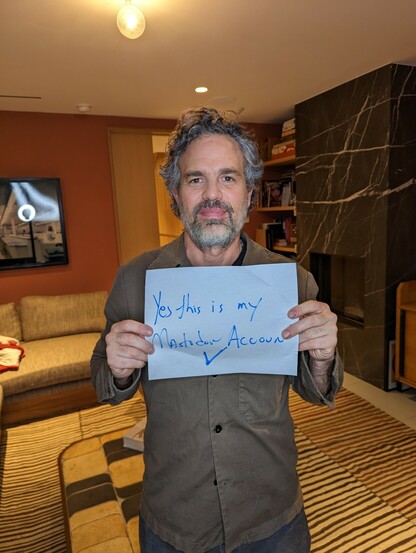
 Mark Ruffalo
Hey everyone. Just wanted to eliminate the confusion and let you know that this is actually me. 😂 Hope you are having an awesome Thursday!
 Brendan Jones
The rise of Mastodon has made me so much more aware of government services requiring us to use private companies’ systems to communicate with them and access services.
Sitting on a Dutch train just now I was shown on a screen “feeling unsafe in the train? Contact us via WhatsApp”.
What if I don’t use WhatsApp? (I do, but I wish I didn’t have to) I’m forced to share my data with Meta to use it.
Public systems should not require use of private services.