
Tom Ross
@tomrossberlin
- 0 Followers
- 17 Following
- 20 Posts
@chockenberry They did mention it in June, but, like you, I didn’t see it in the simulator and therefore assumed that glass would be on all tvOS 26 devices. https://www.macrumors.com/2025/06/09/tvos-26-liquid-glass-redesign-older-models/

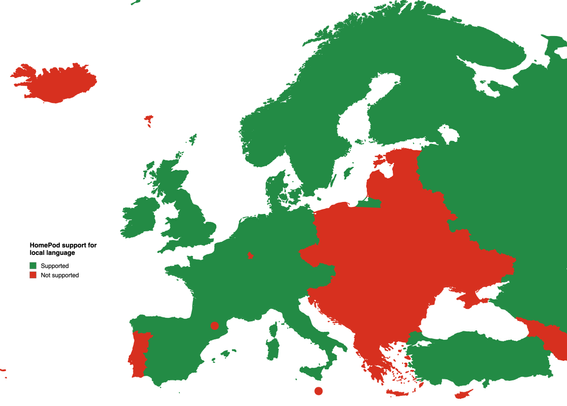
@daringfireball Another perspective: Apple has always been a laggard in international support. Six years after release, HomePod still doesn’t have local voice for a third of Europe, as well as major countries like Brazil, Indonesia, Vietnam and South Korea. Don’t blame the EU for the evidently poor language support of Apple Intelligence.
@daringfireball Under that schedule, CPU speed of the Ultra desktops vs. the Max notebooks becomes are concern. Mac Studio and Mac Pro would struggle to outperform the MacBook Pro for most of the year.
https://9to5mac.com/2023/11/09/every-apple-processor-compared-as-m3-max-matches-m2-ultra/

@washchuk Some additional aspects:
- This represents the view of an independent panel, not the EU commission. Remains to be seen how it pans out.
- The panel members are elected by their national legislations, but are also independent from them. They are indeed among the most pro-privacy voices.
- The national level is responsible for controlling Le Monde-sized companies, not the EU.
- GDPR is still making its way through the courts. Le Monde may or may not lose their Pay-Or-Okay wall one day.
- This represents the view of an independent panel, not the EU commission. Remains to be seen how it pans out.
- The panel members are elected by their national legislations, but are also independent from them. They are indeed among the most pro-privacy voices.
- The national level is responsible for controlling Le Monde-sized companies, not the EU.
- GDPR is still making its way through the courts. Le Monde may or may not lose their Pay-Or-Okay wall one day.
@washchuk From what I understand, this decision was made by by combining GDPR and DMA. That makes it a DMA issue as well, and couldn’t apply to Le Monde.
The rest of your argument in my perception is a rationalization of supporting your home team (I assume you’re American). I think it’s both common and fair to put stricter rules on bigger entities.
And just to be clear, I’d give the DMA a solid 6/10. I’m not blindly defending it. But show me better Big Tech legislation—after you’ve passed it.
@shadash Don’t put words into my mouth and then sarcastically ask me to prove those. Not a good look on you.
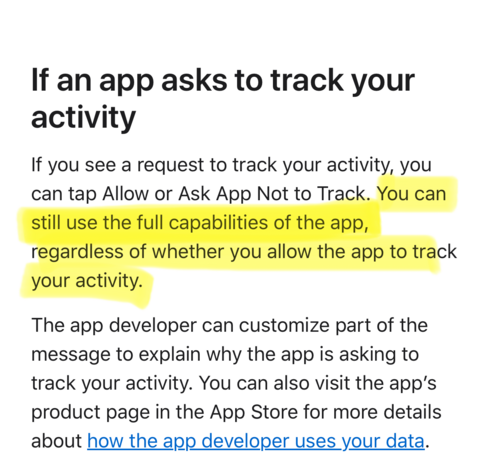
My screenshot was in response to the claim that Facebook and Apple each present the same choice to the user. Facebook’s is a trade-off, while Apple’s has no negative consequences.
The size of the company is a separate matter. Apple only charges 15 % to small devs, for example. And in politics, many ask for billionaire taxes. Why do you think it’s unfair to be tougher on large companies?
@washchuk They target all large platforms. Meta (unwittingly) helped Cambridge Analytica manipulate the 2016 US election and Brexit vote. They had to pay a $5 billion fine to the US government. That fine wasn’t out of spite, correct?
So there’s reason to be concerned, and it’s better to set the rules in advance than having to clean up after. The EU rule is: If you have 45+ million users here, you must do better. The DMA is far from perfect, but it’s not hitting the wrong target.
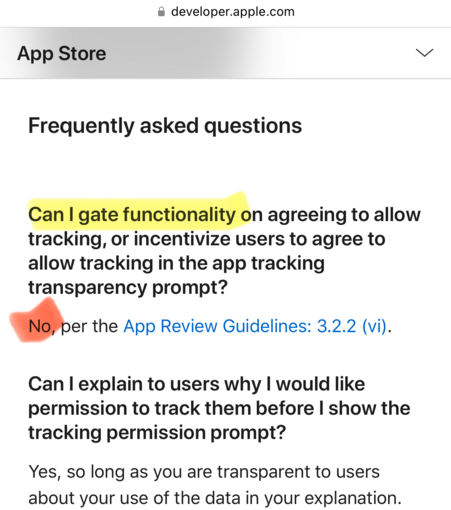
@daringfireball Apple promises the precise same thing as the EU panel asks: People who press “Do not track” must have the full app experience.
@jann Talk about a chicken-and-egg problem.