
Thorsten Mankel
- 10 Followers
- 11 Following
- 102 Posts
Lehrer mit vielen Fragen
tätig in NRW bzw. im Sauerland; Gymnasium, M, Ph; etwas Ch, berufliche Schwerpunkte zurzeit Mittelstufe und Aufbau von eigenen digitalen Kompetenzen; private SP: Natur erfahren, …
 Lüder Kracke
Hier ist noch ein Versuch:
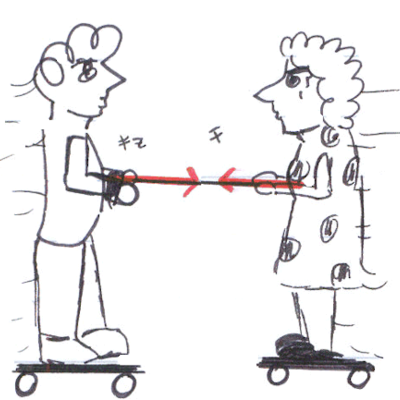
Knoten- und Maschenregel anschaulich erklärt. Vielleicht mag jemand schauen, vor allem natürlich Physiklehrer.
https://youtu.be/82ZRsvbz46E
#PhysikEdu
Knoten- und Maschenregel anschaulich erklärt. Vielleicht mag jemand schauen, vor allem natürlich Physiklehrer.
https://youtu.be/82ZRsvbz46E
#PhysikEdu

12 Knoten- und Maschenregel
 Nele Hirsch (ebildungslabor)
#FediLZ
Wenn für KI-resiliente Aufgaben plädiert wird, wird das häufig damit begründet, dass die Eigenleistung der Lernenden sichtbar gemacht werden müsse. Damit entfernen wir uns aber vom eigentlichen Lernen, das ja - ernsthaft betrachtet - eine innere Entwicklung in Auseinandersetzung mit uns und der Welt ist. Ist es dann nicht offensichtlich absurd, bei solch einem Verständnis von Lernen nach 'Eigenleistung' zu fragen? Denn innere Entwicklung ist ja per se eigen. Es gibt kein 'Fremdlernen'.
Wenn für KI-resiliente Aufgaben plädiert wird, wird das häufig damit begründet, dass die Eigenleistung der Lernenden sichtbar gemacht werden müsse. Damit entfernen wir uns aber vom eigentlichen Lernen, das ja - ernsthaft betrachtet - eine innere Entwicklung in Auseinandersetzung mit uns und der Welt ist. Ist es dann nicht offensichtlich absurd, bei solch einem Verständnis von Lernen nach 'Eigenleistung' zu fragen? Denn innere Entwicklung ist ja per se eigen. Es gibt kein 'Fremdlernen'.

 lutz_
lutz_#FediLZ #BlueLZ #PhysikEdu #MintEudu #Physik #iteachphysics
Bruce Yeany experimentiert mit zwei verschiedenen Glühbirnen. So lässt sich die eine Lampe sprichwörtlich anblasen oder mit Hilfe eines Streichholzes zum Erlöschen bringen…


Gute Frage heute in meinem Schreibimpuls-Kalender. Mir fällt u.a. ein: Hefeteig zu backen, bevor er richtig gegangen ist, Obst noch viel zu sauer und hart zu ernten, bei etwas aufgeben, bevor man nicht vieles versucht hat oder Menschen in Schubladen einzusortieren, bevor man sie überhaupt kennt. Und dir?

 Terence Tao
There are now sufficiently many different examples of Erdos problems that have been resolved with various amounts of AI assistance and formal verification (see https://github.com/teorth/erdosproblems/wiki/AI-contributions-to-Erd%C5%91s-problems for a summary) that one can start to discern general trends.
Broadly speaking, we now see an empirical tradeoff between the level of AI involvement in the solution, and the difficulty or novelty of that solution. In particular, the recent solutions have spanned a spectrum roughly describable as follows:
1. Completely autonomous AI solutions to Erdos problems that are short and largely follow a standard technique. (In many, but not all, of these cases, some existing literature was found that proved a very similar result by a similar method.)
2. AI-powered modifications of existing solutions (which could be either human-generated or AI-generated) that managed to improve or modify these solutions in various ways, for instance by upgrading a partial solution to a full solution, or optimizing the parameters of the proof.
3. Complex interactions between humans and AI tools in which the AI tools provided crucial calculations, or proofs of key steps, allowing the collaboration to achieve moderately complicated and novel solutions to open problems.
4. Difficult research-level papers solving one or more Erdos problems by mostly traditional human means, but for which AI tools were useful for secondary tasks such as generation of code, numerics, references, or pictures.
(1/2)

The seeming negative correlation between the amount of AI involvement and the depth of result is somewhat reminiscent of statistical paradoxes such as Berkson's paradox https://en.wikipedia.org/wiki/Berkson%27s_paradox or Simpson's paradox https://en.wikipedia.org/wiki/Simpson%27s_paradox . One key confounding factor is that highly autonomous AI workflows are much more scaleable than human-intensive workflows, and are thus better suited for being systematically applied to the "long tail" of obscure Erdos problems, many of which actually have straightforward solutions. As such, many of these easier Erdos problems are now more likely to be solved by purely AI-based methods than by human or hybrid means.
Given the level of recent publicity given to these problems, I expect that over the next few weeks, pretty much all of the outstanding Erdos problems will be quietly attempted by various people using their preferred AI tool. Most of the time, these tools will not lead to any noteworthy result, but such failures are unlikely to be reported on any public site. It will be interesting to see what (verified) successes do emerge from this, which should soon give a reasonably accurate picture of what proportion of currently outstanding Erdos problems are simple enough to be amenable to current AI tools operated with minimal human intervention. (My guess is that this proportion is on the order of 1-2%.) Assessing the viability of more hybridized human-AI approaches will take significantly longer though, as human expert attention will remain a significant bottleneck.
(2/2)
 Michael Ramsdell
Pipevine swallowtail (Battus philenor)
Butterfly 2017-124
When they think only they can decide
What is right for you.
They are wrong on so many levels.
#butterfly #butterflies #macro #insect #pics #photography #beauty #nature #photodaily #freedom #endhate #photos #thephotohour #mramsdellpics

#FediLZ #BlueLZ #PhysikEdu #MintEudu #Physik #iteachphysics #Space #Weltraum #FediEltern
Die Erdanziehungskraft auf der ISS ist fast genauso stark wie auf der Erde.
Auf der Erde beträgt der Ortsfaktor 9,81 N/kg, auf der #ISS immerhin noch rund 8,8 N/kg.
Warum sind die Astronauten auf der ISS aber scheinbar schwerelos?
Die #Maus und #AlexanderGerst klären gemeinsam auf: